
Committee turns down Boudinot proposal for Pittsfield Jewish colony
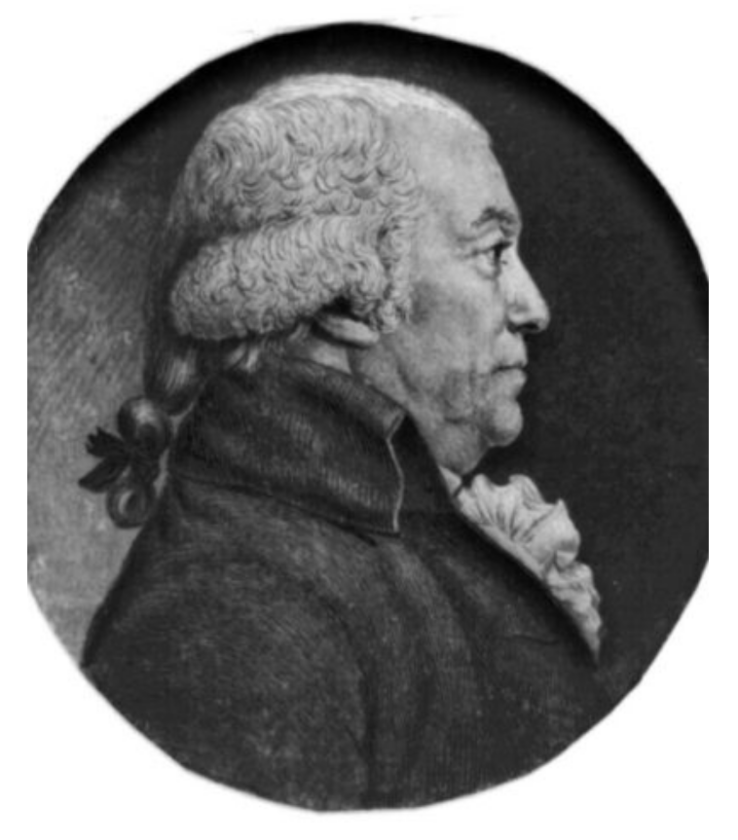
Photo from eBay A later-in-life portrait of Elias Boudinot.
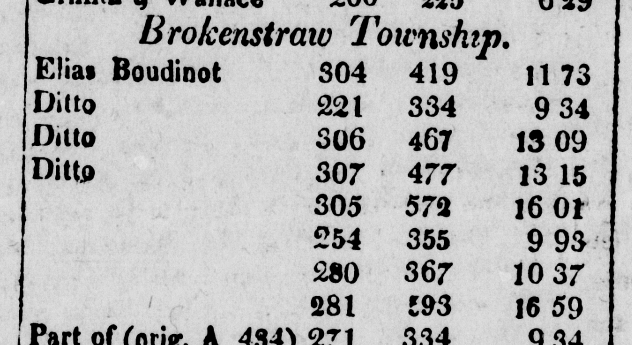
Photo from the Warren Gazette A tax sale listing that shows the acreage owned by Elias Boudinot in Brokenstraw Twp.

Public domain photo Elias Boudinot’s signature.
Photo from eBay A later-in-life portrait of Elias Boudinot.
Photo from the Warren Gazette A tax sale listing that shows the acreage owned by Elias Boudinot in Brokenstraw Twp.
Public domain photo Elias Boudinot’s signature.
Trending
Last week, you met Elias Boudinot.
Now, you find out why a newspaper in Warren County – that strives to make county connections – is writing about him here.
To set up a look at that phase of his life, which is where Warren County enters the picture, we need to look at his time in the U.S. House, specifically when the House voted to approve the First Amendment to the states.
Boudinot (in text found online published by the National Archives) introduced this motion to the body: "That a joint committee of both Houses be directed to wait upon the President of the United States, to request that he would recommend to the people of the United States a day of public thanksgiving and prayer to be observed by acknowledging, with grateful hearts, the many signal favors of Almighty God, especially by affording them an opportunity peaceably to establish a Constitution of government for their safety and happiness."
That day would be celebrated amid some partisan backlash but, for our purposes, it's more important as evidence of Boudinot's strong Christian faith.
According to the Society of the Cincinnati, Boudinot founded the American Bible Society in 1816 and was its president for five years until he died.
That led to social activism that took a variety of forms.
It included advocacy for the rights of black and American Indians, going so far as to allow a young Cherokee writer who stayed with them to take his name.
His connection to Warren County comes from extensive land speculation.
The first nugget that led me down this trail was in the Warren Centennial book I've been writing about recently.
A B. F. Morris was giving a historical lecture and this is what he said: "There is a will on record in the Recorder's office, made by Dr. Elias Doudinot, of New Jersey, giving several thousand acres of land in Pittsfield township which he owned for the amelioration of the Jews."
Now why Morris called Boudinot a doctor or confused the letters in his last name, it didn't take much more than a two-second Google search to find that this was who he was talking about.
He had died in 1821 in New Jersey.
Speaking of things that a Google search can provide, I found the 1823 report for the American Society for Meliorating the Condition of the Jews published in its entirety on the web.
"It will be recollected by the board, that the late President, Mr. Boudinot, with that liberality which has so nobly distinguished his character bequeathed to 'the American Society for meliorating the condition of the Jews;' four thousand acres of land in the state of Pennsylvania, or at the option of the society one thousand dollars in cash, the society to make their election within two years -- to the bequest of the land is annexed the condition, that if the society elect to accept of the same, it must be used and occupied by them as a settlement for the Jews, with the allotment of fifty acres to each family who may become a settler under the direction of the board…."
The will stipulated that if the colony were established, it would have to remain, regardless of what happened to future property values.
"Your committee regret that they have not been able to procure as particular information respecting these 4000 acres as they could wish," the report concluded. "They find, however, that it is part of a large tract lying in the county of Warren, on the waters of the Brokenstraw, creek, and other creeks emptying into the Alleghany river, the main body of which is situated south of Brokenstraw creek."
They got that much right, as well as the claim that the tract is in a "new county and but very partially settled," certainly a fair description of 1820s Warren County.
The committee writes that it tried to work through an Boudinot agent in Crawford County to get a better description of the property but the agency said "I am unable to tell what specific portion of these lands has been bequeathed you," given that he owned thousands of acres in the region, "but even if I knew, the information which I could give you would still be imperfect and unsatisfactory, for though the lands have been for a number of years under my agency, yet as they are situated at a distance of about 60 miles from this place, I have no particular knowledge of the quality of the several tracts, I shall therefore give you such information as I possess respecting this body of lands. Though there are some very good lands among them, yet taken as a body, they are by no means equal to the general quality of the lands in this part of Pennsylvania, which is extraordinarily fine. The lands are in general well watered, and covered with a heavy growth of timber; the county is remarkably wholesome, and though it would be heavy to clear, yet when once cleared, it would well repay the labour of the husbandman, especially for grazing farms, they being well calculated for that species of husbandry.'"
So the committee had a decision to make and precious little information on which to make that decision.
The committee felt "warranted in saying, that its inconvenient location – the indifferent quality of the tract of which it forms a part -- its inadequacy in point of quantity to the wants of the board – its distance and difficulty of access from the city of New-York, labour, money, and time, which must necessarily be consumed, to put it in a situation fit for the occupation of such settlers as the board would send upon it" and claimed that Boudinot would have been "undecided in his own mind as to the suitableness of the land."
Boudinot had given the society an option – take the land or $1,000 in cash, a large sum in the 1820s.
"In respect to the alternative submitted to their election, in the bequest of their venerable late President, Dr. Boudinot, the Board have decided to receive the sum of $1000 from his executors, rather than accept the unwieldy and too remotely situated tract of land conditionally subjected," the report concluded.
With the colony off the table, and Boudinot deceased, there's no grand result to how this story ends.
The properties appear to have been sold at an 1826 tax sale.
The Warren Gazette on March 11, 1826 (five years after Boudinot's death) published a listing of properties that would be going up for sale in June.
That account details nearly 3,584 acres in Brokenstraw Township, 100 in Pine Grove, and 2,274 in Deerfield Township.
The proposed colony land would have been located in what was then Brokenstraw or Deerfield, depending on which version of the lines you're looking at.
Another example of what could have been….