
County sees ‘greatest flood’ in spring 1865
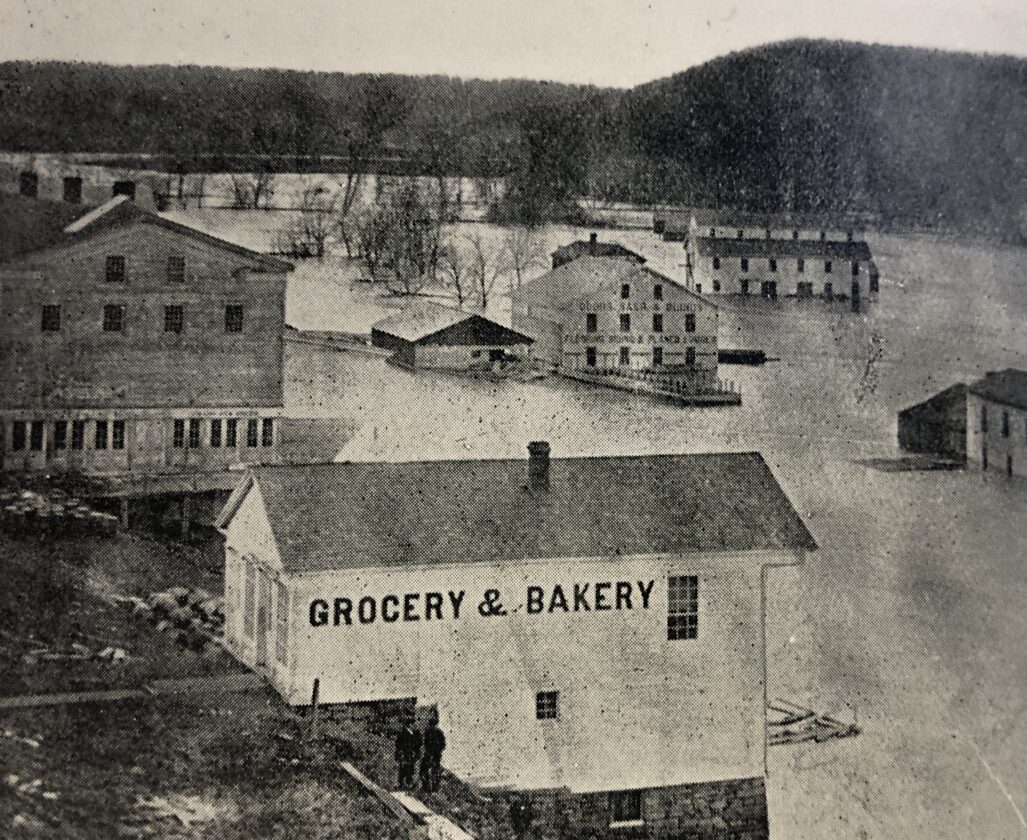
Photo from Warren Centennial A look at the Allegheny River in what I think is the base of Liberty St. during the flood of 1865. The photo was captioned “Mill Buildings on The Island.”
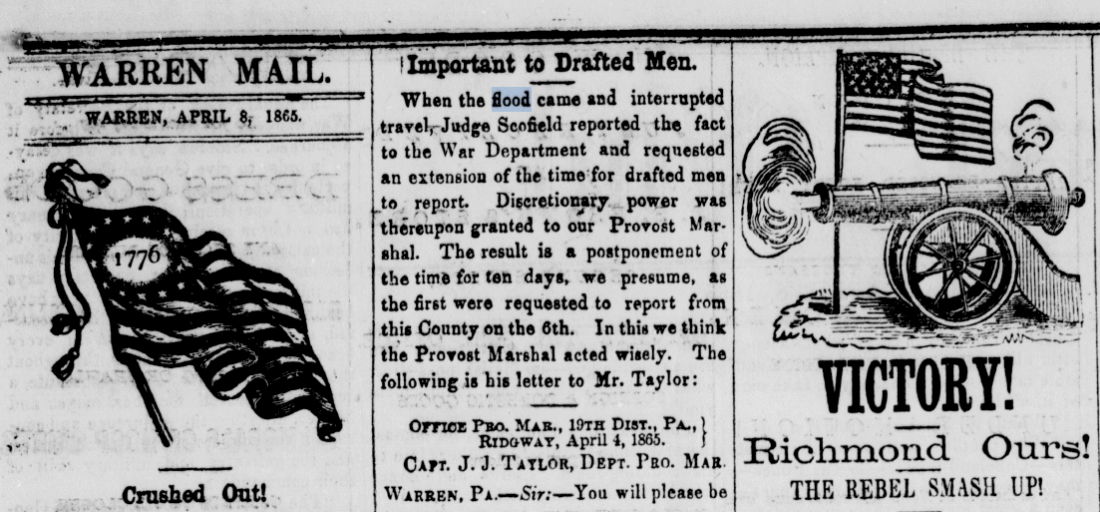
Photo from the Warren Mail The flood in March 1865 kept some local men at home a little longer before they reported at Uncle Sam’s direction.
Photo from Warren Centennial A look at the Allegheny River in what I think is the base of Liberty St. during the flood of 1865. The photo was captioned “Mill Buildings on The Island.”
Photo from the Warren Mail The flood in March 1865 kept some local men at home a little longer before they reported at Uncle Sam’s direction.
Trending
From the Warren Mail on March 18, 1865: "We have not the greatest flood in the history of Warren."
While the Kinzua Dam certainly limits such activity along the Allegheny, spring floods in Warren County aren't an unusual phenomenon.
Warren was 70 in 1865 when, just weeks before the end of the Civil War, a flood hit the county to such a degree that people knew immediately that it wasn't a normal spring.
"We have now the greatest flood in the history of Warren," the Warren Mail reported on March 18, 1865. "The heavy snow commenced thawing gradually some days ago swelling the river to high water mark on Wednesday."
A double whammy – "rain fell heavily nearly all day and this morning" – to make this situation more than just a spring thaw.
"We hear of much damage to property already, but have no time for full particulars till next week when the worse shall be known."
The Mail was published weekly so the full extent of the damage wouldn't be published for another week but details were already starting to emerge.
"The Eastern part of our town on Conewango Creek is inundated," the report explained. "The flat across from town is all under water looking like one wild turbulent sea. "
The "flat across from town" likely refers to the south side Crescent Park area.
"The Island is covered several feet, leaving only the upper part of the Saw Mill in sight."
That would refer to what was once an island at the base of Liberty St.
"Several thousand barrels at the Factory on the Island went off on Thursday with staves and other loose lumber," the Mail reported. " Nearly all the boards, logs and timber along the river bank are gone…. The train from Erie and the mail from Jamestown couldn't come in last night. Doubtless many of the railroad culverts and bridges are gone and we shall be cut off from the world for some days.
"This morning the weather is colder and the snow is a few inches and the mud a few feet deep. So you see we are having such a time as the 'oldest inhabitant' never before (seen) in Warren."
The initial claim that this flood was the worst in the history of the county was affirmed in the Mail the following Sat., March 25, under the headline "The Great Flood."
"The flood, of which we made a brief notice last week, proved to be the highest and most destructive in the history of this county," the mail reported. "Of course the destruction of property is unprecedented."
The writer acknowledged that it was still too soon to start damage estimates but there were many anecdotal reports.
"Many men lost all of their lumber. Some of them will recover a part, but it is at present impossible to tell how much," according to the Mail. "The injury to the roads and bridges is very great…. All the trees on the bank are gone." There was an estimate that $50,000 would not repair the main railroad bridge which was, at one point, "in danger from washing away from the bank above and below….
"The fences are nearly all gone and immense piles of lumber and floodwood are piled up promiscuously in all directions…. These are but a tithe of the losses growing out of this flood. They are all over this section of country, but we can't now ascertain their full extent nor can the parties themselves. Large numbers of men are actively engaged on the river reclaiming and securing what was lost. Some parties can stand their losses; on others they will fall with great severity. They find the labor of a year and about all they possess swept away in a single day beyond hope of recovery.
Information was starting to trickle in that indicated this was a county-wide problem.
"So they are at Irvine and Tidioute, growing worse and worse we are told the farther you go below," the Mail reported. "The Railroad bridge at Irvine went downstream a few inches and one pier of the Youngsville bridge was nearly or quite destroyed. The Brokenstraw was very high. We hear that the Lottsville bridge and the Wrightsville bridge, Wright's mill-dam and nearly all the dams and bridges below Samuel Irvine's are gone, or very severely injured. Pittsfield was for a time inundated and large quantities of lumber taken off. All along the Brokenstraw Valley the fields were swept over by the flood and the fences are generally gone. From Irvine landing many boats laden with engines and other freight for the oil regions, were carried away, with the boards and shingles on the bank."
One local firm lost several thousand oil barrels valued at $3 each "but they will recover a good many barrels between here and Tidioute so that it is hard estimating their actual loss."
The Civil War was in its late stages as this was occurring and the flood impacted local war efforts.
From the Mail on April 1: Be Charitable – We have been requested by some individuals to call attention to the case of E.T. Kidder, living at the lower end of the town in Conewango Township.Being a poor man, himself and family suffered sickness during the last fall and winter, thus relieving him of his ready means. All this he could manage; but not when the flood came, the water surrounded his house and carried away every movable thing in and around it thus leaving him destitute. In the midst of these afflictions Uncle Sam sent him a note that he needed his services in the army. A little timely assistance to obtain substitute so that he might be enabled to remain at home and care for his destitute family, would be doing as any one of us would wish to be done by."
A week later, a slate of drafted men set to report to the service were delayed.
"The result is a postponement of ten days, we presume, as the first were requested to report from this County on the 6th," the Mail reported "In this we think the Provost Marshal acted wisely."
What's most remarkable in the midst of this storm is that there were no injuries reported.
"The Conewango was very high but we do not as yet hear of very serious injury between here and Russellburg," the Mail reported on March 25. "It is some satisfaction, however, to know that in all this excitement and destruction, not a single loss of life or serious injury has been reported."
Writer's note: Thanks to Dave Winans for sharing a book with me published by the Library Association in 1897. That text provided the idea for this story, and stories to follow in subsequent weeks.