
Centennial brought time to reflect and also envision Warren’s future into the 20th century
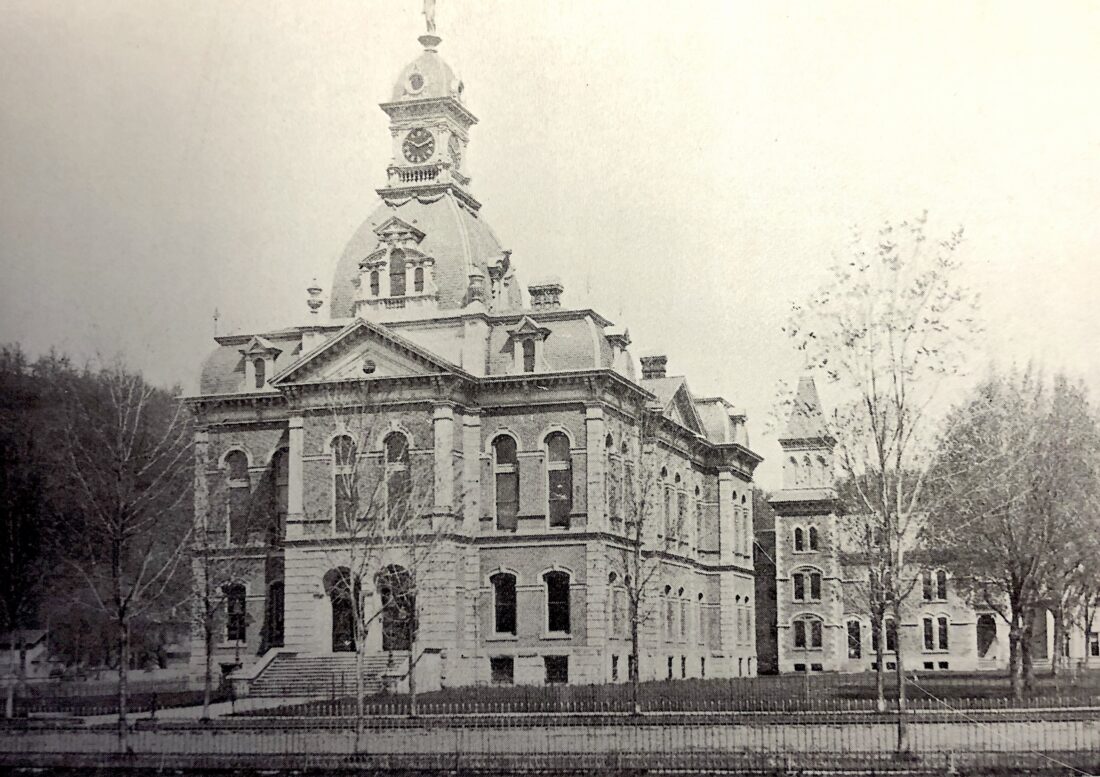
Photo from Warren Centennial An 1895 look at the courthouse. The building on the right was the county jail.
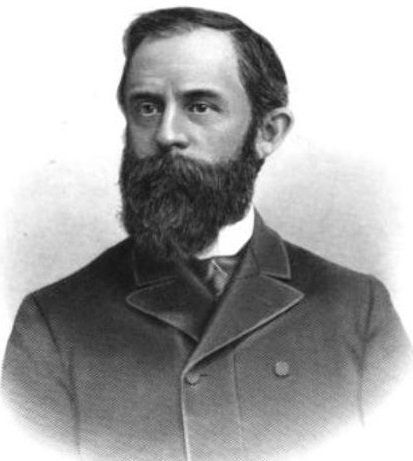
Public domain photo Charles W. Stone, then Warren’s representative in Congress, was one of many speakers as part of the city’s centennial celebration in 1895.
Photo from Warren Centennial An 1895 look at the courthouse. The building on the right was the county jail.
Public domain photo Charles W. Stone, then Warren’s representative in Congress, was one of many speakers as part of the city’s centennial celebration in 1895.
Trending
love a good guess at what the future will be.
Some are based on the facts as best known at the time. Others are based on a wish and a prayer (literally, a prayer in the instances where people guess at the precise timing of the second coming).
Warren's town fathers did a fair amount of that projection when the county's centennial was celebrated in 1895.
"We can see into the illumined future and feel the quickening pulse of that nearby time," a text on the centennial published by the Warren Library Association, claimed. "Thought is quicker, consequently all things will move faster. Five years of the next century will be equal to fifty years of the middle of the century we are passing out of."
In some sense, they were right here. The rate of technological advancement has prompted changes in our lives that people in 1895 could not have even dreamed of.
"In times past, fifty years produced but little change in method of thought. Our ancestry had no time to think. They exhausted themselves in material action, clearing their lands and raising their families. There has been more progress in the world during the last fifty years than in the previous hundred years."
This reminded me of something John Adams wrote in a letter to his wife, Abigail, when he was serving a diplomatic role in Paris in 1780: "The Science of Government it is my Duty to study, more than all other Sciences: the Art of Legislation and Administration and Negotiation, ought to take Place, indeed to exclude in a manner all other Arts.--I must study Politicks and War that my sons may have liberty to study Mathematicks and Philosophy. My sons ought to study Mathematicks and Philosophy, Geography, natural History, Naval Architecture, navigation, Commerce and Agriculture, in order to give their Children a right to study Painting, Poetry, Musick, Architecture, Statuary, Tapestry and Porcelaine."
There's a sense in this Warren centennial book that a similar transformation from generation to generation was underway in Warren.
They reflected on the "wonderful changes in all departments of life" that had occurred between 1785 and 1895.
But all of the claims weren't philosophical; some were very practical.
"But a hundred years from now there will not only be a new woman but a comparatively new man; there will be new and faster methods of travel."
I don't know if we're the new men and women in 2023 that they thought we might be but they absolutely nailed the travel issues.
"The swiftly moving bicycles of this day will be superseded by a swifter vehicle, propelled by an electrical storage battery instead of by foot-power," the test states.
The irony to me here, of course, is that they're probably envisioning very early automobile development. Fast-forward 120 years and – yep – we've got cars propelled by batteries.
This might be my favorite projection though: "There will be a free bridge over the river at this point, a hundred years from now."
In 1895 there was a bridge over the Allegheny River to the southside. But, if my memory serves me correctly, it was still a toll bridge at this stage. Apparently people hated paying tolls in 1895, too.
As with any sizable community event, there were speeches. And a couple of those were included in the commemorative centennial text.
Charles W. Stone was, at the time, Warren County's representative in Congress, having previously served in the state General Assembly and as lieutenant governor.
"The one thought uppermost in all our minds today undoubtedly is of the contrast existing between the conditions that surround us now and those that excited a century ago," he said. "Standing, a hundred years back, where we stand today, we should have found ourselves surrounded by pathless and almost boundless primeval forests."
He acknowledged that many of 1895s moden amenities – trains, steamboats, telegraphs, post office – weren't here in 1795 when the town was formed.
"The conditions that surrounded our fathers were rough and rugged," Stone said. "While they reared a town and built fortunates they builded character, and the town came to partake of the character of its founders. It was not showy, it was not pretentious, it was not sensational…. Slowly, steadily, firmly it moved forward keeping fair pace with the progress of modern life until today it stands 'beautiful for situation,' solid in foundation, substantial of growth, the 'gem of the Alleghenies' – our own loved home."
Stone was quick to note that he wouldn't project what the town's future would be "further than to say it is and will be what, and only what, its sons and daughters make it."
He was optimistic though of a "tendency… to raise the standard of the life of the individual" when men became aware of their obligations in society.
"Fellow citizens of Warren, standing as we do, on the threshold of a new century, with all its opportunities and all its responsibilities confronting us, with the vast possibilities of individual life and individual growth almost unlimited, I press home to each one of you the thought – and the solemn thought – of the weight of responsibility and duty we owe to each other and jointly and severally to the town in which we dwell.
"No man lives alone, and no man comprehends the spirit and scope of this matchless age of ours who does not realize that the duty of the individual to the public in effort and service is no less than of the public to the individual in protection and guidance. To perform this duty he must be awake and alive and act now. He cannot listlessly wait till next month or next year. This is an age of action, of motion, not of rest; of the steam engine and the electric car, not of the stage-coach; of the telegraph and telephone, not of the postman and his saddle-bags."
The county's third president judge, Charles H. Noyes, also had his remarks included in the text.
"It has passed into a proverb that he who dips his feet in the crystal waters of the Allegheny is bound to its banks for life," Noyes began. "One hundred years is not a long period in human history. Men are within the sound of my voice whose years go back almost to the time when Irvine and Ellicott… laid out lots and parks and streets and lanes and sites for public buildings in the midst of the untrodden wilderness."
Noyes said it wasn't "anything remarkable" for a town of 8,000 or 9,000 to grow up in 100 years and acknowledged that Warren "has not produced many men and women who have attained to very wide notoriety, but many who were worthy to fill the highest places."
He did claim, though, that the evolution of the "society of the 20th century is a wonder which will be forever wonderful and of this the growth of Warren is part."
So what did Noyes think the future would hold?
"More houses and finer, more factories and larger, more population and the satisfaction of dwelling in a larger town? I am not unmindful of these things but reflection has taught me not to overvalue them.
"If we have not multiplied as fast as our neighbors, if our chimneys are not so high, our population not so dense, nor our streets so busy, I am glad that our people are better housed, better fed and better paid, and, as I am glad to believe, on the whole, happier and more contented. It is better that we should be happy than great; so may the century that is coming bring our children those things which work for righteousness and happiness rather than greatness."