
Confession: Woman admits to shooting Amann by accident
Trending
The day after John M. Andrews was sentenced to death on a first-degree murder conviction, one of the most bizarre elements of this case broke across the front page of the Warren Evening Mirror.
The headline? "STELLA HODGES CONFESSES TO KILLING EMILE AMANN."
"Another sensation in the Amann-Andrews murder case was afforded the people of Warren today when the wires flashed the news that Stella Hodges… until within a short time a resident of Warren, was under arrest in Atlantic City, N.J. and that she had confessed to the killing of Emile Amann on the night of January 27, 1911, but stated that the shooting was an accident."
The confession ran in excess of 3,000 words and the paper published the whole thing.
"The confession tells of intimate details with Amann, whom she said she first met several years ago in a cottage on the Conewango Creek near Russell," the story says, "and tells of her accompanying Amann to the reservoir and how the pistol was accidentally discharged with fatal results to Amann."
Andrews' counsel, Delford Arird, quickly commented that the confession was true while District Attorney Frank Lyons declined to comment on the confession.
She told police in New Jersey, per the confession, that Amann invited her to the reservoir and handed her the subject pistol as protection while he completed whatever task took him there that night.
"The revolver went off three different times," she said. "On reaching home I found that my dark cotton gloves I had been wearing had blood on them. I also found that I had blood on the right side of the black coat I was wearing."
When the Pinkertons investigating the case questioned her, she denied knowing anything but claimed to have tried -- rather cryptically -- to reach out to a newspaper publisher she knew.
During an interview with the prosecution, she admitted that she gave bits of information "just in order to satisfy them for the time, as I believed that Mr. John M. Andrews would never be convicted of the crime, and in that way the matter would eventually be forgotten."
She acknowledged that she was married (but evidently wasn't living with her husband) and knew the impact of the optics of going out with another man at night.
As if this bizarrely-timed confession wasn't enough, she said that she had "on a number of occasions" decided to go speak with Andrews' attorney but the Pinkerton detective and the district attorney told her not to. "Mr. Lyons told me that I should on no account attempt to see Mr. Arird, as if I did, Mr. Arird would have me arrested as an accomplice and that I would be as bad as Mr. Andrews. Mr. Lyons was constantly accusing me of knowing more than I (told) him as to the shooting."
Hodge claimed she fled to Olean but was brought back by the Pinkertons. She was subpoenaed by both sides in the trial.
She also said Amann was one of her "best friends.
"We never had any misunderstanding of any kind since I have known him, and the shooting of Emile Amann was purely accidental…. I did not know the revolver was one of the automatic type. The whole affair occurred to quickly that I did not realize what was happening and when the revolver began to shoot I did not know what was causing it to discharge."
Presumably because she was arrested a state away, Hodge admitted in the confession that "I should have reported this unfortunate accident but I realized the compromising position it would place me in…."
The Mail reported on July 6 that a group of local citizens "demanded that the authorities make a thorough investigation" of the confessions.
A local grand jury reported around the same time that Andrews's council may have had improper help from the state police.
About 10 days after that call, Hodge spoke again this time to the Warren Mail.
"She now states that she did not kill Emile Amann," the Mail reported. "Miss Hodge sets forth that she was convinced that, if she made a statement that she killed Emily Amann, she would not be in jail for over 48 hours.
"She says that she was told nothing would be done to her if she so declared, and Andrews would go free and that she would thereby be saving an innocent man who could not get a fair trial in this county where everybody was against him."
The Evening Mirror then talked to her in early September after prosecutor Cochran called her first statement a "seaside confession."
"Mrs. Hodge was alone in her apartment on the upper floor of the jail to where she has been kept since brought to Warren and arraigned," the Evening Mirror reported. "Her quarters were tidy and comfortable and the woman was seated at a table littered with paper and books while out from under a hastily arrange pile of magazines peeped Dukes Mixture tobacco and cigarette paper, for cigarettes have been Stella's solace since her incarceration."
She told the paper that she did not know how she had gotten involved in the case, denied her intimate relations with Amann and testified that she had been told what to say.
"Mrs. Hodge was evidently getting into deep water and she declined to talk any more about her numerous confessions," the Mirror reported. "It can safely be said that Mrs. Hodge is no weak-minded person, but is one who is evidently susceptible to flattery and perhaps to the influence of liquor and that under their softening influence might be bent to someone's will."
The Mirror claimed that she might be arrested for perjury once released from jail so that officials could "keep a strict surveillance upon her so that she may not in the future give a demonstration of her monumental capacity to disregard the truth."
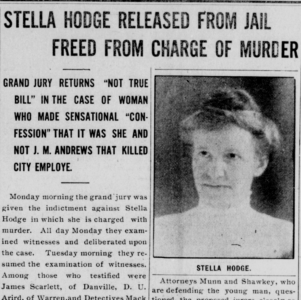
The Mail reported the next day, Sept. 7, that Hodge was released from jail after a grand jury failed to indict her. She immediately left town for Jamestown.
Hodge appears in the papers a couple years later but we'll get to that down the road.
But one thing is clear – the confession and confession left a man convicted of murder in the lurch.