
Reporters, aid workers tasked with describing scenes of Nazi atrocities

Photo from the Warren Times Mirror Published on April 26, weeks before the war would end, readers of the Warren Times Mirror were directly confronted with images of atrocities that Allied forces were uncovering in Nazi Germany and the territories the Nazis had conquered at the outset of the war.
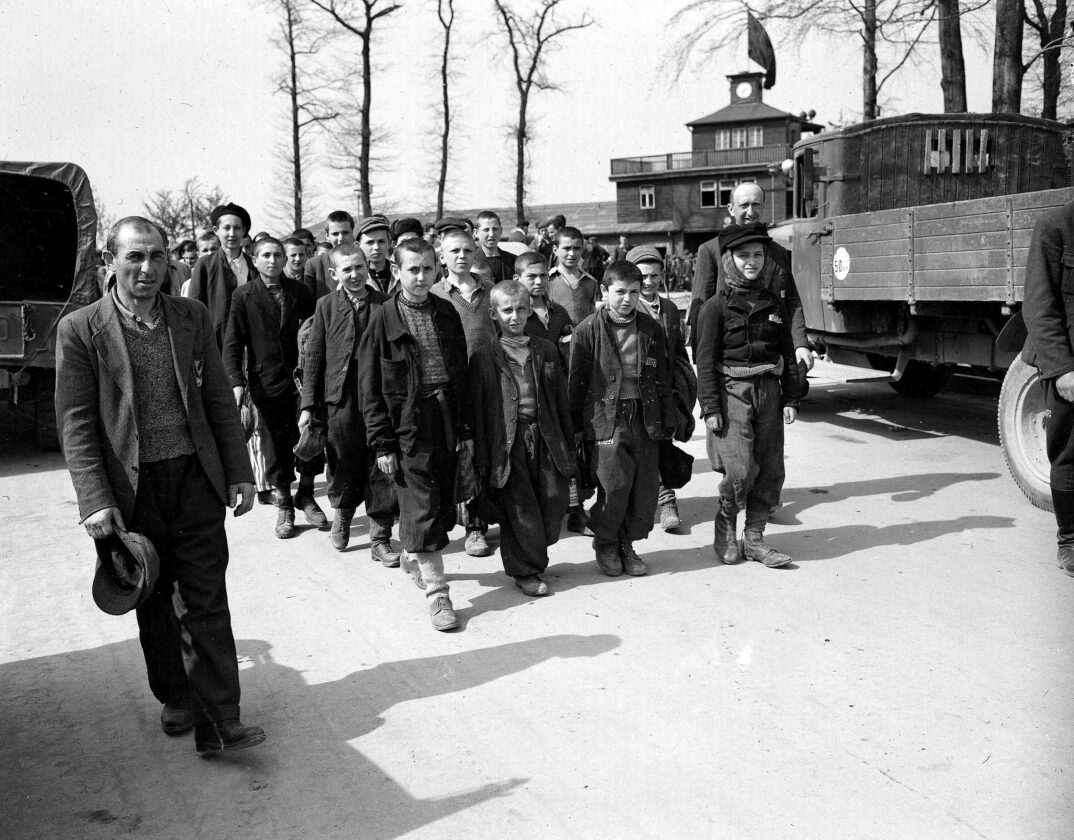
AP file photo This April 1945 file photo shows children and other prisoners liberated by the 3rd U.S. Army marching from the Buchenwald concentration camp near Weimar, Germany. Elie Wiesel, the Nobel laureate and Holocaust survivor was among those freed from the camp.
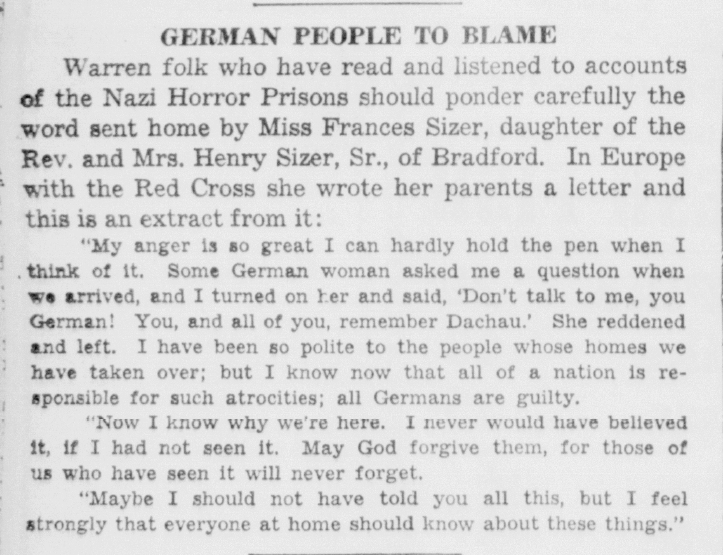
Photo from the Warren Times Mirror A local editorial shares a Bradford woman’s experiences liberating a Nazi camp.
Photo from the Warren Times Mirror Published on April 26, weeks before the war would end, readers of the Warren Times Mirror were directly confronted with images of atrocities that Allied forces were uncovering in Nazi Germany and the territories the Nazis had conquered at the outset of the war.
AP file photo This April 1945 file photo shows children and other prisoners liberated by the 3rd U.S. Army marching from the Buchenwald concentration camp near Weimar, Germany. Elie Wiesel, the Nobel laureate and Holocaust survivor was among those freed from the camp.
Photo from the Warren Times Mirror A local editorial shares a Bradford woman’s experiences liberating a Nazi camp.
Trending
As Allied armies --American, British and Canadian from the west and Soviet from the east --pushed German forces out of the conquered territories, the extent of Nazi atrocities started to become much more widely known.
No longer did reporters and correspondents have to speculate about what happened in Europe.
It was there for all of them to see.
The Times Mirror ran an article on April 19 with the following headline: "And they hold hope of negotiated peace after this!"
"Prisoners in the Belsen concentration camp, a stinking, filthy horror, were freed Sunday," the account began.
According to the U.S. Holocaust Memorial Museum, thousands of corpses lay unburied at the camp.
"Between May 1943 and April 15, 1945, between 36,400 and 37,600 prisoners died in Bergen-Belsen. More than 13,000 former prisoners, too ill to recover, died after liberation. After evacuating Bergen-Belsen, British forces burned down the whole camp to prevent the spread of typhus."
Anne Frank died in the camp in early 1945.
"The camp contained 39,000 persons still alive and uncounted dead," the wire report in the Times Mirror continued. "It contained typhus, typhoid, tuberculosis, nakedness, starvation, dumps of unburied corpses in vast heaps, mounds covering great burial heaps, one cavernous pit half-filled with blackened bodies."
It further made special mention that there were 500 children in the midst of this scene and quoted a medical officer: "Anything you have seen doesn't even begin the story.
"The living are being moved to the relative luxury of a nearby army barracks… 'Horror camp' is what the medical officer calls it. In the middle of the camp there is a mound 80 yards by 30 yards of the naked bodies of women piled table-high."
Details continued to unfold six days later in the Times Mirror when town officials from surrounding German communities were taken to view "corpses of atrocity victims outside the stone barn at Gardelgen, Germany, where SS and Volsksstrum troops burned to death 500 anti-Nazi French, Belgian, Polish and Dutch prisoners just before American soldiers stormed into town."
That edition also told the story of the British liberating the Buchenwald camp, one of the largest in the Nazi concentration camp system.
"Profoundly shaken by the horrors they had seen at the Germans' infamous Buchenwald prison camp, 10 members of a parliamentary group began today to prepare a report for submission to the house of commons, backed by gruesome exhibits," the wire report explained.
"Returning last night from the hell-camp, they disclosed that several of them had wept and one had fainted at the scenes of brutality. One brought back for exhibition to commons as evidence a long strip of human skin beating a tattooed prison number and which he said had been cut from the back of a living Buchenwald prisoner by his SS (elite guard) jailer."
A woman in the delegation said "never have I seen so much suffering."
About a week later, American forces liberated Dachau.
From the April 30 Times Mirror: "The US 42nd and 45th Divisions captured the infamous Dachau prison camp today and freed its 32,000 captives.
Two columns of infantry riding tanks, bulldozers and Long Tom rifles – anything with wheels – rolled down from the northwest and surprised the S.S. (Elite Corps) guards in the extermination camp shortly after the lunch hour.
Scores of S.S. men were taken prisoner and dozens slain.
The American Doughboys were quickly joined by "trustees" working outside the sprawling barbed wire enclosure. Poles, Frenchmen and Russians seized S.S. weapons and turned them against their captors.
Officials said the Nazis recently moved several distinguished inmates including Marshal Stalin's son Jacob Djugashvili, captured on the Russian front in 1941; former Austrian Chancellor Kurt Schuschnigg and his wife, and the German anti-Nazi protestant leader Pastor Martin Niemoller.
An editorial in the May 24 edition was quick to place responsibility for the atrocities, the depths of which continued to emerge in the following weeks.
Their answer? "GERMAN PEOPLE TO BLAME."
The editors were given a copy of a letter from the daughter of a Bradford minister who was working with the Red Cross. She's identified as Frances Sizer and the editors included part of her letter: "My anger is so great I can hardly hold the pen when I think of it. Some German woman asked me a question when we arrived, and I turned on her and said, 'Don't talk to me, you German! You, and all of you, remember Dachau.' She reddened and left. I have been so polite to the people whose homes we have taken over; but I know now that all of a nation is responsible for such atrocities; all Germans are guilty.
"Now I know why we're here. I never would have believed it, if I had not seen it. May God forgive them , for those of us who have seen it will never forget. Maybe I should not have told you all this, but I feel strongly that everyone at home should know about these things."
By June of 1945 local readers were informed that "two stone columns 50 feet high, one topped by a cross and the other by a Star of David, are being erected here by German civilians under the direction of Allied military government authorities to mark the mass grave of 3,500 Dachau concentration camp victims."