
Scene of young Irvine’s death remains at estate?
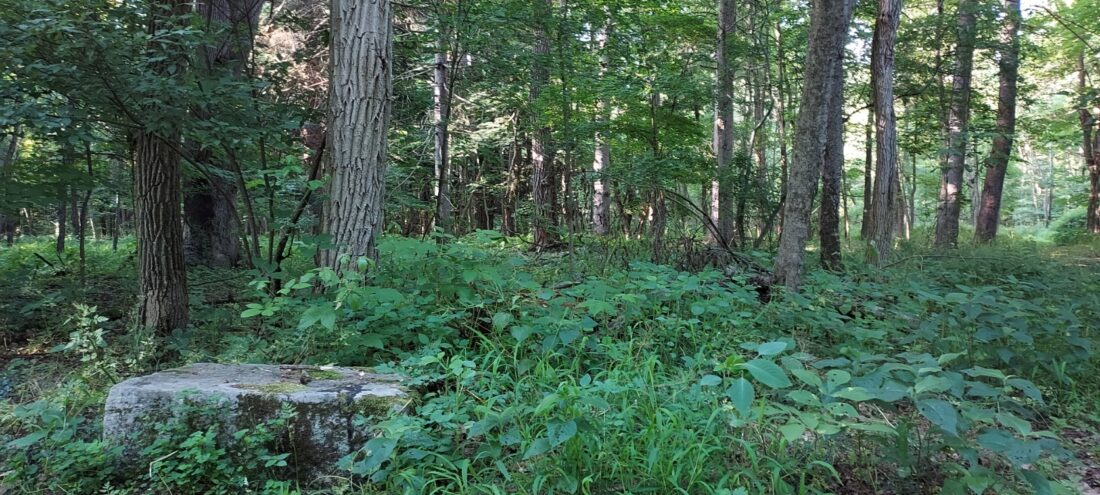
Times Observer photo by Josh Cotton This stone is supposedly the location where a young Callender Irvine was killed in a firearm accident in 1850. Is the story apocryphal or carefully preserved family history?
This might seem a little ghoulish.
But it stuck out when I was on the Irvine-Newbold estate tour a few weeks ago.
The reality is that nature has taken back much of the once-grand estate. And, boy, that estate was grand.
Like I wrote in the story on the tour, there’s some fence posts left, some field stone, a slight indent in the ground where the mansion was, the icehouse and one single flower that was possible where a garden was once located.
But one field stone stands out prominently along the trail, right on the corner where the mansion once stood.
It’s supposedly the site of a tragic Irvine family death.
Callender Irvine was a 12-year-old in the spring of 1850, son of Dr. William Irvine and Sarah Duncan Irvine, for whom the stone Presbyterian church in Irvine was built.
“While (siblings) Margaret and Sarah continued their education in New York,” Nicholas Wainright wrote in “The Irvine Story,” published in 1964 by the Historical Society of Pennsylvania, “their brother received private tutoring at Irvine.
“He was a very fine boy, the apple of his father’s eye, a manly sportsman who ranged the hills and fields with his gun. When only ten years of age, he had written Mrs. Blaine of a hunting excursion to shoot blackbirds for his father who was ill in bed with a cold.”
But tragedy struck.
From Wainwright: One day in the spring of 1850, twelve-year-old Callender sat on a large block of stone which bordered the drive connecting the house and the barns. The boy toyed carelessly with his loaded gun. To the horror of those nearby, the gun went off.”
That accidental discharge killed the young boy.
Dr. Irvine hurriedly scribbled a note to a family member in Warren.
“Dear Sir, Please Telegraph to No 190 2nd Avenue New York to Miss Emily Duncan that Callender accidentally shot himself dead a few minutes since. What my anguish is no one can conceive but those who know his noble nature. W. A. Irvine.”
Wainwright wrote that “the father had wanted to erect a monument over Sarah (his wife and the boy’s mother), but had deferred to Emily Duncan’s desire for an unostentatious marble slab. For his son, however, he would have a monument, a column of stone, funereally black. In the family Bible he recorded the death as ‘1850;’ he could not bear to name the fatal day. To cherish poor Callender’s appearance, he had several oil portraits and a miniature painted after photographic likenesses.”
Wainwright notes that William “sought consolation through spiritualism. He bought books like the ‘Phantom World and The Celestial Telegraph and attended seances in Warren, where, through the aid of a medium, he attempted to commune with the spirits of the dead. The result was not inspiring….”
So little remains of the estate that it struck me odd that this stone where this purportedly occurred sits.
It’s possible the story – that the stone is the exact spot – is apocryphal. It may be family lore based in someone’s alternate vision of reality.
But maybe it was preserved very deliberately, passed down from generation to generation with strict intentionality.
The answer to that question is probably lost to history. The last Newbold sister living on the estate died in the 1960s.
The young boy is buried at the cemetery behind the church built for his mother. (CHECK THIS)
A family member wrote to William in a letter preserved by the Historical Society of Pennsylvania.
“I was so shocked to hear of the dreadful calamity which has befallen you that I scarce know how to write to you. Dear Callender; he was too noble a boy. It has filled all our hearts with grief. I will offer you no expressions of sympathy for I know they are of no consolation for so irreparable a loss.”