
Memorial Day commemorated century before it was an official holiday
I was surprised to learn that Memorial Day wasn’t a declared federal holiday until 1971.
Knowing that it had been observed for more than a century before that, where did it start?
And when was it first recognized here in Warren County?
“Memorial Day, initially referred to as Decoration Day, was observed by many communities after the Civil War, when the nation suffered more than 620,000 military deaths, roughly 2 percent of the total population at the time,” according to an article from archives.gov. “John A. Logan, the Commander-in-Chief of the Grand Army of Republic, chose May 30, 1868, as a day to decorate the graves of Union troops across the nation. From this beginning, Memorial Day is now designated as an annual day of remembrance to honor all those who have died in service to the United States during peace and war.”
The Grand Army of the Republic was the most notable Union veterans organization coming out of the Civil War.
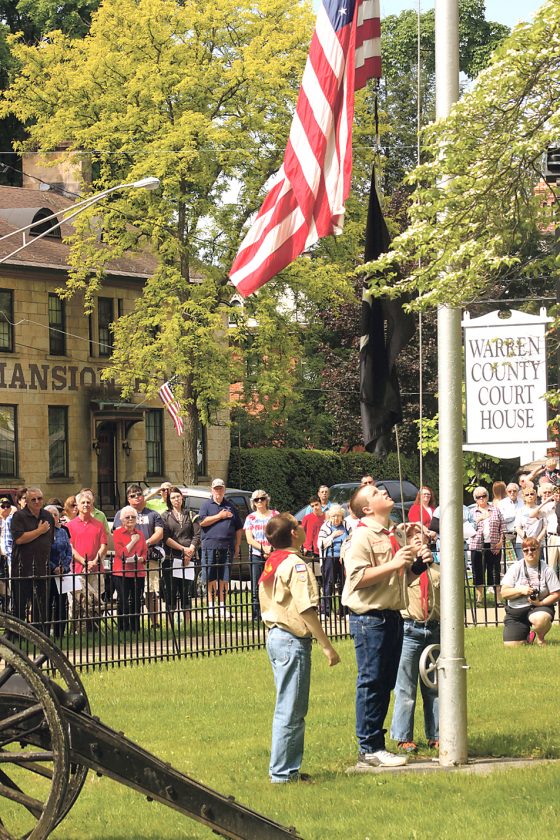
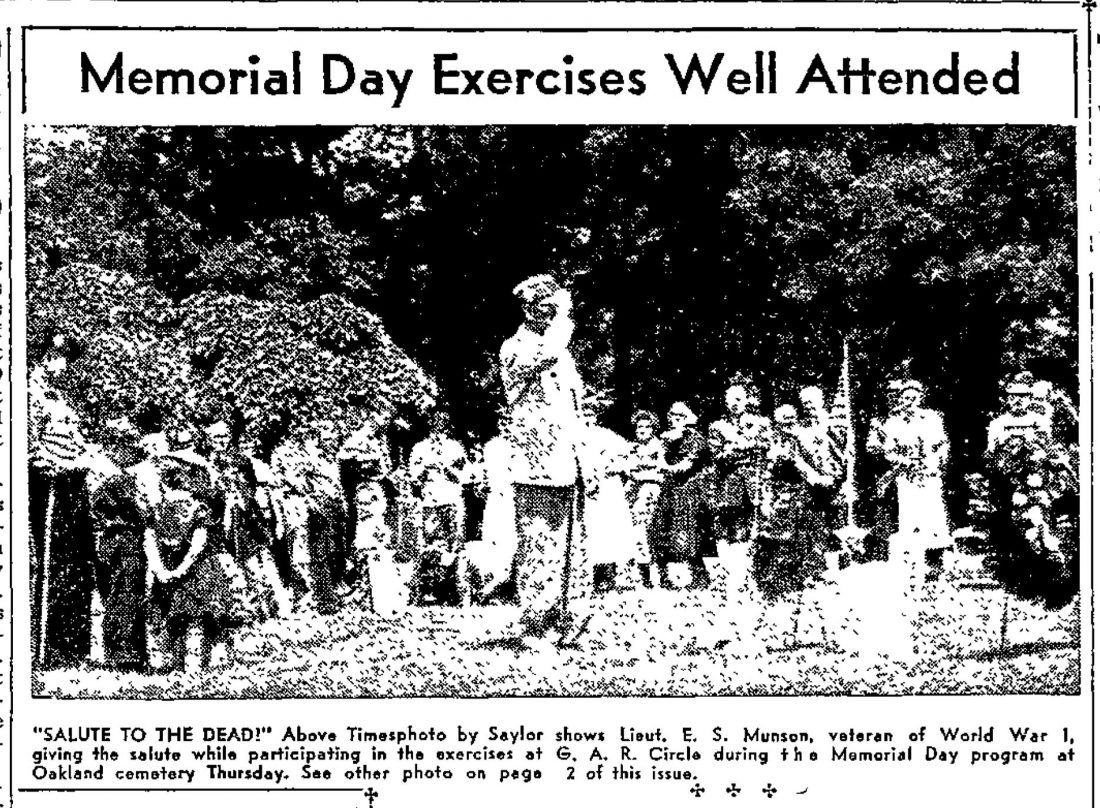
Photo from the Warren Times-Mirror/Times Observer file photo Contrasting views of Memorial Day commemorations in Warren County - a 1957 image of a World War I veteran saluting at Oakland Cemetery and a 2010s event at the Warren County Courthouse.
So that’s considered the first “official” Memorial Day in the United States.
The first reference I can find to the holiday in Warren County is the following year in the April 27, 1869 edition of the Warren Mail.
“General Logan, as head of the “Grand Army of the Republic,” calls attention to the fact that the 30th of May is Decoration Day – the day set apart to visit and decorate the graves of the dead soldiers of the Union,” the paper reported. “He says ‘(T)his is the second public observance of the occasions, which, it is trusted, will recur yearly while there remains a heart loyal to the cause in which our comrades fell, and while the moving principle of that struggle is worth preserving.’
“He thanks the patriotic men and women who gave their aid and sympathy on a former occasion to make successful this National Memorial Day, and invites them to unite with the comrades of the Grand Army in the approaching ceremonies; he thanks the loys press everywhere, through whose generous aid a lasting record has been made of the observance one year ago.”
Interestingly, there appears to have been no coverage of the actual event in the Mail.
And the following year in the Mail: “The 30th of May is not a legal holiday, but it was observed as though it was, in most of the Northern cities and towns. Every where patriotic hearts and hands responded to the call of the nation to do honor to the heroes who died that the nation might live.”
According to an article from PBS, the first national commemoration was highlighted by a speech by then Congressman James Garfield (who was also a Union general and would go on to be president, most notably as one of our nation’s assassinated leaders). The speech was given to a group of 5,000 at Arlington National Cemetery who, after the speech, decorated the thousands of graves at America’s most famous burial ground.
“This national event galvanized efforts to honor and remember fallen soldiers that began with local observances at burial grounds in several towns throughout the United States following the end of the Civil War, such as the May 1, 1865 gathering in Charleston, South Carolina organized by freed slaves to pay tribute and give proper burial to Union troops,” that article explained.
New York was the first state to make Memorial Day a legal holiday and several states had followed by the late 1800s, including southern states that held commemorations on other days in memory of Confederate war dead.
The Uniform Monday Holiday Act formally made Memorial Day a legal holiday nation-wide in 1971.
Here’s an abridged version of Garfield’s speech on that first Decoration Day from the National Park Service.
I am oppressed with a sense of the impropriety of uttering words on this occasion. If silence is ever golden, it must be here, beside the graves of fifteen thousand men, whose lives were more significant than speech, and whose death was a poem, the music of which can never be sung.
The Nation was summoned to arms by every high motive which can inspire men. Two centuries of freedom had made its people unfit for despotism. They must save their Government or miserably perish.
As a flash of lightning in a midnight tempest reveals the abysmal horrors of the sea, so did the flash of the first gun disclose the awful abyss into which rebellion was ready to plunge us. In a moment the fire was lighted in twenty million hearts. In a moment we were the most warlike Nation on the earth. In a moment we were not merely a people with an army–we were a people in arms. The Nation was in column–not all at the front, but all in the array.
Hither our children’s children shall come to pay their tribute of grateful homage. For this are we met to-day. By the happy suggestion of a great society, assemblies like this are gathering at this hour in every State in the Union. Thousands of soldiers are to-day turning aside in the march of life to visit the silent encampments of dead comrades who once fought by their side.
From many thousand homes, whose light was put out when a soldier fell, there go forth to-day to join these solemn processions loving kindred and friends, from whose heart the shadow of grief will never be lifted till the light of the eternal world dawns upon them. And here are children, little children, to whom the war left no father but the Father above. By the most sacred right, theirs is the chief place to-day. They come with garlands to crown their victor fathers. I will delay the coronation no longer.
-
- Photo from the Warren Times-Mirror/Times Observer file photo Contrasting views of Memorial Day commemorations in Warren County – a 1957 image of a World War I veteran saluting at Oakland Cemetery and a 2010s event at the Warren County Courthouse.