
Fight & homecoming
Windsor, Co. I involved in minor action in?Puerto Rico, return to Warren with a hero’s welcome
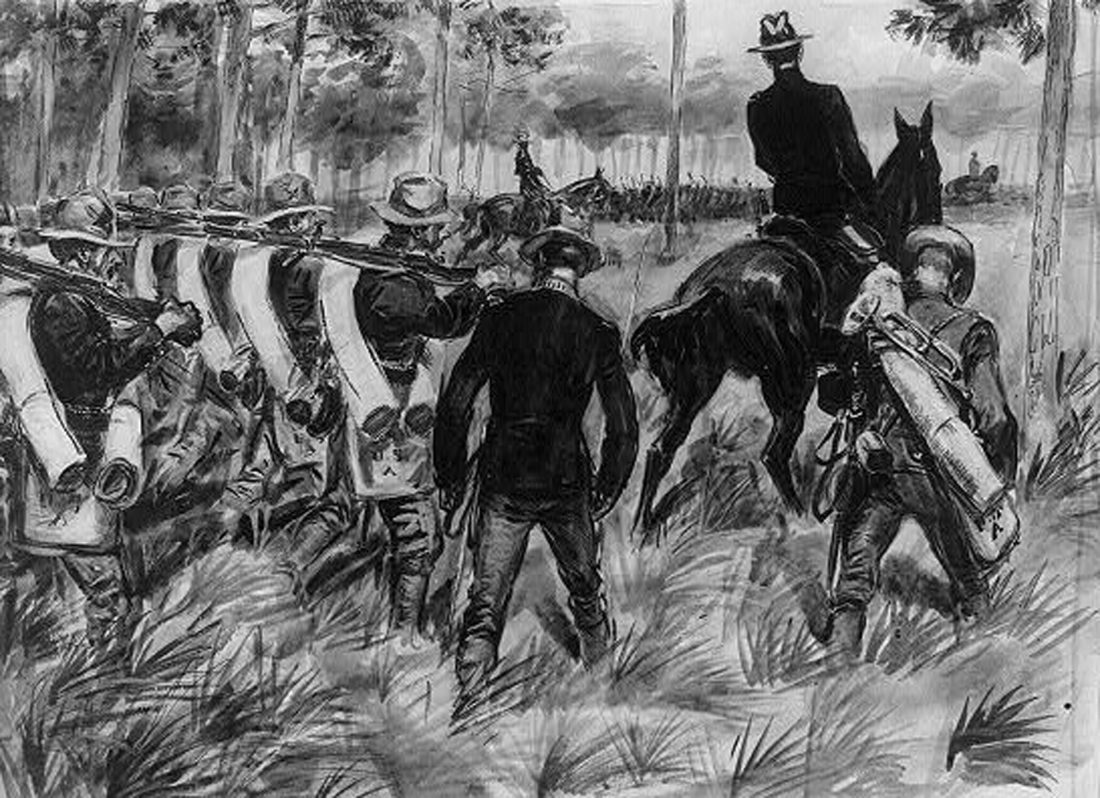
Library of Congress photo A drawing in the collection of the Library of Congress depicts fighting during the Spanish-American War.
The Spanish-American War has received the “Splendid Little War” moniker – Windsor and Co. I were involved in one small engagement in over two months in Puerto Rico.
Six Americans were killed and 36 wounded in the Battle at Coamo in August, according to the Library of Congress.
“Two distinct lines of battle were simultaneously engaged,” per Pennsylvania Volunteers. “After much desultory fighting and a stubborn contest of an hour and five minutes, the enemy surrendered. The enemy’s loss was 11 killed, about 71 wounded and 167 prisoners.
“The loss of the regiment was six wounded and one killed.”
“On July 26, at the behest of the Spanish government, the French ambassador in Washington, Jules Cambon, approached the McKinley Administration to discuss peace terms, and a cease-fire was signed on August 12,” according to the State Department, meaning that the war ended just four days after Windsor and Co. I’s engagement at Caomo.
According to Pennsylvania Volunteers, Windsor, Co. I and the 16th Regiment sailed for the United States on October 11 and arrived in New York City on the 17th.
The regiment was then furloughed for 60 days and formally mustered out of the federal service on Dec. 28.
The war had formally ended a couple of weeks earlier.
“The war officially ended four months later, when the U.S. and Spanish governments signed the Treaty of Paris on December 10, 1898.,” per the State Department. “Apart from guaranteeing the independence of Cuba, the treaty also forced Spain to cede Guam and Puerto Rico to the United States. Spain also agreed to sell the Philippines to the United States for the sum of $20 million. The U.S. Senate ratified the treaty on February 6, 1899, by a margin of only one vote.”
“Fred served admirably in the Spanish-American War,” the Historical Society article notes, citing that he was breveted for gallantry and promoted to colonel while in Puerto Rico. “It made him immensely proud to be equal in rank to his father who had attained his colonelcy during the Civil War.”
Taking a long view at Windsor’s life, it’s not hyperbole to suggest that this may have been the high point of his life.
If it wasn’t, he certainly utilized the experience to promote himself throughout the rest of his life.
Evidence of that pops up quickly after Co. I’s return to Warren.
“Shortly after returning home, Fred began to recount his war stories,” according to the Historical Society article. “The hour-long Battle of Caomo was elevated through the telling until it became as familiar to Warrenites as Teddy Roosevelt’s charge up San Juan Hill.
“Fred was Warren’s own war hero and regarded from then on as the town’s resident expert on all military matters. In an address to a veterans group in January 1899, Fred ‘spoke in a most entertaining manner of the par ‘our own’ played in the recent struggle. He referred to their awful 20 days stay on the docks of Charleston before their embarkation to (Puerto) Rico and of their stay on the island including the memorable Battle of Coamo. He scored the food, and said that the boys were actually starving…. The speaker told some good stories and closed to enthusiastic applause.'”
A Windsor quote from that event? “Puerto Rico is a good place for about 24 hours. People who contemplate going there would do well to stay home.”
Now whether that’s because Puerto Rico was really that bad… or because visiting Puerto Rico would cut into Windsor’s monopoly on storytelling is anyone’s guess.