
Editor’s corner: Minimum wage gimmick in New York adds to labor crisis
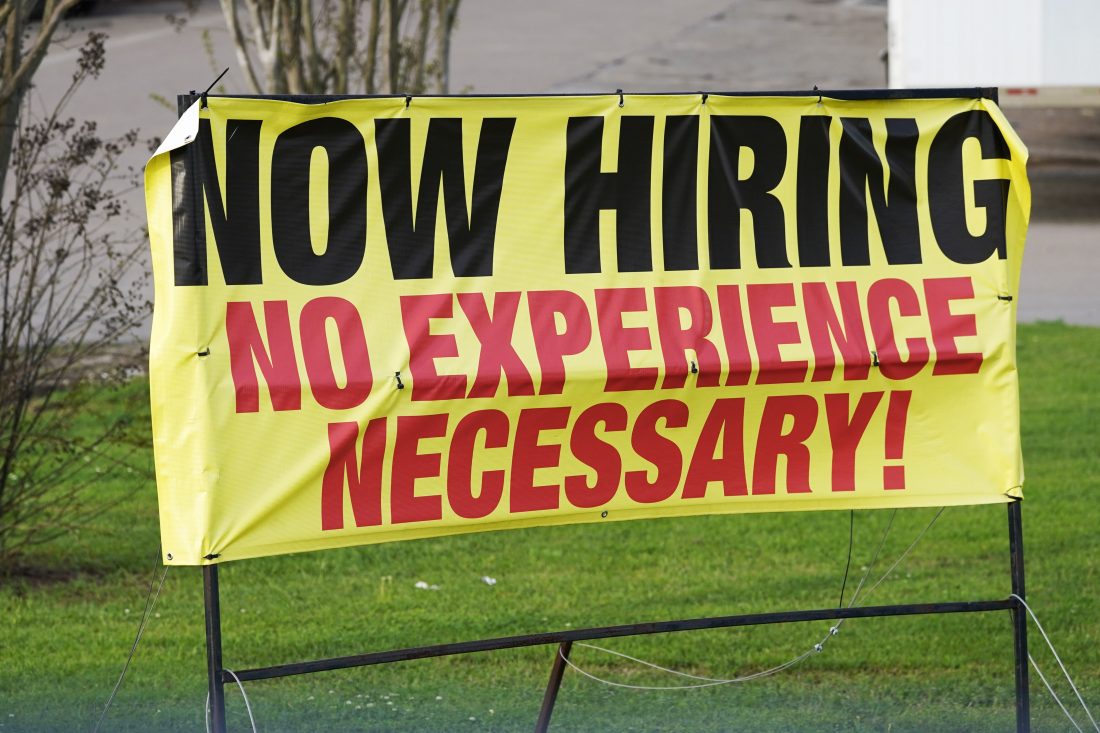
AP photo Signs such as these are not unusual across the region.
There is an obvious disparity for New York businesses that is apparent once they have crossed the state border into Warren County. Help wanted signs practically scream for applicants — much like they do across neighboring Chautauqua County.
Here, however, the starting pay at the fast-food restaurants ranges anywhere between $10 to $12 an hour. In Pennsylvania, that is a significant bump. On the other side of the line, that is still below the current minimum wage.
How different is that threshold for these two nearby communities? Pennsylvania’s rate has not changed in 15 years and remains at $7.25 per hour. In upstate New York, it is $12.50, with $13.20 looming on Dec. 31 — a 70-cent increase.
Those yearly hikes in our area have taken a toll on expenses for those in the private sector and the smaller non-profits. But as the rate continues to balloon, it is beginning to impact the public sector in New York state– where pay and benefits are already at generous levels.
This week, Gowanda Central Schools had to move to a remote model for learning due to a shortage in its workforce. “We do not at the moment have enough staff in critical areas to operate the school district fully in person,” said Dr. Robert Anderson in a note to the school community on Tuesday.
In Mayville, lawmakers are starting to look at pay levels for Chautauqua County employees after hearing from the Human Resources Director Jean Riley earlier this month. She noted the county had 82 vacancies, which does not include the new positions that were created in the 2022 budget. “In the environment we’re in with the worker shortage, it’s going to be even more difficult to recruit people for our open positions,” she said.
This certainly does not bode well for the numerous industries, health-care facilities and restaurants in the Chautauqua County area already desperate to fill openings. All one has to do is look at municipal and school district payrolls where the larger entities budget for millions of dollars. For instance, the county payroll for 1,234 employees is $56 million annually.
Each year the hourly minimum wage rate rises in New York state, employees who are above it rightfully want additional compensation. This creates an instability, which is something we are dealing with in the current crisis.
In the meantime, officials in the state capital continue to speak as though everything is dandy. Consider this comment from Roberta Reardon, New York labor commissioner, in September: “Companies, particularly those that employ low-wage workers, are already raising wages and in some cases offering incentives to hire amid a labor-shortage that is showing no sign of abating, and it makes sense to raise the wage floor now and continue supporting New York’s families while providing a predictable path forward for businesses. With today’s action (of increasing the minimum wage) we are continuing the work of building back with equity and justice.”
Numbers tell a different story.
Though Chautauqua County’s jobless rate continues its decline from 9.6% in January to 4.7% in September, the number participating in the work force — according to the state Labor Department — is estimated at about 100 less today than it was at the beginning of 2021 when numbers were closer to 53,200. Additionally, poverty rates — throughout the minimum wage increase — have been stable at 16% in the county and 25% to 30% in the cities of Dunkirk and Jamestown. The median county household income, the Census notes, is $46,820.
There are more discrepancies in this model. Here in Warren County, which has a minimum wage that is 42% less than New York state, there is a higher median household income at $50,250 and its poverty rate is 13.5%, which is 3% less than the rate to the north.
This begs the question: is the continuing minimum wage increase helping or hurting New York state? This is something Harrisburg needs to keep in mind — even though the labor crisis is very much evident here at home.
John D’Agostino is the editor of the Times Observer, The Post-Journal and OBSERVER in Dunkirk, N.Y. Send comments to jdagostino@observertoday.com or call 723-8200, ext. 253.
Our Opinion
Our opinion: Decision day coming for downtown property
Once again, Warren’s Redevelopment Authority seemed poised to order demolition of a property at 231-237 ...
Our opinion: Firefighting equipment problem isn’t going away
Legislation proposed by Sen. Michele Brooks to reopen the Redevelopment Assistance Capital Program to help pay ...
Our opinion: How do we fix child neglect, abuse problem?
The number of child abuse and neglect cases that come through the Warren County School District should be ...

Editor’s corner: U.S. history of division, freedom always tested
Our opinion: Showing frustrations with fuel prices
There is some good news to report when it comes to the summer travel season. AAA East Central notes fuel prices are ...
Our opinion: School cell phone ban is coming
Gov. Josh Shapiro announced June 1 that both the House and Senate have come together on a cell phone ban in schools ...