
New law will provide funding to internet predator task forces
Trending
Bipartisan legislation signed by Gov. Josh Shapiro will create a dedicated state grant program to fund law enforcement task forces focused on investigating and prosecuting internet predators who target children.
House Bill 1098, sponsored by Reps. Jason Ortitay, R-Washington/Allegheny, and Jessica Benham, D-Allegheny, was carried in the Senate by Sen. Devlin Robinson, R-Allegheny, who introduced a companion measure, Senate Bill 1335. The House bill passed with dedicated funding attached.
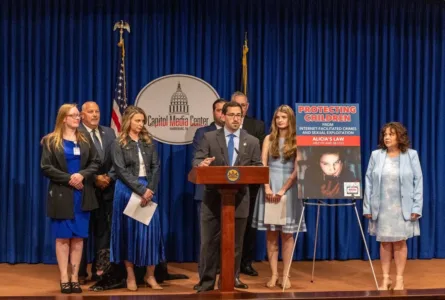
The legislation, Ortitay said, began over lunch in Pittsburgh with Lena Hannah, a former South Fayette school board member who started the Girls Night Out Program at South Fayette. Hannah brought Alicia Kozak (Kozakiewicz) to meet with Ortitay and introduced the idea of pursuing the legislation in Pennsylvania. From that conversation, a coalition was built - a survivor, a parent from Ortitay's own district, advocates and lawmakers on both sides of the political aisle.
"I'm pleased that after more than two years of advocacy, we have been able to get Alicia's Law to the finish line," Ortitay said. "Alicia's experience isn't some relic from the early days of the internet. It's a warning about what happens when kids can freely interact with strangers online while law enforcement lacks the tools to keep pace. With elementary-aged children on social media, these crimes aren't diminishing. They're growing. This legislation puts Pennsylvania on the offensive."
Alicia's Law is named for Kozak, a Pittsburgh-area survivor who was abducted at age 13 on New Year's Day 2002 by a man she met online. She was chained in his basement and sexually assaulted, and her abuse was livestreamed on the internet. She was rescued after a stranger who saw the stream called the FBI. She was the first known case of an internet-related child abduction in the country.
Kozak has since testified before Congress, founded The Alicia Project to teach internet safety to children and families across the country, earned a master's degree in forensic psychology, trained the FBI, and has worked for years to get this law passed in every state in America. Pennsylvania is the latest to answer that call.
"My rescue felt like a miracle, but no child's safety should depend on a miracle. That’s where Alicia’s Law comes in," Kozak said. "After serving 19 years in prison, the man who kidnapped me was released in Harrisburg, Pennsylvania. In July 2024, I stood at the Pennsylvania Capitol advocating for Alicia’s Law knowing he lived just 2 miles away. Then, just a few weeks later, in a stranger-than-fiction turn of events, my boyfriend and I discovered he was re-offending: targeting a local woman and in possession of child sexual abuse material. Last week, I sat in a Pennsylvania courtroom and watched him be convicted. Less than a week after his conviction, my home state has become the 14th state to pass Alicia's Law. The timing is deeply personal, but this law is not about one offender or one survivor. This is not just my story. Predators are in every community, and they are targeting our children. Protecting children takes all of us working together, and this week, Pennsylvania did exactly that. With the passage of Alicia's Law, Pennsylvania has made clear that protecting children cannot be left to chance."
The legislation was also deeply personal for Jill Sodini, a South Fayette mother whose daughter was one of many girls targeted by an online predator who turned out to be a student in her own school. He spent five months operating anonymously, creating fake social media accounts, some in the names of real male students, and used them to harass, stalk, manipulate and even threaten girls to solicit nude images. He sat at a lunch table across from Jill's daughter the entire time. He was caught only because of the dedication of a single detective who worked the case on his days off and in the evenings after putting his own kids to bed.
Sodini became one of the driving forces behind this legislation, standing alongside Kozak and pushing lawmakers to act.
"This is a huge victory for families that I know will save lives," Sodini said. "Having these resources allocated means perpetrators will be caught earlier thus sparing future victims. It will also be a deterrent to these perpetrators when they know they can no longer fly under the radar. In addition, I encourage parents to have a conversation with your tween or teen urging them to come to you no matter how scary or embarrassing something is even if they think they did something wrong."
The Warren County District Attorney’s Office former the Web Response Against Traffickers and Harmers (WRATH) Program in 2025 under the direction of Cody Brown. Last week, the U.S. Attorney General's office filed federal charges against William K. Young of Sugar Grove based in large part on information generated by the WRATH task force locally that resulted in local charges in July. The investigation involved coordination with Homeland Security Investigations, Pennsylvania State Police, Conewango Township Police and the United States Marshals Service.
“The protection of children requires coordinated efforts among law enforcement agencies at every level,” Brown said in a news release from the Warren County District Attorney's Office following the federal charges. “Our WRATH Program works diligently with our federal and state partners to investigate allegations of child exploitation and pursue accountability through the criminal justice system."
Brown said the district attorney's office will work with its partners to pursue federal charges when supported by the evidence and applicable law. The investigation remains ongoing. Authorities said the participating agencies will continue to investigate leads and evaluate evidence for potential additional criminal conduct or charges.
The indictment further alleges that Young possessed and accessed the material with intent to view it in July 2026.
The investigation was conducted through the Warren County District Attorney’s Office WRATH program.
The state task forces created under Alicia's Law would work alongside the existing federal Internet Crimes Against Children (ICAC) Task Force Program, which funds 61 task forces nationally. Currently, Pennsylvania has just one federally funded ICAC task force. Alicia’s Law Pennsylvania has one federally funded task force dedicated to investigating internet crimes against children. Alicia's Law would create a state grant program, administered through the Pennsylvania Commission on Crime and Delinquency, to fund additional task forces, train investigators and supplement existing federal resources. Thirteen other states have already passed similar legislation.
"Children deserve better protections from predators online, and our laws must keep pace with the rapid growth of technology," said Benham prior to Alicia's Law receiving Shapiro's approval. "Alicia's Law is designed to strengthen Pennsylvania’s capacity to prevent and identify these crimes, support investigations, and hold perpetrators accountable. I'm excited it will soon be signed into law."
House Bill 1098 would establish the Investigation and Prosecution of Internet Crimes Against Children Program within the Pennsylvania Commission on Crime and Delinquency. The program creates a state-level funding structure to pay for law enforcement task forces made up of state and local prosecutors dedicated to investigating and prosecuting online crimes against minors; supplement federal funding for task forces combating child sexual exploitation online; and train task force members on the latest techniques for detecting, investigating and prosecuting these crimes.
"As more children have access to the internet at a young age, the predators we once worried about on our streets are now sitting behind computers and smartphones interacting with innocent children," said Robinson. "By providing the funding and tools needed to better investigate and prosecute these horrendous crimes, our children will be safer and better protected."
Delaney Chase contributed to this report.