
Anniversary of Robert Jackson’s closing argument at Nuremberg is Sunday
Trending
Eighty years ago this month, the International Military Tribunal trial of Nazi war criminals had begun hearing closing arguments on behalf of the accused.
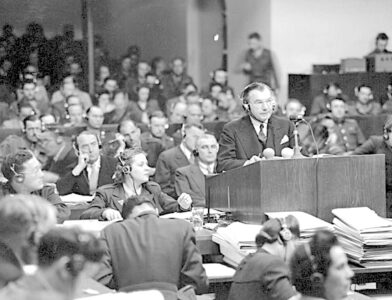
Supreme Court Justice Robert H. Jackson delivered his closing arguments on July 26, 1946. Those who want to watch the video can visit the Robert H. Jackson Center's social media channels. Here's a spoiler – Jackson spoke with a clarity and a forcefulness that created a foundation for international jurisprudence for years to come.
"Of one thing we may be sure," Jackson said early in his closing arguments. "The future will never have to ask, with misgiving, what could the Nazis have said in their favor. History will know that whatever could be said, they were allowed to say. They have been given the kind of a trial which they, in the days of their pomp and power, never gave to any man. But fairness is not weakness. The extraordinary fairness of these hearings is an attribute of our strength. The Prosecution’s case, at its close, seemed inherently unassailable because it rested so heavily on German documents of unquestioned authenticity. But it was the weeks upon weeks of pecking at this case, by one after another of the defendants, that has demonstrated its true strength. The fact is that the testimony of the defendants has removed any doubt of guilt which, because of the extraordinary nature and magnitude of these crimes, may have existed before they spoke. They have helped write their own judgment of condemnation."
So began the beginning of the end of the International Military Tribunal for Jackson, who had been selected by President Harry Truman to represent the United States and serve as the chief prosecutor in the trials. Jackson would go on to lead prosecution against 22 defendants, 19 of whom would be found guilty by the tribunal.
Efforts to begin the coordination of the yearlong symposium commemorating the Nuremberg war crimes trials began with Jackson Center officials wanting to put together an unprecedented event to commemorate the importance of this anniversary, according to Robert H. Jackson Center President Kristen McMahon. McMahon said it is important to remember the International Military Tribunal at Nuremberg and acknowledge the creation of the modern International Criminal Justice System standards that resulted from the trials.
Those interested in more should visit the Robert H. Jackson Center's Facebook and YouTube channels. There they can recap the trial's daily events through videos compiled by Greg Peterson, Jackson Center founder and longtime board president.
The daily digest, published daily across the center’s social media channels under the hashtags #OTD and #Nuremberg, began on November 20, 2025, the 80th anniversary of the trial’s opening. Each entry covers one session day, drawn directly from the original trial transcripts and using audio and video from the Center's archive.
The project is now on Trial Day 180 of approximately 218 session days. The anniversary of Jackson's closing will be Sunday, July 26, all closings conclude August 31 and the verdicts delivered October 1.
Peterson raised $20,000 from private philanthropists to purchase a complete set of 16mm Nuremberg film and audio files from the Library of Congress, a copy now owned by the Jackson Center. Peterson enhanced the audio, added photographs, and made it available on YouTube. The result is 800 hours of trial audio and 25 hours of film, among the most complete multimedia records of the Nuremberg proceedings that are publicly available.
The digest format was chosen deliberately. The volume of media content competing for public attention makes sustained engagement with a 218-day trial record difficult. A short daily entry, grounded in the primary source and published one session at a time, meets audiences where they are. Engagement across the Center’s social media channels has grown measurably as the project has advanced toward its conclusion.
“As the 80th anniversary of the Nuremberg Trial is almost complete, we are reminded that its lessons are not self-sustaining. The Robert H. Jackson Center developed this project precisely because it returns people to the primary source, not a summary, not a dramatization, but the actual proceedings, one day at a time. What makes it valuable is also what makes it necessary: Each year new generations of youth and adult learners discover the trials at Nuremberg, and their modern impact, as revelatory. The work of distilling that record into something accessible, accurate, and even engaging, is exactly the kind of education Justice Jackson had in mind when he said the trial’s greatest legacy would be what the world chose to learn from it," said Kristan McMahon, Jackson Center president.