New minimum wage proposal tied to legislators’ pay
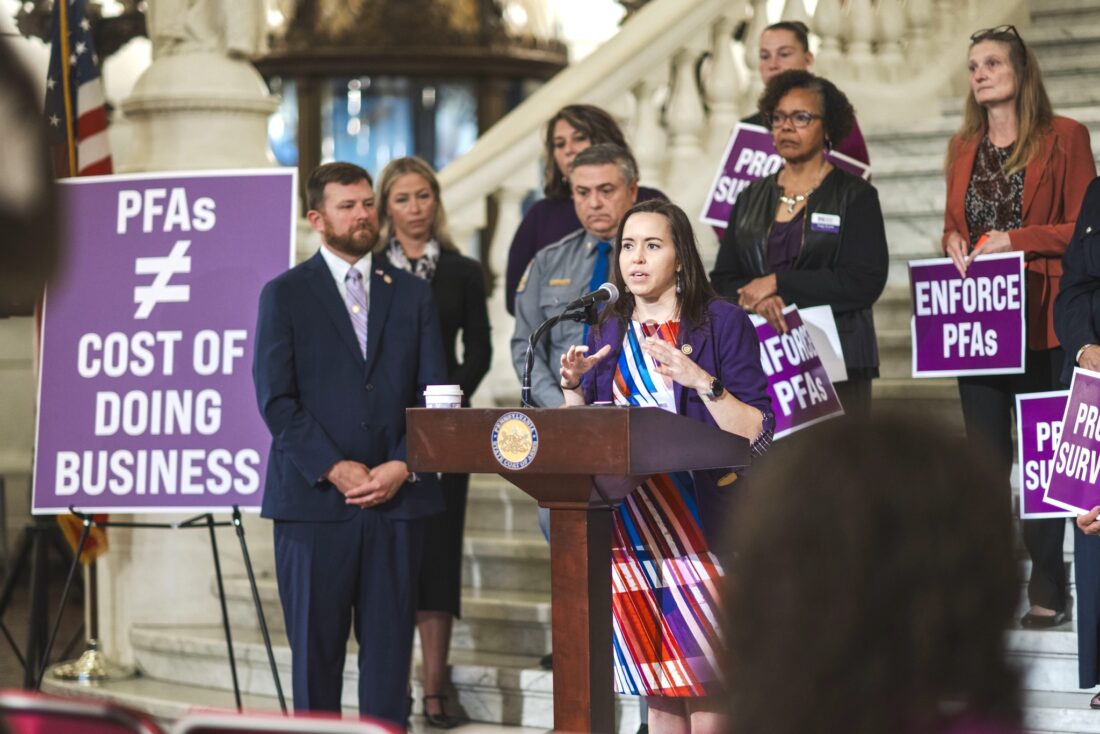
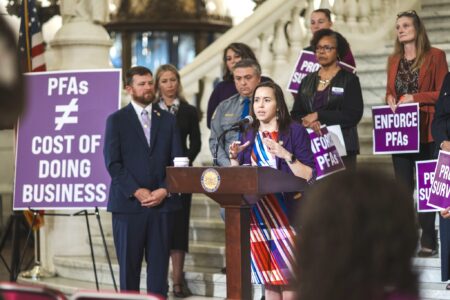
Rep. Emily Kinkead, D-Bellevue, is pictured during a February news conference in Harrisburg.
If state lawmakers get a cost of living increase, a pair of state lawmakers think taxpayers should, too.
Rep. Emily Kinkead, D-Bellevue, and Rep. G. Roni Green, Philadelphia, are circulating a co-sponsorship memorandum for legislation they are drafting that would increase the minimum wage whenever state legislators receive a cost-of-living-adjustment.
Kinkead and Green are still drafting their bill and seeking additional co-sponsors. Pennsylvania’s minimum wage hasn’t been increased from the current $7.25 an hour since 2006. Gov. Josh Shapiro has again made increasing the minimum wage part of his annual budget proposal – as did former Gov. Tom Wolf during his term. There have also been regular attempts by state legislators to increase the minimum wage over the years.
Since 2006, Kinkead and Green say, the cumulative rate of inflation has increased by more than 50%, leaving the more than 47,000 Pennsylvania workers that earn the minimum wage or less struggling to afford basic necessities like food and housing. Comparatively, the salary for General Assembly members in 2009 was $78,314.66, and current legislative base salaries are $113,591.40.
“It is shameful that state lawmakers have seen a more than 45% increase in salary over the last 17 years while the minimum wage has remained unchanged. For this reason, we plan to introduce legislation that will increase the minimum wage in Pennsylvania by the same percentage calculated for the salaries of members of the General Assembly,” Kinkead and Green wrote in their co-sponsorship memorandum. “This means that the annual cost-of-living adjustments (COLA) received by state lawmakers will raise the minimum wage at the same rate. If we are getting a raise from taxpayers, then taxpayers should get a raise, as well.”
Republicans have generally opposed minimum wage increases, with Senate Majority Leader Joe Pittman, R-Indiana, saying in response to Shapiro’s budget proposal that even at $15, minimum wage workers will still struggle economically.
Those who oppose raising the minimum wage have also argued that it would result in the closure of small businesses who can’t afford to pay their employees that much while also arguing that relatively few people make the minimum wage, with most of them being workers like servers who supplement those earnings with tips.
The current minimum wage mirrors the federal rate of $7.25 per hour. Pennsylvania’s minimum wage is less than half of neighboring Maryland, New Jersey, Delaware, and New York.
Increasing the minimum wage is far from a new argument, though Kinkead and Green are using an argument that hasn’t been heard in recent years.
“Low-wage workers are suffering, and policies need to be put in place that will help them,” Kinkead and Green wrote. “The General Assembly voted to give ourselves automatic and annual raises with public money and we have benefited from this policy for decades. It is time that we afford the same respect to taxpayers.”
Local News
Council reviews Pennsylvania Avenue parking changes
City staff are considering removing a mid-block crosswalk, which could allow for the addition of two to three ...
As winters warm, falling through the ice is more common — and deadly
Deerfield Center offering client transportation
RTPI to open exhibit March 29

Four area scouts honored by Pack 13 with Arrow of Light