Clerks, courts warn of new toll scam
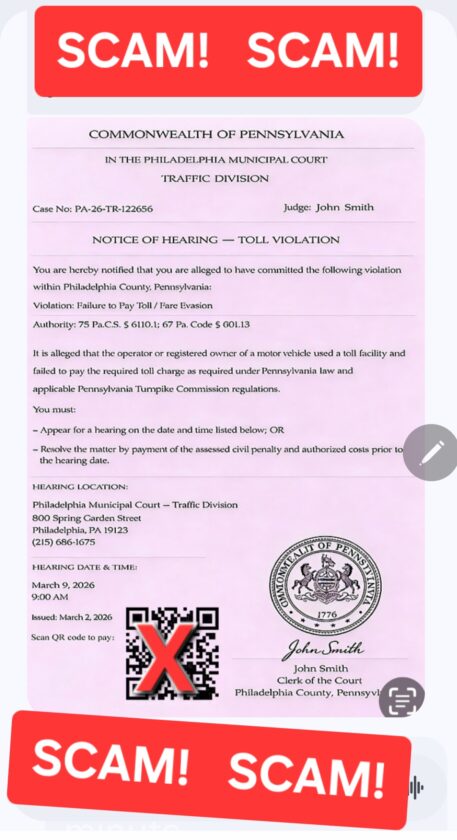
Photo courtesy Pennsylvania Court System Pictured is an example of a new toll violation scam that has reached Pennsylvania, New York and New Mexico, among other states.
By JOHN WHITTAKER
jwhittaker@post-journal.com
Police agencies around the country are warning of a new text messaging scam that attempts to get people to pay false toll violations.
The Pennsylvania State Court system recently sent a warning after the Philadelphia Courts issued a statewide fraud alert warning consumers about the fictitious text messaging scam purporting to come from the Traffic Division of Philadelphia Municipal Court. The headline on the text message reads, “Notice of Hearing – TOLL VIOLATION.” A similar warning was issued late last week by the Chautauqua County Clerk’s office regarding a similar scam that states the County of New York is trying to collect a toll violation. New Mexico officials are also among those warning of the scam. The text notice falsely instructs recipients to “Appear for a hearing” or resolve the matter by “payment of the assessed civil penalty . . . prior to the hearing date.” A QR code for payment is provided in the text. The summons is signed by “John Smith” in examples provided by Pennsylvania, New York and New Mexico officials.
Pennsylvania Court officials said they have been hearing from people throughout Pennsylvania who have received these fraudulent text messages. The courts advise consumers to ignore the texts and not to scan the QR code.
The courts will never send a text message demanding payment for any toll, parking or other violations. The public is cautioned to never provide personal, banking or credit card information via a link sent through an unknown text or phone call. The courts never request Social Security numbers or credit card information over the phone or via text.
Anyone who has received one of the scam text messages or is a victim of the scam is asked to call their local police department, contact the PA Attorney General’s Bureau of Consumer Protection at 800-441-2555, or contact the Federal Trade Commission (ftc.gov).
“Scammers rely on fear, urgency, and embarrassment to pressure people into acting quickly,” said Pennsylvania Attorney General Dave Sunday. “Before responding to any messages like this, take a moment to verify its legitimacy. If you’re unsure, do not click any links. Ask a trusted loved one for help or contact my office to report the potential scam.”
The Federal Communications Commission says a scam text will likely include a link and ask the recipient to click the link to pay immediately or verify their information. The link appears to be an official website, but is actually a phishing site. The scam message may also use generic greetings such as “Dear Customer” or “E-ZPass user,” rather than addressing you by name. E-ZPass typically uses the name on the account in a greeting. Toll operators typically don’t use text messages to collect on overdue accounts, and do not use threatening language to rush customers into action.
Tips from the FCC include:
– Do Not Engage with the Texter. Do not reply to the message, including pushing a button or responding “Y” or “N.”
– Do Not Click any links embedded in the text.
– Find Out if the Text Message Is Legitimate. Call a customer service number or log into the toll-paying account to check for any valid violations or unpaid tolls. If the account is in order, report the scam text to the toll company.
– If the text claims to be from a toll company operating in a different state, independently find a customer service phone number online and call before sending any money or providing personal information.
– Block the Number. Consider blocking the sender’s number to prevent future scam attempts.
– Report the Scam to Law Enforcement. If a text message is suspected to be a scam, report it to the Internet Crime Complaint Center (IC3) at www.ic3.gov.
– Do Not Share Your Info. Never share personally identifiable information or financial information in response to unsolicited or suspicious messages.
– Don’t Be Bullied. Any request received urging immediate action can lead to a rushed response that may be unwise.
– File a Complaint with the FCC. Information from the public helps to inform FCC enforcement and policy efforts, and helps the FCC raise public awareness of these scams.
Local News
Clerks, courts warn of new toll scam
Pa. power load buckling under neighboring renewable energy goals
As states across the mid-Atlantic adopt aggressive goals for renewable energy generation, most look to ...

Philharmonic will host “Spring Awakening” concert Sunday
Children’s Advocacy Center receives Order of the Eastern Star donation
Fundraiser and donations help strengthen library programs
The Warren Public Library celebrated a lively and successful fundraiser on Jan. 31, as over 150 community members ...