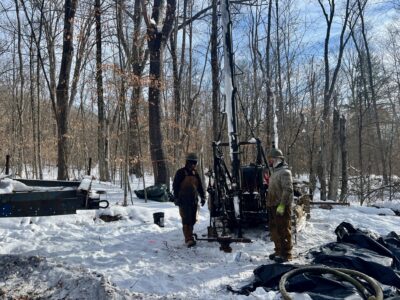
Senate bill seeks to speed up well plugging
Legislation that would help speed up the process of plugging abandoned oil and gas wells has passed the state Senate with support from Sen. Scott Hutchinson.
Senate Bill 712 was approved recently by a 32-16 vote. Hutchinson was a co-sponsor of the bill, which was sponsored by Sen. Gene Yaw, R-Williamsport. Senate Bill 712 is an attempt to make federal well plugging dollars more easily available by better defining what constitutes a reasonable effort to reach the attainable bottom of a well, eliminating ambiguity that has led to costly delays and inconsistent interpretations. Yaw said the additional clarity will help Pennsylvania fully leverage nearly $400 million in federal funding dedicated to addressing legacy oil and gas wells.
“Clear standards are essential for both environmental progress and industry participation,” Yaw said. “This bill eliminates uncertainty for operators and positions Pennsylvania to take advantage of available federal well plugging funds.”
The bill now moves to the House of Representatives for consideration.
Currently, the Pennsylvania Department of Environmental Protection (DEP) requires well pluggers to clean out a well to its total depth before plugging, a process that often becomes complicated because many older wells lack accurate records of their original depth. Contractors frequently face significant back-and-forth with DEP inspectors to determine what the actual depth is and then must attempt to reach that depth before plugging can begin.
If the total depth cannot be achieved, DEP expects a “reasonable effort” to reach what is called the “attainable bottom.” What constitutes “reasonable effort” varies widely among inspectors, leading to unpredictable costs, extended timelines and difficulty in planning projects.
“We appreciate Sen. Yaw’s and Sen. (Camara) Bartolotta’s leadership on this issue and the Senate’s support for providing clarity on the standards necessary to properly plug wells,” said Jim Welty, president of the Marcellus Shale Coalition. “Such clarity has been lacking from Pennsylvania regulators for far too long, and it is necessary if the commonwealth is to maximize the federal funding opportunity to plug legacy wells.”
In 2024, estimates discussed during a state Senate Republican Policy Committee hearing estimated the number of abandoned wells in Pennsylvania to be between 200,000 to 750,000. Pennsylvania calls a well abandoned when it’s been dormant for 12 months; an orphan well is one that was abandoned before 1985 and doesn’t have a traceable owner. The state Department of Environmental Protection counts about 30,000 orphan wells across the state, many of them forming an arc from the southwest border up to McKean County in the northern tier.
Local News
WASU to host Valentine’s Day Party for fifth-graders today
Elk County man sentenced to jail time
An Elk County man has been sentenced to between 8 and 23 months in jail as well as 3 years probation after pleading ...
Thompson challenger kicks off campaign
GT Thompson announces re-election bid
Senate bill seeks to speed up well plugging
Legislation that would help speed up the process of plugging abandoned oil and gas wells has passed the state ...