Last-minute agenda change policy still undecided
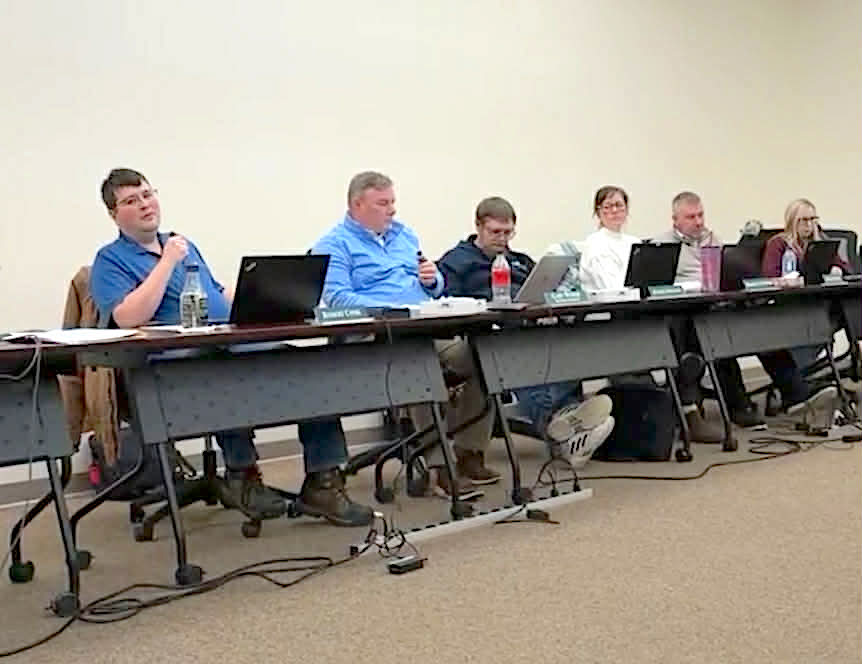
Times Observer photo by Jessica N. Rex Superintendent Gary Weber and School Board President Robert Cook discussed the Sunshine Act policy language during Monday’s Warren County School District Board of Education meeting.
Warren County school board members agree a 24-hour notice of items on the board’s meeting agenda is preferable – but how to handle emergencies has yet to be decided.
Superintendent Gary Weber shared Attorney Rachel Glasoe’s response in regards to the questions that board member John Wortman had asked during the board’s Feb. 9 meeting regarding how the school district will comply with the state’s Sunshine Act and the effect of a state Supreme Court decision on how local governments handle last-minute additions to agendas.
The district is not required to pass a new policy. Glasoe said in regards to the Sunshine Act, she found no statute, regulation or judicial decision that would lead her to believe the district would incur any kind of liability simply for choosing not to conform its policies on agenda amendments to the full range of Section 7.12.1 in the state’s Sunshine Act.
There are state laws that act to restrict government action. A local government body may, as a general rule, make provisions that limit its own actions to similar or to an even smaller scope. The Sunshine Act sets minimum standards, and the act, for instance, requires that a public meeting be posted no later than 24 hours in advance of the time of the convening of the meeting. Many agencies that meet on Monday’s post their agenda on the Friday or even Thursday prior to that meeting. Section 7.12.1 may be seen as setting a minimum standard which limits the subject matter of business that may be added to an agenda meeting after the agenda has already been published. The difficulty is that in making such a statement, it would say that school board policy does not have the effect of law. In the case of Waters versus Pennsylvania Department Corrections, school boards do not have the power to enact ordinances that would be binding on the actions of the directors or future directors. School boards remain free to make exceptions to their own policies when a majority of members choose to do so. A majority vote is also required to amend an agenda item under that section of the Sunshine Act to add a matter of agency business to the agenda during a meeting.
Many school board policies overlap with statutory law, and in such cases, a school board that overrides the policy might also be in violation of the statute. There is nothing illegal about violating the policy, only the statute that underlies it. If the Warren County school district decides to adopt policies that omit the ability to amend an agenda item under that section of the Sunshine Act, that omission would not have the binding effect of restraining the board from amending the agenda. According to Glasoe, it is in conformity with that section, even if the district adopted policy that, “prohibits” the board from amending an agenda item after it’s been published, the prohibition would not be enforceable in the face of a decision by a majority of the board to amend an agenda.” Advising that the board keep in mind that outside of Section 7.12, 1e, an agenda may only be amended at a meeting for two categories of business: emergency or de minimis. The section has a restricted definition for “emergency,” in that it must be a real or potential emergency involving a clear and present danger to life or property. There may be a time when the school board may have a matter of business that is urgent but does not meet the definition of “emergency” under the Sunshine Act. If such a situation were to rise and 7.12, 1e amendments were not permitted by this district policy, the board and the public may be filled with confusion, questions or resentments, rather than a focus on the urgent issue at hand.
School Board President Robert Cook added that Glasoe made it clear it was a strong recommendation that the board put the language in the policy. Adding that it was also brought up by the previous solicitor that the board should try to match their policy to current state law of the Sunshine Act Update. Cook said, “PSBA even strongly recommended that as updates come along, we should be doing it on a three year basis, but specifically, when court cases are decided and state law is done, we should try to reflect and update our policies as soon as possible. It’s not a requirement, per se, but it’s definitely a best practice.” Cook commented that they should be seen as tools to use. An example is when a price on laptops arose and the district decided to purchase quickly in order to save the district $90K. “We want that ability, and if we don’t put this in the policy, and then we do have to use it, the amount of confusion that will happen to the public will be outstanding.”
Wortman stated that he appreciated the time spent on a thorough review of the current case law regarding the Sunshine Law. He also asked if the board could make a statement that they are committed to maintaining the 24 hour advance postings, unless there is a circumstance that was described. Wortman said, “I do feel that it is best practice for our school district and the community that we serve, for the members of our public to know what is going to transpire at our meetings.”
Weber said Glasoe provided language that could be added to the policy that basically says that the board, although it’s passing the policy to reflect the current legal statute, that there is a belief statement there that the board could add to the policy that would be reflective of that.
Weber ended the discussion by saying that he will prepare that for the board so that there will be an opportunity to make a decision at a future meeting.
Local News
New railroad safety rules get nod from state regulators
Safety lessons learned from the East Palestine train derailment may soon make it into Pennsylvania’s rule books ...

Tidioute Community Charter School students take part in Hearts Around The World

Last-minute agenda change policy still undecided
4-H tree sale order deadline is Monday
The Forest County 4-H Office will be holding the annual tree sale in addition to perennial bulbs and small fruit ...

Weather concerns prompt ideas for amphitheater covering