
Senators host hearing on reading instruction
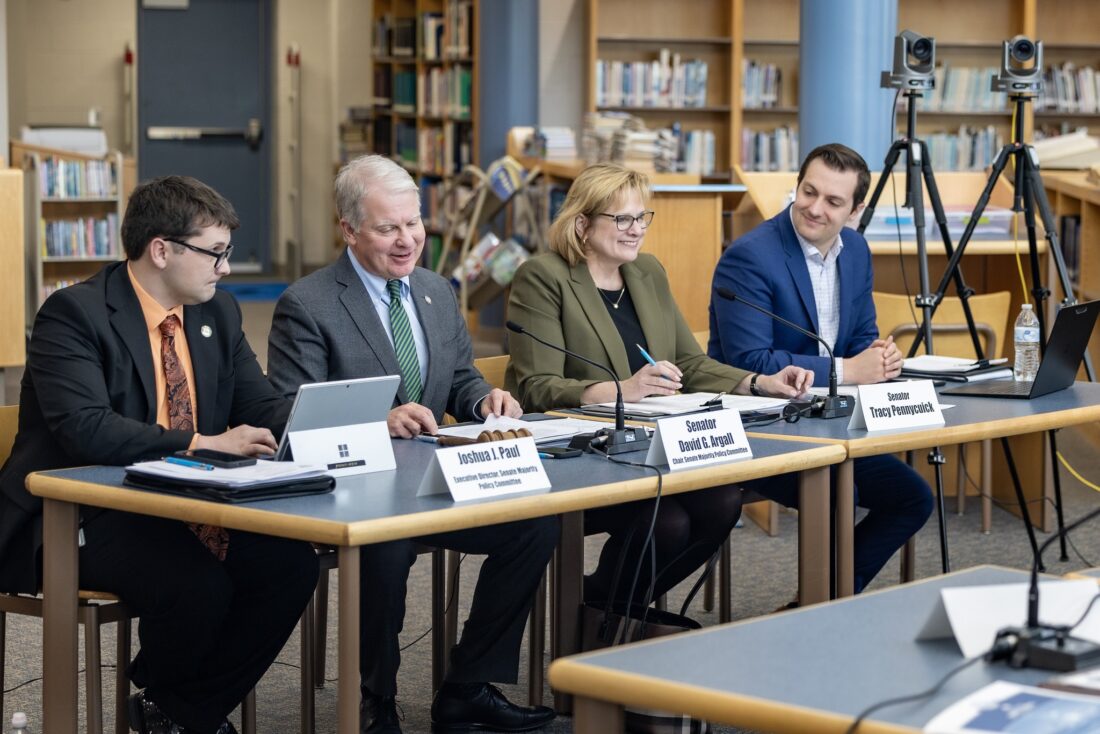
State senators David Argall and Tracy Pennycuick, center, are pictured during a Senate Majority Policy Committee hearing on reading instruction.
State lawmakers have a better grasp of how legislation passed in 2024 and 2025 are affecting reading instruction in the state.
There may be more changes to come.
The state Senate Majority Policy Committee hosted a hearing recently to hear from teachers and reading specialists how new requirements for reading instruction have helped students and to identify areas where further progress. The hearing was hosted by Republican senators Tracy Pennycuick and Dave Argall.
Panelists reviewed in detail how students, teachers and school districts have responded to new frameworks for reading instruction codified in Act 135 of 2024 and Act 47 of 2025, which require schools to utilize structured literacy to teach students to read, create a process to identify struggling students early and provide high-quality literacy resources to teachers. These laws were enacted after Mississippi’s adoption of structured literacy resulted in its reading scores moving from among the lowest in the country to above the national average, a low-cost turnaround often called the “Mississippi Miracle.”
The state Education Department released the results of 2025 PSSA results that showed, statewide, PSSA proficiency rates in decreased statewide by 4% from 2024 from 53.9% to 49.9% in English language arts, while in Warren County proficiency decreased by 5% year over year in ELA from 39.8% in 2024 to 34.8% in 2025.
The news wasn’t all bad on the ELA tests across the county. The county’s fourth graders saw proficiency increase from 29% to 33.1%, though the rest of the grade levels saw decreases in proficiency. Third grade proficiency on ELA testing decreased from 38.6% to 34.8%; fifth grade proficiency decreased from 47.3% in 2024 to 30.3% in 2025; sixth grade proficiency decreased from 43.7% to 40.1%; seventh grade proficiency decreased from 39.4% to 32.6% and eighth grade proficiency decreased from 40.4% to 33.6%.
“There are few things more important in a young person’s life than learning to read,” Pennycuick said. “We know students who fall behind in reading are less likely to be successful in almost every subject area. That’s why establishing structured reading instruction is critical to the growth and education of our kids.”
Shane Cross, director of curriculum and instruction for Daniel Boone Area School District, shared the progress his district has made in implementing structured literacy, praising the efforts of teachers, administrators and families. He noted areas where additional resources could further support students, calling for a centralized repository of vetted curriculum documents and the hiring of literacy coaches.
Rachel Garnick, Pennsylvania coalition manager for Teach Plus, said only 33% of Pennsylvania fourth graders read proficiently on the National Assessment of Educational Progress, with average reading scores declining significantly from 2015. She contrasted this with Mississippi, which increased its reading scores faster than any other state in the nation from 2013-24 after incorporating structured literacy into the classroom. Candace L. Hall, a board member of the International Dyslexia Association — Pennsylvania, pointed to how this effort came to fruition, stating that “the ‘Mississippi Miracle’ was not luck; it was the product of intentional, long-term implementation.” She called for the creation of a statewide plan that aligns families, teachers, the Pennsylvania Department of Education, the Pennsylvania Training and Technical Assistance Network, intermediate units, and school and district leadership with the goal of boosting reading scores through evidence-based instruction.
Rachel Langan, senior education policy analyst for the Commonwealth Foundation, called for additional reforms to expand educational options in Pennsylvania, noting that public education spending in Pennsylvania has increased by 68% over the last decade, while reading scores have dramatically declined. She called for education spending to follow the student and for the expansion of tax credit scholarships for K-12 students.
“It doesn’t matter which career path our young people decide to take — it is impossible to function in today’s world without being able to read,” Argall said. “Our work to boost literacy rates and ensure our children have the tools they need to succeed is just beginning. Today’s hearing gave us valuable insight into what is working well and what work remains ahead.”
Local News
Senators host hearing on reading instruction

Board talks meeting rotation, updates on closed schools

Poll asks Americans to weigh in on Trump’s foreign policies

CASA names Kelsey Howard as new executive director

Inflation cooled slightly in December though it remains above Fed’s target
County accepting proposals for Youngsville HS building
The Warren County Commissioners are seeking proposals for the former Youngsville High School building. According ...