Senate GOP eyes police cooperation with ICE
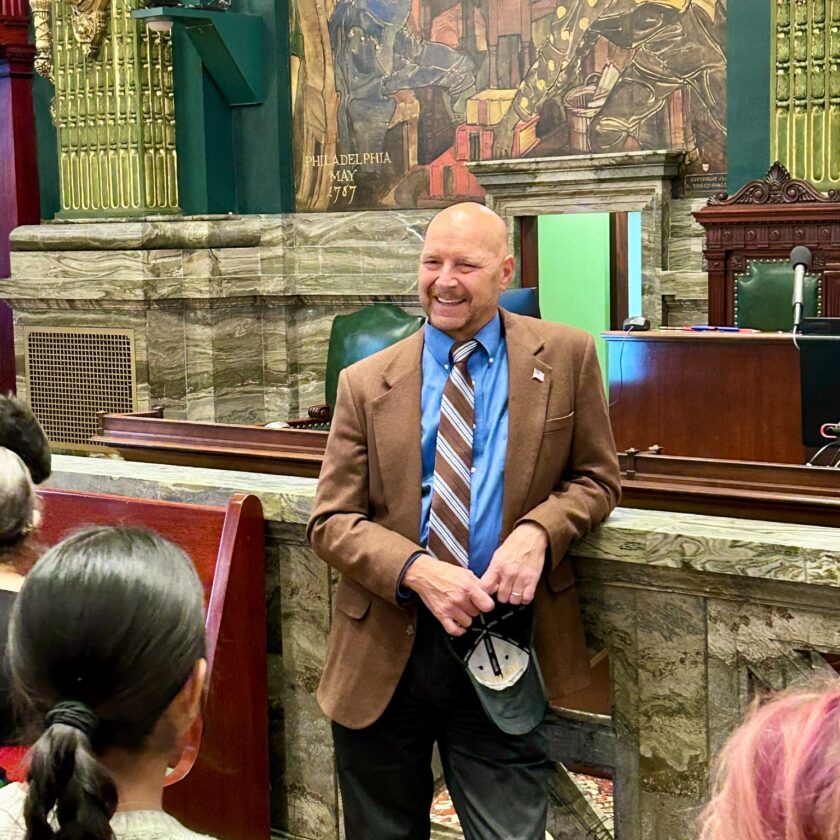
Sen. Doug Mastriano is pictured with students during a tour of the state Senate.
Three state Senate Republicans are eyeing additional cooperation from the commonwealth’s law enforcement agencies with Immigration and Customs Enforcement officials.
A co-sponsorship memorandum has been introduced by Sen. Doug Mastriano, R-Chambersburg, with Republican co-sponsors Chris Gebhard and Cris Dush providing early support. In September, House Democrats proposed legislation that would limit the Pennsylvania State Police agency’s cooperation with ICE.
Mastriano is proposing to establish uniform statewide standards for cooperation with federal law enforcement officers carrying out lawful duties; prohibit local ordinances or policies that restrict such cooperation; require agencies to honor valid immigration detainers and notification requests; authorize participation in 8 U.S.C. §1357(g agreements for immigration enforcement functions; include transparency reporting, and whistleblower protections; provide defense by the state Attorney General’s office and indemnification for agencies acting in good faith; and require campus police to cooperate with ICE as well under the state’s Title 24 laws.
“Pennsylvania must maintain strong partnerships with federal law enforcement to protect public safety, uphold the rule of law, and prevent the creation of sanctuary jurisdictions that undermine enforcement efforts,” Mastriano wrote in his co-sponsorship memorandum. “This bill ensures clarity, accountability, and constitutional compliance while promoting cooperation across all levels of law enforcement.”
Bills either limiting or expanding cooperation with ICE have been popping up in state legislatures around the country in recent months. State Rep. Abigail Salisbury, D-Braddock, began circulating a cosponsorship memorandum in September to prevent the Pennsylvania State Police from signing agreements with the federal government to participate in ICE raids. Salisbury’s bill has yet to advance from the House Judiciary Committee.
“These agreements, known as 287(g) agreements, take important resources away from local matters to instead put police time and funds towards federal matters,” Salisbury wrote in her co-sponsorship memorandum. “Given these facts, it would be especially concerning if the Pennsylvania State Police were to participate in such an agreement. While there has been no stated interest in doing so by the PSP, and in fact they have adopted internal policies that prohibit such an agreement, I believe it is important to statutorily ensure that no such agreement can ever take place.”
U.S. Customs and Immigration Enforcement in 2025 revived and expanded a decades-old program that trains local law officers to interrogate immigrants in their custody and detain them for potential deportation. The 287(g) program — named for a section of the 1996 law that created it — currently applies only to those already jailed or imprisoned on charges. In the early 2000s, many of the initial participants in the 287(g) program had agreements that allowed them to enforce immigration laws in their communities, not just their jails.
In recent years, ICE has offered two types of 287(g) agreements to law enforcement agencies. One model requires four weeks of training and allows local officers to question suspected noncitizens who are jailed on other charges and detain them for ICE. The other model, which President Donald Trump launched during his first term, requires eight hours of training and only allows local officers to serve federal immigration warrants. As of December, ICE had 135 agreements with sheriff’s offices, police departments and prison systems in 21 states, with requests pending from 35 others. Two-thirds of the agreements were in just three states — Florida, Texas and North Carolina. But no agreements had been signed during Biden’s four years as president, according to ICE data.
On his first day back in office, Trump ordered the Department of Homeland Security to maximize 287(g) agreements for local law officers to investigate, apprehend and detain immigrants. At a recent National Sheriffs’ Association conference, Homan said the administration is looking to lighten detention facility regulations and shorten the training to encourage greater collaboration with federal immigration officials.
Salisbury said the Pennsylvania State Police’s use in rural counties as a primary law enforcement agency – something some state lawmakers have said costs the state too much money amid a push to create more local police agencies – is one reason the Pennsylvania agency shouldn’t sign a 287(g) contract. Many areas in Warren County rely on the State Police for basic law enforcement needs.
“Two-thirds of Pennsylvania municipalities rely on part-time or full-time PSP coverage at increasing costs to the agency and the taxpayer,” she wrote. “Given their expansive coverage area and growing patrol costs, I believe that it is important that we ensure that the PSP cannot involve itself in the work of federal immigration authorities. The PSP joining a 287(g) agreement would only result in a higher workload for troopers, more burdens for taxpayers, and less faith in the PSP by the communities that rely on them.”
Local News
Jackson Center, Ehmke Manufacturing sponsor civic essay contest
The Robert H. Jackson Center, in partnership with Ehmke Manufacturing Co., Inc., developed an essay contest ...
Senate GOP eyes police cooperation with ICE
Warren Public Library to host annual “Books, Blues & Brews”
The Warren Public Library will host its annual fundraiser, “Books, Blues & Brews” on Saturday, Jan. 31, ...
Trump ties his stance on Greenland to not getting Nobel Peace Prize

Visitor’s Bureau post is extension of county resident’s personality