
Rapp opposes abortion amendment
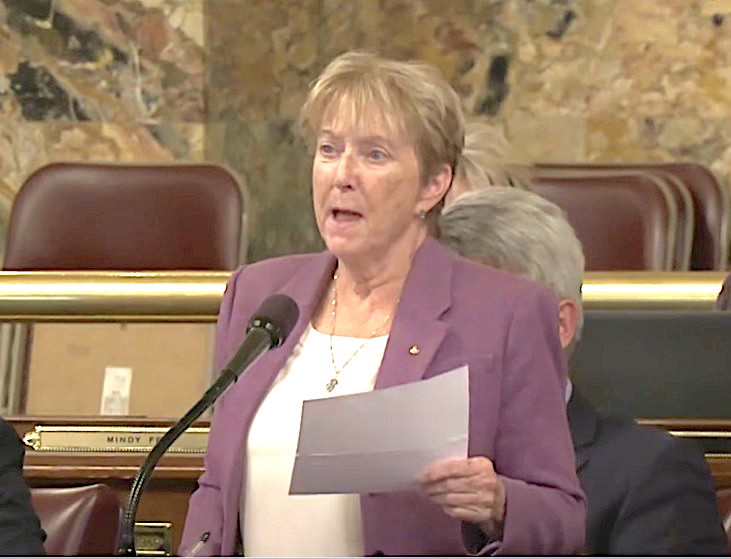
Rep. Kathy Rapp, R-Warren, is pictured speaking on the House of Representatives floor opposing House Bill 1957, a bill to amend the state constitution to enshrine abortion rights.
An amendment seeking to add abortion rights to the state constitution has passed the state House of Representatives – though not without opposition.
House Bill 1957 passed the House in a largely party line vote, though Democrat Frank Burns and Anita Kulick voted against the measure with Republicans Kathleen Tomlinson and Joe Hogan crossing party lines to vote in favor of the amendment. Rep. Kathy Rapp, R-Warren, voted against the amendment and spoke on the House floor against the constitutional amendment because, she said, it would make it possible to perform abortions after the 24-week prohibition included in the state’s Abortion Control Act. She took specific exception to definitions that include allowing abortions if a health care professional, which Rapp said is undefined in the law, could perform an abortion if there is a mental health issue. Rapp also took exception to the possibility of allowing abortions until the point of birth.
“Madame Speaker, I rise in opposition to this amendment,” Rapp said. “Under the current Abortion Control Act, abortions are limited except for the life of the mother beyond and through the 23rd week or the 24th week of pregnancy. The only exception being the life of the mother being in danger. This amendment goes way beyond that, Madame Speaker.”
House Bill 1957 is sponsored by Rep. Danielle Otten, D-Exton, with dozens of fellow Democrats serving as co-sponsors. Otten said she introduced the bill after the reversal of Roe v. Wade in 2022. While abortion and reproductive care remain legal in Pennsylvania, she said the U.S. Supreme Court’s decision in Dobbs v. Jackson prompted her to propose the amendment to explicitly enshrine Pennsylvanians’ right to privacy and bodily autonomy in the state constitution.
“Our bill would give Pennsylvania voters the opportunity to ensure that reproductive liberty is permanently protected in our state constitution,” Otten said in an email to constituents on Friday that was also posted on her House website. “This legislation comes at a pivotal moment in the national conversation on reproductive rights. Since the U.S. Supreme Court’s decision in Dobbs v. Jackson Women’s Health Organization overturned Roe v. Wade in 2022, the authority to regulate reproductive health care has shifted to individual states. In response, voters in more than a dozen states including Ohio, Michigan, Vermont, and California have approved constitutional amendments or ballot initiatives to protect reproductive rights. Our proposed amendment gives Pennsylvania the opportunity to join this national movement.”
The proposed amendment’s text states Pennsylvania can regulate abortion care after fetal viability, unless an attending health care professional is “medically indicated to protect the life or physical health of the pregnant individual.” Fetal viability is defined as the point in a pregnancy when a health care professional determines there is a significant likelihood of the fetus’s survival outside the uterus without the use of extraordinary medical measures.
Rapp said she prefers the approach included in the Pennsylvania Abortion Control Act, enacted in 1982 and upheld in part by the Supreme Court in Planned Parenthood v. Casey. The act regulates abortion by requiring informed consent, a 24-hour waiting period, mandatory state-approved counseling and parental consent for minors, (with a judicial bypass option), prohibiting sex-selective abortions and generally restricting abortions after 24 weeks (viability) except to save the pregnant person’s life or major bodily function.
“Madame Speaker, I find this amendment abhorrent and I ask and state that, in my opinion, that this goes way beyond what we have held in the state of Pennsylvania since the Abortion Control Act was signed into law,” Rapp said on the House floor. “Our Abortion Control Act, even before Roe, was upheld by the U.S. Supreme Court and it still stands today. Madame Speaker, this goes way beyond the boundaries of our Abortion Control Act, which is still law today, and I request and hope that this body will vote this amendment down for the sake of the unborn child.”
Local News

WAHS VEX Robotics Team advances to world championships for third straight year

Limits on vape shops near schools proposed

Trump has one prescription for midterms. House GOP has another
JCC Announces Fall 2025 Graduates
Dr. Jessica Kubiak, vice president of Academic Affairs, and Ron Shidemantle, vice president for Student Experience, ...
Man receives probation; most serious charges dropped
A Warren man has been sentenced to up to two years of probation after pleading guilty to a simple assault charge. ...
