
Vietnam vet Smoulder details how his views of the war have changed over time
Trending
Earlier this year, the Times Observer undertook a series of stories on local coverage of the leak of the Pentagon Papers, which revealed that the government misled the American people about the war in Vietnam.
For generations born since the 1960s, that's a historical venture.
For Blair Smoulder and hundreds of thousands of other veterans of the conflict, it was real life.
"I took out ambush patrols and when there was an encounter, questions about body counts were primary during debriefings," Smoulder, a combat engineer patrol leader who went to Vietnam in 1965 emailed the Times Observer in response to those stories. "'I say thank you Walter Cronkite for speaking out against the war in 1968. I say thank you Mr. Ellsberg for providing the Pentagon Papers to the press. All lives matter. 58,000 plus, many of them friends, gave theirs because of our country's lying politicians."
He agreed to sit down with the Times Observer and share his story.
GROWING UP IN WARREN
Smoulder was born and raised in Warren "below the tracks, a true westender," as he calls it. And while Warren was then -- as it is today -- a Republican-dominated county, that wasn't the case on the west end.
"The west end of Warren, the fourth ward, totally Democrat," Smoulder said. "That's because there were a lot of blue-collar workers, a lot of Italians down there. My mother was second generation Italian.
Transcending political identity, though, Smoulder remembers 1950s and 1960s Warren as a "grassroots town," regardless of political party." After graduating from Gannon University with a degree in marketing, he had some choices to make.
"As I was nearing graduation it was clear that I was going to get drafted," he said. "There was no avoiding it. Vietnam wasn't on the horizon for me yet."
JOINING THE ARMY
Smoulder thought he could enter the Army as a lieutenant with his college degree and, courtesy of Uncle Sam, "travel a little bit…. It was something I decided to do, something I told my mom. She was OK with it. She didn't know about Vietnam coming up either. The next thing I know I woke up in a fox hole in Vietnam."
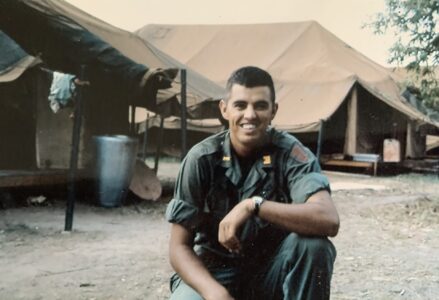
Smoulder reported for active duty in October 1964 at Fort Belvoir, Va. It didn't take long for the Army to learn of his construction experience -- his father was a contractor and he worked construction through high school and college -- and ship him off to combat engineer training.
"It was hard," he said. "I was a marketing major. I was not an engineer."
He also spent time at three different schools -- one learning how to load ships, military intelligence school and Vietnamese language school. Vietnam may not have been on the forefront of his mine when he signed up. By the end of that training, it certainly was -- 22 of the 45 lieutenants in the engineer basic course, Smoulder included, were assigned to the 1st Infantry Division -- The Big Red One.
"The division needed to flesh up," he said. "To get a unit ready for war, there is so much manpower that has to be pushed into it."
Smoulder was part of that manpower.
"It was January of (19)65 when I had to report there," he said. "It was become more and more clear."
He went to Vietnam as a part of Charlie Company, 1st Engineer Battalion.
"I wasn't politically driven at all in those days," Smoulder said.
He locked eyes -- and almost shook hands -- with John F. Kennedy during a campaign stop in Erie. But that was about it.
"I kind of bought into the Domino Theory, to fight communism," he said. "I was pretty superiorly minded in that. We were going to kick (butt) and be home by Christmas. It didn't take me long to figure out that wasn't going to happen."
While the sitcom "Mash" was set in the Korean War, Smoulder said "that was us. Everything that was funny about Mash happened to us in Vietnam."
The Domino Theory was the doctrine that if one country -- in this case, Vietnam -- fell to communism, other countries would fall too. Smoulder wasn't thinking about the politics of what he was involved in while he was in Vietnam.
"We were taught to follow orders," he said. "I joined the Army. I was assigned to this unit. I was to do what they told me to do."
Perhaps the first crack in that perception was the ability to interact with the South Vietnamese who worked as hired help.
"We were able to understand about their families, how they felt about the war. It was neat," he said. "And the thing that always stuck with me, they were just common people. They didn't care about the politics of the war. It was about today and tomorrow and getting by."
RETURNING HOME
When he returned to the states in September 1966, he was confronted with the anti-war movement for the first time, news that wasn't part of the updates provided by the U.S. Army in the field.
He flew into the San Francisco airport with his uniform on.
"I felt very uncomfortable," he said, going into the bathroom and changing into civilian clothes before continuing his trip back to Warren.
"I don't know what gave me the sense," Smoulder said. "For one thing, no one came up and said anything to me. People were indifferent. That's what I noticed. And that was very early" in the war. "I just wanted to come home and forget about it."
He did come home, still "gung ho believed in the cause," he said. "I was glad that I served, glad that I made it."
And while he came home flush with money -- not spending in Vietnam -- his mom eventually started pushing him to get a job. He interviewed at a few places both in and out of Warren.
"I had family and friends at New Process," he said.
He realized he liked being in Warren. He would go on to rise to the level of executive vice president of marketing and operations when he retired. He married Pam Blanks in 1967 and they had five children and now many grandchildren. Smoulder still had a reserve obligation for several years after he returned from Vietnam and it was his young family that prompted a difficult decision.
"I had to resign my commission," he said. "It was hard to resign that commission but we had gotten married, started to have kids. I didn't want to risk having to be called up and I could have been called up. I was eligible for that."
While Smoulder didn't return to Vietnam, he had friends that did. One went back 18 months later and told Smoulder after that tour that he "wouldn't believe how the morale of the troops has diminished."
He identifies that as when his view of the war really started to shift.
"I feel that we were the first warriors to be criticized for going to war," he said. "Wars after that and wars before, the warriors were not criticized. We were simply doing what we were supposed to do."
He remembers Walter Kronkite broadcasting to the nation in 1968 that the war was not winnable. He remembers the Pentagon Papers.
"Just stuff like that slowly began to sway my opinion," he said.
The "coup de grace" was in 1971 when he watched 800 Vietnam veterans take their medals and throw them over the White House fence. Gold Star Mothers did the same thing.
"That was big for me," he said. "It was so volatile then. It was crazy. Cities burning, people against the war, was all over TV. Woodstock. It was tough and the country became something else because of all of that. The free sex. The decline of morality. People not going to church anymore…."
LESSONS LEARNED
Smoulder said he has become more conservative as he has matured, describing himself as a moderate that leans to the right. He's voted for both Obama and Trump, though he said he won't vote for Trump again because of what happened on Jan. 6.
"It's the most divided since the 60s, I think," he said of our current moment. "I think it's worse, growing worse throughout the years. They all say 'I'm going to reach across the aisle.' I think they're all liars."
So how would he explain Vietnam to someone who asked?
"First of all, we were misguided," he said, citing the Domino Theory and the Red Scare facilitated by McCarthyism. "I very strongly bought into that philosophy. I would describe that as how we got into it.
"I would also say that I have a tremendous amount of respect for the North Vietnamese military," he added. "They were fantastic and they were willing to lose as many people as it would take to win. We totally underestimated them. They were fighting for a cause. We were fighting because of communism, I don't know, because we were told to."
It would be 26 years before someone, anyone, would thank Smoulder for his service.
"I had not given that thought, that no one had said anything to me," he said.
Then he was in church and the pastor asked for veterans to be recognized.
"It struck me. I got tears in my eyes…. You just grow to accept it. I had no expectation of that," he said.