
WPC members are recipients of Forest Service awards
Trending
The Western Pennsylvania Conservancy works on projects in Warren County from cleaning up the Allegheny Reservoir to stabilizing creeks and streams to planting trees along streams through farmland.
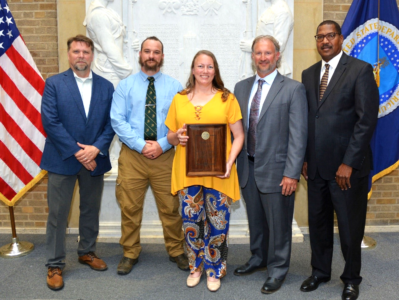
Last week, three members of the WPC Watershed Conservation Program were awarded U.S. Forest Service 2022 National Rise to the Future Awards.
Watershed Program Manager Luke Bobnar, Senior Director of Aquatic Sciences Eric Chapman, and Conservancy Watershed Manager Kylie Maland received the awards for excellence in "Fisheries, Hydrology, Wildlife, Air, and Soil Science Programs" for "their work protecting, studying, and improving the waterways that flow into, through, and out of, the Allegheny National Forest.
"The Rise to the Future Awards honor Forest Service staff and partners for leadership in stewardship… on national forests and grasslands, and recognizes their hard work and dedication to improving our nation's natural resources," according to the release.The Western Pennsylvania Conservancy Watershed Conservation Program is one of the Allegheny National Forest's strongest watershed restoration allies and is a great example of the power of partnership," ANF Supervisor Jamie Davidson said. "I am proud of everything they accomplished over nearly two decades of collaboration with local landowners, farmers, oil and gas operators, and conservation groups to implement watershed restoration projects across our landscape."
"This critical work is key to maintaining the value of the high-quality forests and streams in the Forest, as well as improving aquatic habitat and watershed conditions," Davidson said.
The ANF pointed to some projects the WPC has worked on. "A few projects of note completed over the decades include in-stream projects to slow erosion and improve floodplain connectivity, collaboration with partners to protect and improve more than 3,000 stream miles and plant more than 40,000 riparian trees, and improving watersheds and aquatic communities through large woody material restoration on over 30 miles of streams," according to the release. "A mussel translocation project at the Hunter Station Bridge became one of the largest freshwater mussel restoration projects in North America."
The release also pointed to studies that the Conservancy has conducted or been a part of.
"Scientific studies of note include extensive research on eastern hellbender salamanders, surveys to document the biological, chemical, and physical attributes of Pennsylvania's unassessed waters, and snorkel surveys for freshwater mussels that resulted in the discovery of the presence of the threatened clubshell mussel in Tionesta Creek."