
County commissioner candidates outline positions
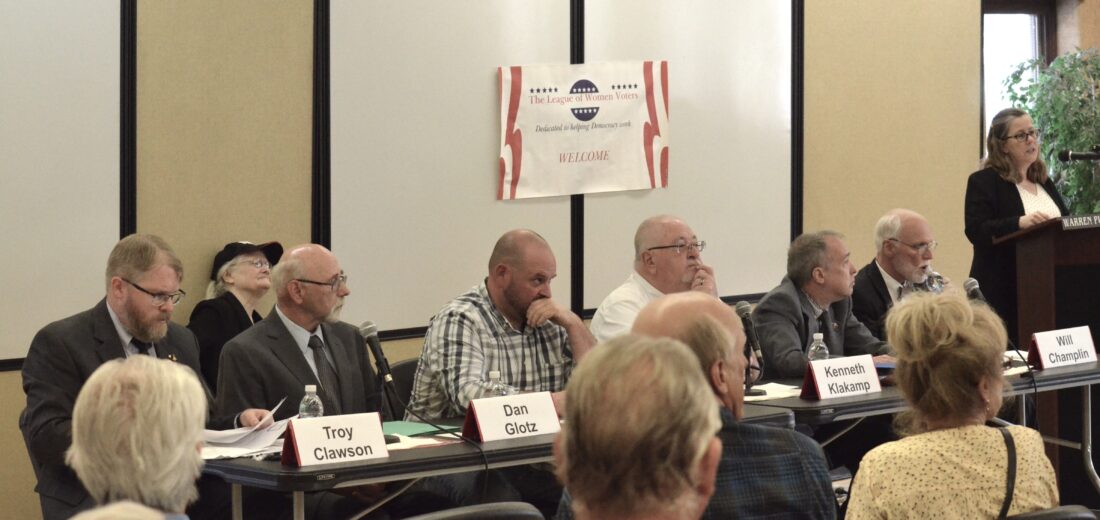
Times Observer photo by Josh Cotton Candidates for Warren County Commissioner that participated in Wednesday night’s candidate forum include, from left, Troy Clawson (R), Dan Glotz (D), Joe Perrin (R), Ken Klakamp (R), Jeff Eschborn (R) and Will Champlin (R).
Six Republicans and one Democrat are looking to move through the primary process Tuesday to serve as the county’s next board of commissioners.
They answered a wide range of questions during a League of Women Voters candidate forum held Wednesday night at the Warren Public Library.
Six of the seven candidates participated in the forum. That included the sole Democrat, Dan Glotz, as well as Republicans Troy Clawson, Joe Perrin, Ken Klakamp, Jeff Eschborn and Will Champlin.
Commissioner Tricia Durbin was unable to participate but the Times Observer presented a series of the questions from the forum to her.
The questions from the form included here are the ones more closely tied to the role of county commissioner.
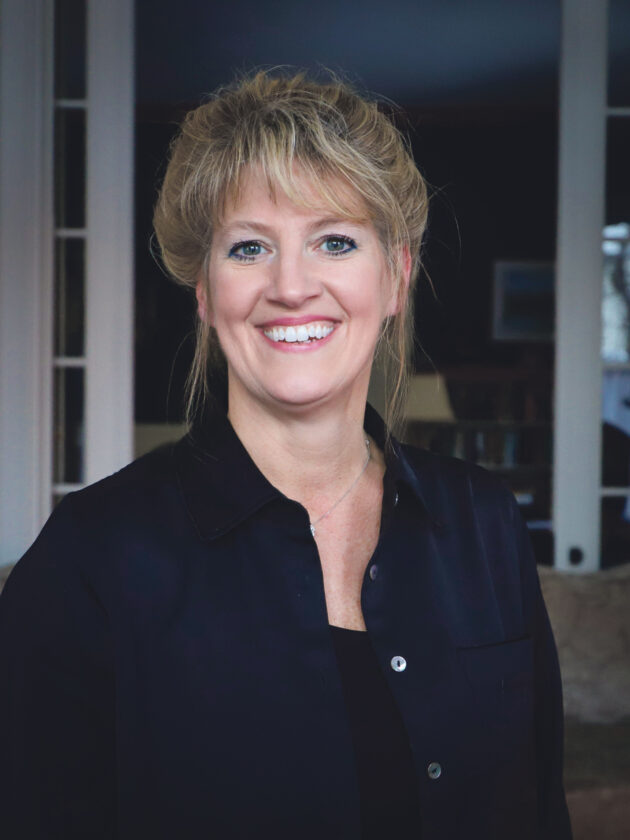
Tricia Durbin
Each candidate was given two questions in advance. The first dealt with what area of county services needs resources should additional funding become available.
Troy Clawson said that “human services wou;d have the most impact” but acknowledged that new funding streams usually come with strings attached. Glotz advocated for an investment in the county’s 911 communications system, highlighting the need to ensure a state of the art system.
Perrin and Eschborn followed Clawson in raising issues of mental health and human services.
“Talking with a lot of the community, we have definitely our share of kids out there… unable to handle their emotions,” Perrin said. “I think they could really benefit from some kind of programming based around that.”
Champlin called for paying down debt and then contributing to promotion efforts in the county.
Klakamp and Durbin both identified expanded high-speed internet access.
Klakamp stressed that he would support broadband initiatives currently on the table if they are “cost-effective” to the end user.
Durbin, the sole incumbent seeking re-election, said broadband was something that she “recognized” as a problem in 2020 when she took office and “part of what I said was needed in rural Warren County.” The pandemic “made it all the more public.”
-
- Times Observer photo by Josh Cotton Candidates for Warren County Commissioner that participated in Wednesday night’s candidate forum include, from left, Troy Clawson (R), Dan Glotz (D), Joe Perrin (R), Ken Klakamp (R), Jeff Eschborn (R) and Will Champlin (R).
-
- Tricia Durbin
The second question answered by each candidate related to barriers that people experience in entering the workforce.
“I think we have what I would describe as a bifurcated workforce,” Durbin said, where some have trouble accessing the workforce for drug and alcohol reasons while at the same time the county has a “low unemployment rate. Anybody who really wants a job can have a job.”
She stressed the importance of working with employers and education entities to ensure technical skill development.
Glotz said that the county “can’t force people to work” and said he has heard two things from employers — that candidates can’t pass drug tests and that there is a lack of a trained workforce. He also highlighted the importance of educational offerings.
Perrin, Klakamp and Eschborn also centered their answer around the drug program.
Perrin added that childcare, transportation and education are related issues, proposing tax rebates to employers for apprentice programs. “It would be nice to see almost a technical school in the area that offer training in the jobs we have locally.”
Klakamp highlighted the severity of the drug program and the “cartel meth that is coming into our county.” He highlighted experience as sheriff starting the school resource officer program in response to the crisis and called for another county investigator.
Eschborn added a need for technical jobs and to “somehow find ways to offer companies incentive to come to Warren County so they can employ these people.”
Champlin said that the “foundation of Warren County’s prosperity is the aggregate of the prosperity of all its citizens” and asked who might enter the county workforce if “better, faster broadband were available county-wide.”
Clawson also highlighted broadband and stressed that the commissioners could bring in workforce development dollars currently going to other counties.
Not every candidate was given the opportunity to answer each of the rest of the questions presented in the forum — which candidates got what questions was determined by a random draw at the beginning of the session.
The first dealt with experience budgeting.
Clawson highlighted experience budgeting for his own business as well as 10 years of public budgeting while serving on Youngsville Borough Council.
Glotz, as the county’s planning director, said part of his role is to set the department budget and is “proud to say I’ve airways held within my budget.”
Durbin has obviously been involved with the last few county budgets as a commissioner and said she’s overseen budgets as small as $800,000 and as high as $356 million in her professional career as a fiscal officer. “I’m always one that’s focused on process improvement, doing more with less.”
The next board of commissioners will be tasked with implementing a county-wide property tax reassessment initiated by the current board.
Perrin called it “bad timing to do any kind of tax assessment.
“I know we’ve been pushing it down the road,” he said. “The way the economy is going and such, I feel it’s something we can hold off on.”
Klakamp stressed that the contract has been signed.
“The main thing that needs to occur is the messaging to the public to keep them informed,” he said.
“It’s gotta be revenue neutral,” Champlin stressed. “The county is doing the right thing by taking the initiative.”
Champlin and Glotz were asked about what can be done to address issues of population decline.
“My vision is simply the outreach,” he said, to make Warren County the “best-known asset in northwest Pennsylvania.”
Glotz stressed that it’s not a problem “unique to Warren County.
“It’s going to take a group effort,” he said, and require elements like expanded internet as well as “agencies coming together to give us some sort of a model, a catch phrase to draw folks into the region.”
Eschborn and Klakamp were asked about changes that may need to be made from an elections perspective. The commissioners oversee the county’s election operation.
“I think changes should be made at every level,” Eschborn said. “I do believe that the 2020 election was not an honest election. I’m not saying it was stolen from the president. I do think there was infidelity.”
Klakamp attempted to draw a distinction between how elections are conducted locally and regulations at the state and federal level that govern those operations.
“(Our) elections office does a fantastic job. I know I have not seen any issues with that office,” he said. “However, I believe that federally… there does need to be improvements but not at the local level.”
Perrin and Glotz were presented a question that dealt with the scope of human service and mental health resources in the county.
Perrin said that the current system is not “meeting the current needs…. I believe there are people falling through the cracks.”
Glotz acknowledged that the “system is severely stressed” and that “there’s a shortage of providers…. We have to come together and evaluate where we are willing to sacrifice funding in order to beef up the funds necessary” for this space.
The commissioners also set the budget for the county jail. So what can be done to reduce costs and recidivism?
Klakamp highlighted a work program that he implemented when he was warden that paired inmates with municipal and non-profit help.
“The thing that amazed me, when those inmates… recognized they have skills, and marketable and good skills, they just needed that encouragement.”
Durbin said a pre-trial program aimed at keeping people out of jail while awaiting trial has brought the prison population down. “(We) don’t always have the opportunity to give additional guidance to people once they leave incarceration,” he added. “There are other programs that are out there that have been tested. I think there’s some opportunities there.”
Clawson stressed the importance of focusing on treatment rather than imprisonment. “Sometimes people need mental health treatment and (are) thrown in jail or prison. (That’s) not going to help rehab.”
EMS and fire services are provided at the local level but the system is in crisis.
Champlin called for more state funding to the municipalities to support those services while Eschborn said enhanced training is needed to “make it more readily available and easy to obtain.”
Klakamp said he’s a life-member of a VFD and an EMT and EMT instructor and highlighted state regulations as a challenge “our volunteers are facing.”
Candidates were also asked how to increase public and community engagement.
“Volunteerism today is at an all-time low,” Glotz said. “Oftentimes, the best result is if (we) approach people one-on-one to volunteer.”
Clawson agreed. “One of the biggest things I’ve known — I got asked. I showed up and never left. Leaders lead by example. Commissioners are members of lots of boards. I’m going to continue to do that.”
Durbin also noted the number of boards that commissioners sit on. Encouraging volunteerism, she said, “even goes back farther, taking children still in school and have them volunteer for things.”
Part of governing is relationships and candidates identified several different relationships that they believe most central to doing the job.
Durbin said it’s been helpful to engage with members of the Northwestern County Commissioners Association. She said it’s an opportunity to “engage with some of the things they learn differently” and explore best practice to bring back
Perrin said the relationship with law enforcement would be most important while Clawson said that “local would be important first,” raising efforts with the Council of Governments, working and listening with other municipal officials. “Those are the important relationships you have to start with and go out from there.”
Everyone seems to recognize faster internet in rural Warren County but there’s a fundamental question — how?
Clawson said he has worked with Youngsville TV and “know a lot of the hurdles and a lot of the pitfalls.”
He proposed a county-wide plan that “will cost the taxpayers zero” by entering into public-private partnerships that then work with private equity groups to raise the funding.
“Everybody in the county should have it,” Eschborn said, explaining that he would ask constituents if they are happy with their service and then go to the authorities to see how the system can be improved.
Durbin said this is an issue the current board has “had lots of conversations about.”
“(We) need to understand and have infrastructure laid out for us,” she said, highlighting an agreement entered into with a consulting firm that “takes a look at what our real broadband deficiencies are.” The goal, she said, would be to create a plan so the county can get to the “front of the row for all the federal and state funding that we can get.”
It’s been several years since taxes have been raised at the county level. Several candidates responded to whether a tax increase is something they could even consider.
“I’m not a big fan of raising taxes at all,” Durbin said. “(I’m) all about finding process improvement, find ways to do more with what we have.” She said she’d consider a tax increase if she could “make sure those dollars that were spent in increases had a meaningful impact on the residents of Warren County.”
Eschborn said he would agree to increases “as a last resort.
“People in Warren County as it is right now are only living day to day,” he said. “I don’t want to see that being jeopardized any more than it is.”
“I believe in fiscal responsibility,” Clawson added. “If the need is there and it’s justified, it might have to happen.”
In closing, Champlin highlighted his “professional career in healthcare, business and finance” and said he’s been a “life-long Republican” and “fiscal conservative.”
“I do promise I will do it as a full-time job,” Eschborn said of the job.
Klakamp highlighted 43 years in county government service.
“I understand the issues facing our county,” he said. “We’ve lost our tax base. We need to be aware of that.”
“We’re in one of the best counties there is,” Perrin said, noting that many of the area’s issues have been “kicked down the road for decades.”
He said the office of the commissioner should be full-time — “I just don’t think we should settle for anything less.”
Glotz emphasized 33 years experience in county government as well as 21 facilitating regional transportation planning and 18 running the Council of Governments as well as currently serving as president of the Route 6 Alliance.
Clawson and Durbin raised other issues that did not come up in the forum.
Clawson argued that tourism is a “gigantic part of Warren County” both now and in the future. Serving on the Warren County Visitors Bureau board, he has “Seen the numbers skyrocket…. Tourism has changed for the better and we need to continue to promote it.”
Durbin raised issues of economic development.
“The commissioner’s role is not primary economic development,” she said, but argued that it is a “huge driver” for the county’s tax base.
She said she would be supportive of using “discretionary funding to assist with an economic development idea” that would have a positive “return in the community.”
Local News
Active intruder exercise to be held Monday at Eisenhower
The Warren County School District is hosting a multi-agency active intruder exercise at the Eisenhower campus on ...
Youngsville Life: ‘Alumni Lunch’ planned for July 14
Please email community news to Colette Nelson at Colettenel.ypl@gmail.com by Wednesday of each week to be included ...
Kane’s Art in the Wilds returns June 27-28
KANE - Art in the Wilds returns to Kane’s Evergreen Park for its 20th year on June 27 and 28. “For twenty ...
Leading the Pack
Bail modification denied in Spring Creek man’s case
A bail modification has been denied for a Spring Creek man who faces charges of aggravated assault and discharging ...
School district summer food program starts Monday
The Warren County School District (WCSD) will launch its Summer Food Service Program (SFSP) Monday. This ...