Options include relocating Sheffield, Youngsville high schools
There are now options on the table.
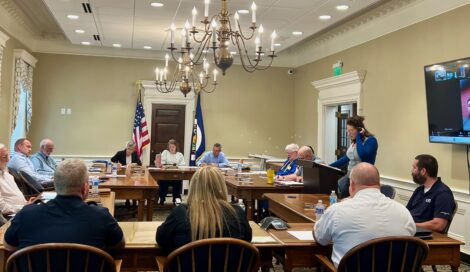
At a public input session Wednesday night, visitors brought their ideas for school reconfiguration and made it clear which ideas they did not like. Before the meeting, district officials had repeatedly said there were no options on the table and no options that were off the table.
That is no longer the case.
In addition to ideas formulated by board members, administrators, and citizens, a document prepared by Thomas and Williamson details two options for high school reconfiguration – “relocate Sheffield 9-12 to Warren” and “relocate Sheffield 9-12 to Warren plus relocate Youngsville 9-12 to Eisenhower.”
Superintendent Amy Stewart said the district had asked consultant Thomas and Williamson – which handled previous steps in the master facilities planning process – for its recommendations and received them recently.
“I got the product last week, and it was shared for the first time last night,” she said.
PUBLIC COMMENT
The school board set up public meetings to ensure that citizens at large had the opportunity to weigh in on the reconfiguration process. More than 100 people were in the gymnasium at the district’s central office – formerly Russell Elementary School – shortly after 6 p.m. About 15 people signed up to speak at the meeting and another 10 submitted written comments which were read by Stewart.
“I would like to ask the board members to be sure that they have all the pertinent data,” Victoria Hollis said. “Get the answers to the questions and concerns they hear today.”
With the district citing a building utilization study, some of the commenters suggested that open spaces in school buildings be filled by administrators.
“Close and sell the most underutilized (by students) building – central office,” Carl Lewis said.
He suggested that teachers could be freed up to lessen the load by eliminating the district’s Virtual Academy and reassigning those teachers.
Tom Holden suggested that the district’s attendance area boundaries could be redrawn to help more equally balance attendance at the high schools. “Why not spread out some kids and let them get picked up?”
Concerns about possible closures dominated the comments.
“If your plan goes through, we’ll have tons of kids that are going to be just forgotten about,” Dan Sullivan said. “You as a board are going to have to ask yourselves… ‘Do these kids matter?'”
“Our children are amazing,” Kelly Sullivan said. “They are not a number on a piece of paper. They are the ones that are going to be affected by this.”
“I don’t think you’ll find many people who disagree that some consolidation is required,” she said, and suggested that Youngsville Middle/High School could be turned into a K-12 center like those at Eisenhower and Sheffield.
With respect to closing Youngsville and/or Sheffield, she said, “I think the district would look at transportation cost or the time on the bus these students will endure…” and said studies show long rides lead to a “decrease in academics and increase in absenteeism.”
“Small schools offer many opportunities,” Walter Cook said. “They are quicker and easier to get to. There are greater opportunities to participate in and attend activities.”
“Research shows that smaller schools outperform larger schools,” he said.
“I am not sure why the school board would want to destroy what is working so well in each community,” Cook said. “Why would they seek to destroy student and community pride?”
“Has anyone asked the students how they would feel if they were ripped away from their small towns where they were happy and felt connected?” he asked.
One student told of his experiences at both Warren Area Elementary Center and Youngsville Elementary School.
At Warren, “you barely got any one-on-one time with teachers,” Wyatt Lewis said. Youngsville “is way smaller. I got way, way more one-on-one time with my teachers. I could walk to school or ride the bus.”
“There’s no reason to close Youngsville or Sheffield schools,” he said. “That’s all I have to say.”
Sheffield Area High School junior Peyton Bailey said she is on track to be valedictorian of her class and possibly receive scholarships that go with that honor.
“Being sent to a larger school would take those opportunities away from me,” she said.
“Most of Sheffield’s high school classes have been in the same class since kindergarten,” she said. “They have been used to small classes. Moving them to a school with a graduating class of 162 would be unethical at best.”
“Moving students to a larger school will impact students socially, mentally, academically, financially, and physically,” Bailey said. “You need to formally interview us students.”
Retired Sheffield and Eisenhower teacher Annie Cook said she went to school in Bradford before moving to Sheffield.
“I was completely lost in that huge school,” she said. “No one talked to me. No one made me feel special in any way.”
At Sheffield, “I found myself in a high school where every student was important,” she said. “I had an opportunity to get to know my classmates and my teachers as well. For the first time, I witnessed school pride. They made me start to feel school pride as well.”
Kyle Young pointed to transportation, saying he moved back to Youngsville so his daughter could walk to school. “I cannot imagine busing my daughter over an hour to go to another school,” he said.
Wendy Doneyhue said offering more classes by bringing students together could be desirable, but “some of the classes in some of these schools are quite large.”
She also pointed out that while a larger school’s athletic teams “might” be more competitive, “you have more opportunities for more players” at smaller schools.
“I know your biggest concern is education. I’m (also) concerned about their health and well-being,” Kari Smith said. She said the impact on students from closing schools would be long-lasting, “extremely traumatic and detrimental.”
Carl Lewis said the schools and communities are inseparable.
“This is harmful to our county,” Kasey Smith wrote. She said school closure would have a domino effect, starting with a “decline in property values,” leading to “population will further decline.”
“Warren County needs communities,” Melanie Lewis said. “Warren County derives value from the sum of its parts.”
STUDENTS UPSET
Some informal, community surveying of students was conducted – including asking questions about their mental health since they heard about the possibility of a school closure – and the resulting letters were read by Stewart.
“Going to a larger school would have a (major) effect on my mental health,” one said. “I know my mental health (problems) would skyrocket if I were asked to go to Warren.”
“I would like to say that I think this plan is a horrible idea,” the student said. “Don’t take our school away from us.”
“I’m pretty upset you’re… shutting down our schools,” another said. “You’re taking away the achievements these schools have made over the years. We want to keep our schools and we will do whatever it takes to do so.”
“I felt more upset recently because I don’t want to switch schools,” a third said.
“I think closing schools is dumb,” another said. “It would not be good and everyone would feel out of place. In the long-run, everyone will leave and it will hurt everyone in the whole county.”
“Don’t do anything to the schools. Nothing is wrong with the schools,” a student said. “It’s important because this is where a lot of kids have grown up.”
“It’s close to where I live,” another said. “My friends go there. I don’t want more people in my class. I have felt sad, mad, and nervous.”
“It feels like home,” another said.
“There is an election coming,” Tom Holden said. “Things are going to change next year.”
“Five spots are opening up in May for school board,” he said. “This is all going to change. How can you push a proposal through in this short period of time and look everybody in the eye?”
Local News
Bicyclist taken to hospital after mishap
Commissioners agenda includes 911 recognition
The Warren County Commissioners will meet at noon Wednesday in the Jackson Courtroom of the Warren County ...
Temporary signal installed on Scandia Road
The Pennsylvania Department of Transportation (PennDOT) is advising drivers to be alert for temporary traffic ...
Team efforts

Warren, McKean county businesses eligible for facade work