State energy debate enters cautiously optimistic era
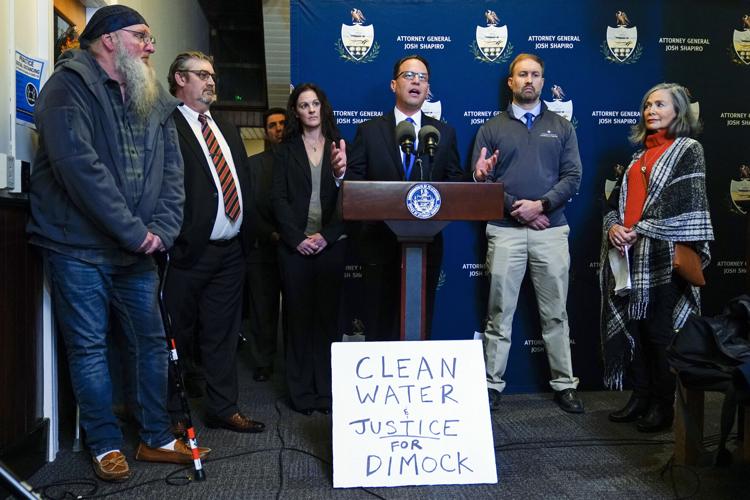
AP Photo Former Pennsylvania Attorney General Josh Shapiro, center, speaks with members of the media during a news conference at the Susquehanna County District Courthouse in Montrose, Pa., in 2022. Shapiro became Pennsylvania’s 48th governor on Jan. 17, 2023.
Though warm feelings of bipartisanship quickly fell apart in the state House earlier this month, hope remains for a working relationship between Senate Republicans and Democratic Gov. Josh Shapiro.
On issues like energy and the environment, one key senator struck a hopeful tone in the hours after Shapiro swore the oath of office.
“I look forward to working with the new governor and hope he will be a reliable partner in the ongoing effort to balance our environmental responsibilities with our energy needs,” said Sen. Gene Yaw, R-Williamsport, who chairs the Senate Environmental Resources and Energy Committee, in a statement released Tuesday.
“I believe there are opportunities to work with the governor to advance commonsense energy policies that create jobs for workers and lower prices for customers,” Yaw said. “I believe we can find some common ground with the new governor on policies intended to defend our environment and ensure future generations can benefit from the commonwealth’s natural assets.”
During the campaign, Shapiro distanced himself from former Gov. Tom Wolf’s years-long battle against legislative Republicans to enter Pennsylvania into the Regional Greenhouse Gas Initiative (RGGI).
RGGI, an 11-state cooperative – including nearly every one of Pennsylvania’s neighbors to the north, south and east – charges power producers for greenhouse gases emitted from their facilities and then reinvests the proceeds into projects and programs that support improved air quality or energy efficiency.
Republicans have long opposed RGGI as a threat to Pennsylvania’s status as the region’s top power exporter and said the administration’s estimated $410 million revenue constitutes a tax on the industry that will trickle down to ratepayers.
It’s anticipated the battle, currently working its way through the court system, will enter a new phase under an “ambivalent” Shapiro administration.
Shapiro has questioned the efficacy of RGGI in reducing greenhouse gas emissions and told trade unions he didn’t support the program, fearing its impact on the state’s economy.
He also expressed doubts in late 2021 as attorney general and did not directly address RGGI on his campaign website, either. Instead, he argued for an all-hands approach and has pledged to be an “all-of-the-above energy governor.”
Shapiro’s plan doesn’t specifically mention fracking or natural gas, but instead focuses on investments in clean energy and zero-carbon technologies to create jobs. He wants renewable resources to generate 30% of Pennsylvania’s energy by 2030 and hopes to achieve net-zero emissions by 2050.
Hitting Shapiro’s 30% target will be difficult if nuclear power is excluded. Of Pennsylvania’s total energy production, 89.5% comes from coal, oil, and natural gas, 8.4% ? comes from nuclear power, and almost 2% comes from renewables, according to the Energy Information Administration.
Pennsylvania is the second-largest natural gas producer in America after Texas, and the third-largest coal producer. It’s also a leader in nuclear power, second only to Illinois.
For electric power, 39% still comes from coal, 34% from nuclear, and 24% from natural gas.
Local News

Warren County receives Trail Town recognition

Warren’s Tellmann made mark in Milwaukee
Judge denies motion to dismiss charges against Sugar Grove man
A judge has ruled against a motion to dismiss the charges filed against a Sugar Grove man accused of ...

Jamestown native works on NASA’s Artemis II, receives special invite to launch

Warren to host new U.S. Forest Service regional headquarters amid national overhaul