
Fill among 10 county men to leave for service in Navy in 1943
-
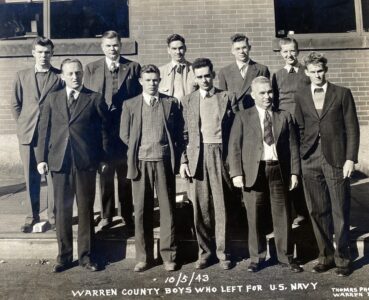
- Photo provided to the Times Observer These men left for service in the U.S. Navy in Oct. 1943. George Fill is back row, second from left.
-
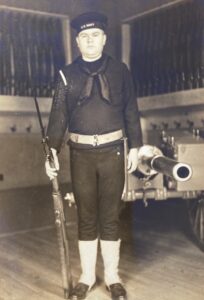
- Photo provided to the Times Observer Seaman First Class George Fill.
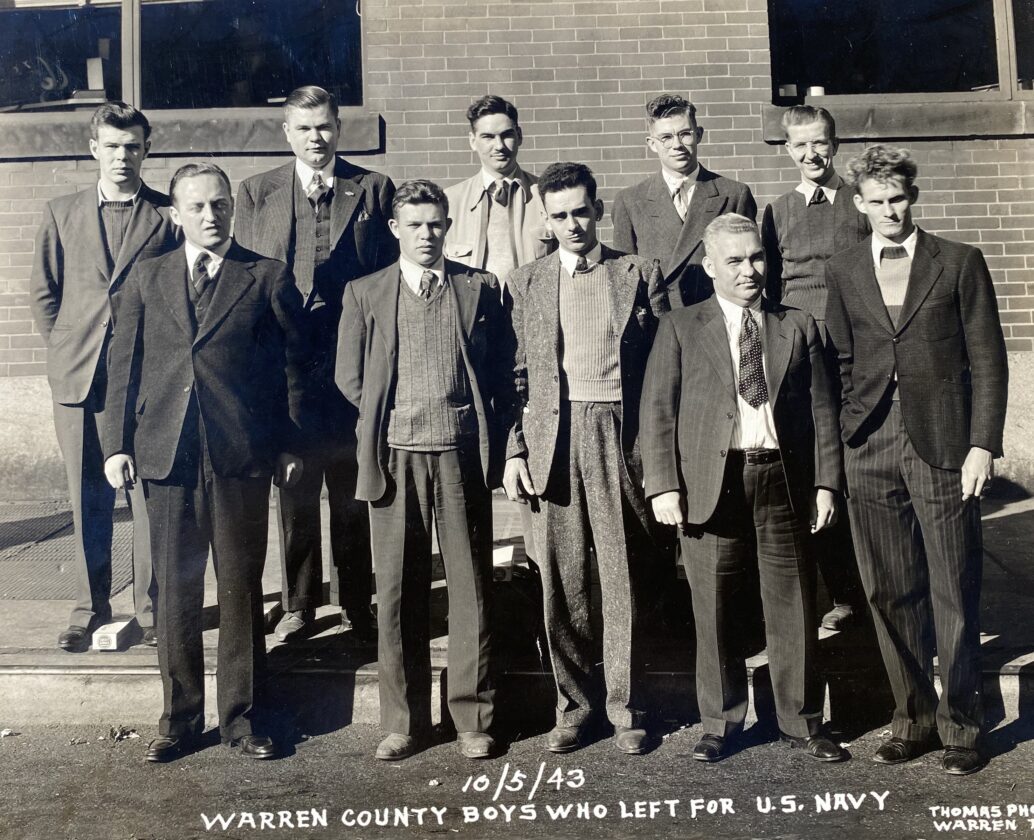
Photo provided to the Times Observer These men left for service in the U.S. Navy in Oct. 1943. George Fill is back row, second from left.
George Fill was one of 10 men from Warren County who left for service in the U.S. Navy on Oct. 5, 1943.
Fill was born in Monessen, Pa. on April 21, 1916, the son of Joseph and Victoria Fill, who came to this country from Poland and Russia/Ukraine, respectively.
When he was 3-years-old, Joseph bought a farm on Davey Hill outside Tidioute and that was where George was raised.
It was a modest childhood but by all accounts a happy one.
Flash forward to the outbreak of war and Fill could be found working as a machine operator at National Forge.
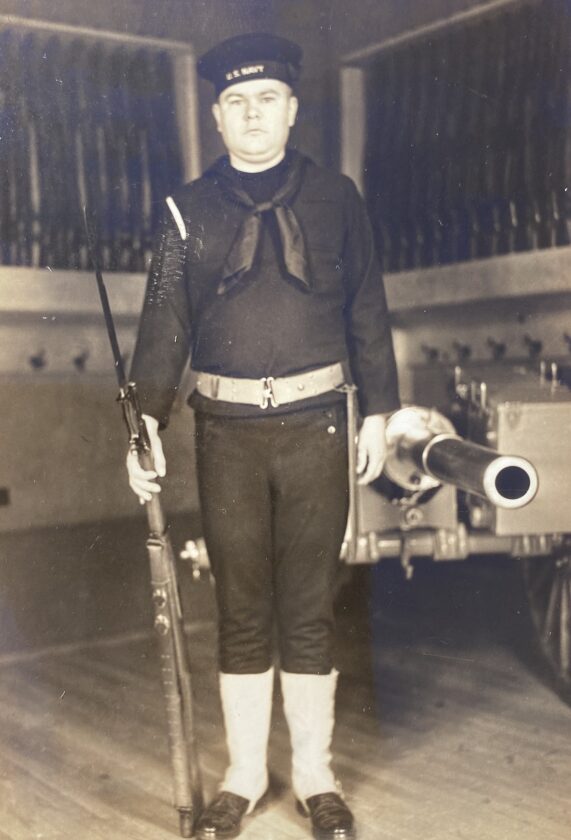
Photo provided to the Times Observer Seaman First Class George Fill.
He was drafted into the service in 1941, reported for duty and rejected due to his war production capabilities in contributing to the manufacture of periscope tubes and gun barrels.
Six months later? Drafted again and rejected for the same reason.
And again.
And again.
The process played out four times before Fill was accepted into the service in Oct. 1943.
He was sent to the Great Lakes Naval Training Station in Chicago for basic training before he was stationed on an LST, landing ship tank.
According to the U.S. LST, landing ship tanks were a unique creation of the Allies during World War II.
“It supported amphibious operations (ship to shore) by carrying tanks, mechanized vehicles, supplies, cargo, smaller landing craft, and most notably–landing troops directly onto enemy shores,” the Association explains. “They were designed to land on virtually any type of shore that had a gradually sloped beach due to their specially designed hull and flat bottom.”
Fill was first assigned to an LST but a training accident resulted in a hernia and he was ultimately assigned to LST 965 in the Pacific Theater.
His service took him back and forth across the Pacific Ocean eight times and included participation in the invasions of Saipan and the Philippines as well as the occupation of Japan.
Over three million men served in the Navy throughout the course of the second World War. Many of those service records would read very similarly to what has been written here about Fill’s experiences – a manufacturing job before the war, getting drafted, going to the Pacific or Europe.
Fill was discharged in December 1945 and awarded the Victory Medal, American Campaign Medal and Asiatic Pacific Medal, the three most common that a sailor could earn.
And like millions of men, he returned to his home – and the Forge – started a family and raised that family in Warren County.
It’s easy to lose sight of the individual stories of the men of the Greatest Generation.
But Fill’s story isn’t lost.
And he has his son, Tom, to thank for that.
Fill shared the image, which appears to have been taken at the War-Penn Building across the street from the post office, with the Times Observer because he’s got questions.
He knows which one is his father – back row, second from left – but nothing about anyone else in the image.
“There’s a lot of stuff he told us,” Tom said. “A lot of stuff he didn’t. A lot of stuff he kept to himself.”
Some of the stories are funny.
In the midst of those Pacific crossings, Fill was onboard a ship with a teetotaler – someone who didn’t drink alcohol. There were 250 cases of beer on the ship that no one could drink.
And Fill was not a teetotaler.
“He said that was the only thing that irritated him about the war,” Tom said.
Some of the stories were series.
A 5 inch shell struck the ship that Fill was originally assigned to and killed 17 men. He also went sightseeing on Saipan, running the risk of courtmartial, and witnesses citizen suicide there.
He also spent a week in December riding out Typhoon Cobra which enveloped the Pacific Fleet for days in December 1944.
“My dad just talked about that constantly,” Fill said, “riding that typhoon.”
He also told his family about how he had a close friend on the ship from Tennessee and they would go on the deck of the ship at night and pray the rosary. That man found George decades after the war and came here to visit him.
Coming back to the states with the war over, Tom said his father kept all of his military memorabilia in a suitcase. Those documents, books and images continue to be preserved.
“He had a lot of pride in what he did,” Tom said of his father’s service. “He talked about it up until the day he died.”
Seaman First Class George Fill died in 2002 at the age of 85.
And while Tom has learned a lot, it’s the faces in that draft day photo that still pique his interest.
Who are the other men?
Did they survive the war?
That’s what he’d like to know “just of curiosity.”
If you recognize any of the men in the photo, please email jcotton@timesobserver.com.
Local News
State Police honor service, heroism in ceremony
The Pennsylvania State Police (PSP) this week hosted its annual department awards ceremony at Bishop McDevitt High ...
Strike up the bands
County approves 18 reassessment challenges
Warren County has reached tax assessment settlements with 18 property owners representing roughly one-third of the ...
Trump to headline McCormick’s Defense and Innovation Summit
Board cheers season for Unified Sports
RibFest returns to downtown with food, music and events
The smell of barbecue and the sound of live music will once again fill downtown Warren as RibFest returns to ...