Child care tax credit proposed
-
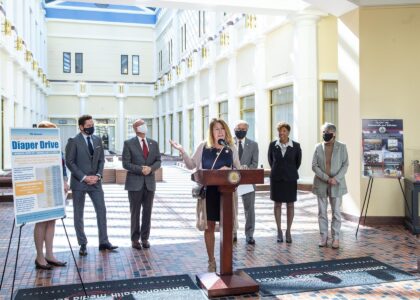
- Rep. Tina Davis, D-Bucks, speaks inside the state Capitol in 2021 to discuss “Diaper Need Awareness Week.”
-
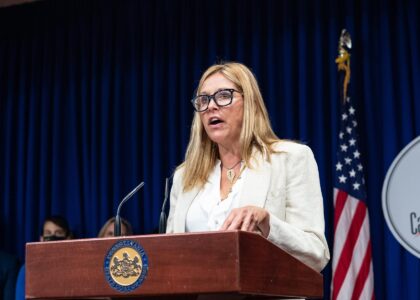
- Rep. Melissa Shusterman, D-Chester/Montgomery, is pictured speaking at a news conference earlier this year.

Rep. Tina Davis, D-Bucks, speaks inside the state Capitol in 2021 to discuss “Diaper Need Awareness Week.”
Two House members are proposing spending $10 million for a child care tax credit.
Reps. Tina Davis, D-Bucks, and Melissa Shusterman, D-Chester/Montgomery, have introduced House Bill 2737 to provide a tax credit for families whose day care costs are more than 10% of their taxable income. The tax credit would be capped at 20% of total day care costs or $5,000, whichever is lower. The total cost to the state would be $10 million, according to the bill text.
“As more people return to work, many families are facing a tough decision–should both parents head back to the office?” Davis and Shusterman wrote in their legislative memorandum. “With the rising costs of child care, caregivers, who are typically mothers, are delaying their return to the work force. As of September 2021, nearly 1.6 million mothers of children under 17 have not returned to their jobs. One of the top reasons? It is more cost-efficient to remain at home rather than pay for day care or summer camp.”
A 2020 study by Philip Sirindes of the Institute of State and Regional Affairs at Penn State-Harrisburg and Gregory Collins of Muhlenberg College found a range of child care costs across the state with some providers charging less than $200 a week per child and others charging more than $500 per child, with an average of about $290 a child statewide.
In October, Gov. Tom Wolf announced changes to the state’s Child Care Works program to decrease costs for families qualifying for incentives and to add incentives for child care providers. Changes were paid for with federal stimulus funding.
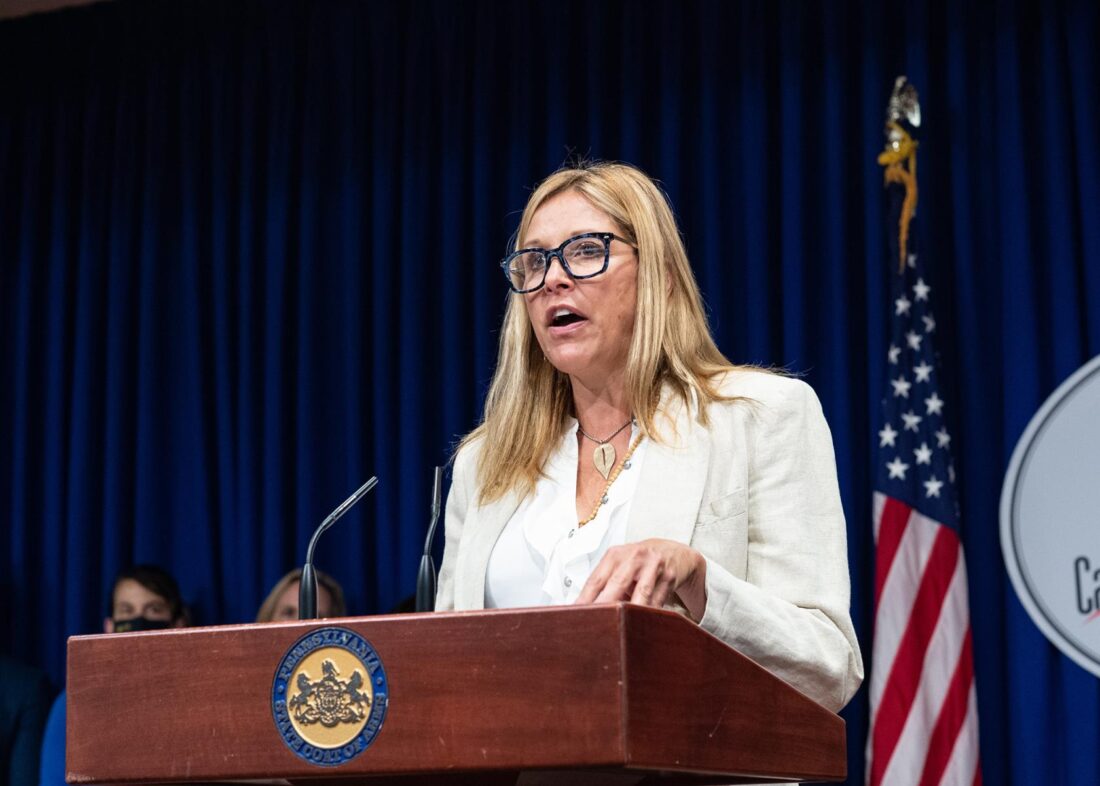
Rep. Melissa Shusterman, D-Chester/Montgomery, is pictured speaking at a news conference earlier this year.
Beginning January 1, 2022, $352 million in Child Care Development Fund federal ARPA funding is being used to lower maximum copayments for families eligible for Child Care Works, with $121.9 million used to reduce the maximum family copayment for families participating in subsidized child care to be closer to federal recommendations. The state also increased base rates for providers participating in Child Care Works, with $213.7 million spent increasing base rates paid to subsidized child care to the 60th percentile compared to the private pay market rate. The change brings Pennsylvania closer to the federally-recommended 75th percentile. Another $16.8 million is being spent to create incentives for providers offering child care during non-traditional hours.
Davis and Shusterman said child care for one child in Pennsylvania averages almost $12,000 annually. They also cite a 2021 survey showing 85% of parents are spending 10% percent or more of their household income on child care.
“By providing this credit, we hope to ease the burden of child care cost while simultaneously encouraging women to return to the work force and aid in decreasing the labor shortage,” Davis and Shusterman wrote.
At the same time, Rep. Morgan Cephas, D-Philadelphia, has proposed three bills focused on child care costs. House Bill 2738 would create a tax credit for employers who provide employee child day care. Cephas also proposes (House Bill 2739) changing the Child Care Works program so a parent who is not employed but who is enrolled in a postsecondary education program or a workforce training program is eligible for child care assistance for at least two years of the postsecondary education or workforce training program as long as the parent meets all other eligibility requirements. Counties would be able to give priority for services to a working family over a family enrolled in postsecondary education or workforce training, and its provisions would only be effective subject to available funding. House Bill 2740, meanwhile, would require postsecondary educational institutions to consider a student’s child care expenses when calculating decisions on the amount of financial aid that a student is eligible to receive. The bill would apply to Pennsylvania State System of Higher Education (PASSHE) institutions, state-related institutions (Pennsylvania State University, University of Pittsburgh, Temple University, and Lincoln University) and community colleges.
“According to a 2018 report issued by the Institute for Women’s Policy Research (IWPR), 51% of independent college students in the U.S. are parents of children under 18,” Cephas wrote in her legislative memorandum. “The majority of these student parents have an unmet financial need after utilizing all family contributions, grants, and need-based aid. As such, these students often must work at least part-time to cover child care and other basic expenses, leaving less time for school and lowering the likelihood of degree attainment. This is why I will be introducing a bill package designed to better provide for the child care needs of parents, including parents who are seeking to better their lives through higher education or workforce training, or those who are employed.”
Local News
Recent gifts made to Warren Public Library
The following gifts have been made recently to the Warren Public Library: - In honor of Sharon Aldrich and ...

35 Years of Laughs

Nonprofits want legislators to keep skill games legal
Northwest Bank property included in new reassessment decreases
Another $3,454,677 is set to come off Warren County’s newly reassessed tax rolls as that latest round of ...
Four charged in two separate drug investigations
Four county residents face drug charges after two investigations into alleged drug trafficking in Youngsville and ...