Little remains of estate 50 years since demolition
-
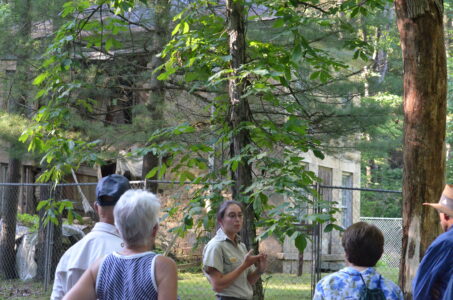
- Times Observer photos by Josh Cotton ANF District Archaeologist Zaakiyah Cua speaks during a tour of the Irvine-Newbold mansion held last week. The structure in the background is one of several stone houses built as part of the estate specifically to house the workers needed to make the estate operate.
-
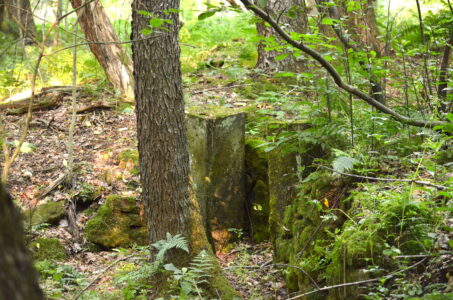
- Several field stones are all that remain of the once-grand Irvine-Newbold mansion.
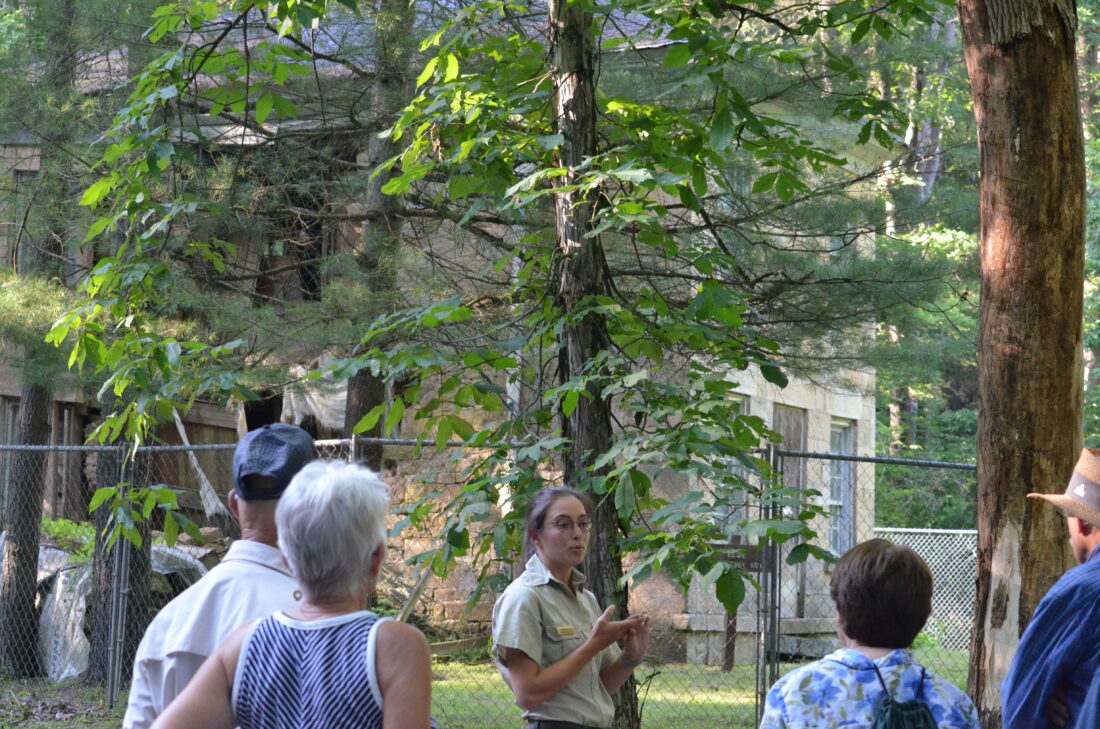
Times Observer photos by Josh Cotton ANF District Archaeologist Zaakiyah Cua speaks during a tour of the Irvine-Newbold mansion held last week. The structure in the background is one of several stone houses built as part of the estate specifically to house the workers needed to make the estate operate.
Last week’s tour of the site of the Irvine-Newbold estate is a look back at what once was.
But it’s also a reminder of just how quickly nature can take what belongs to it if given the chance.
About 20 people took part in the tour last Thursday sponsored by the Warren County Historical Society and presented by Allegheny National Forest Archaeologist Zaakiyah Cua.
The estate is located in the woods off of Dunns Eddy Road and fronts the Allegheny River.
The Irvine family claimed ownership of the grounds after General William Irvine first scouted the area in 1787. He selected a large portion of the area along the Allegheny River for his family. A sprawling estate was erected and quickly became the picture of prosperity.
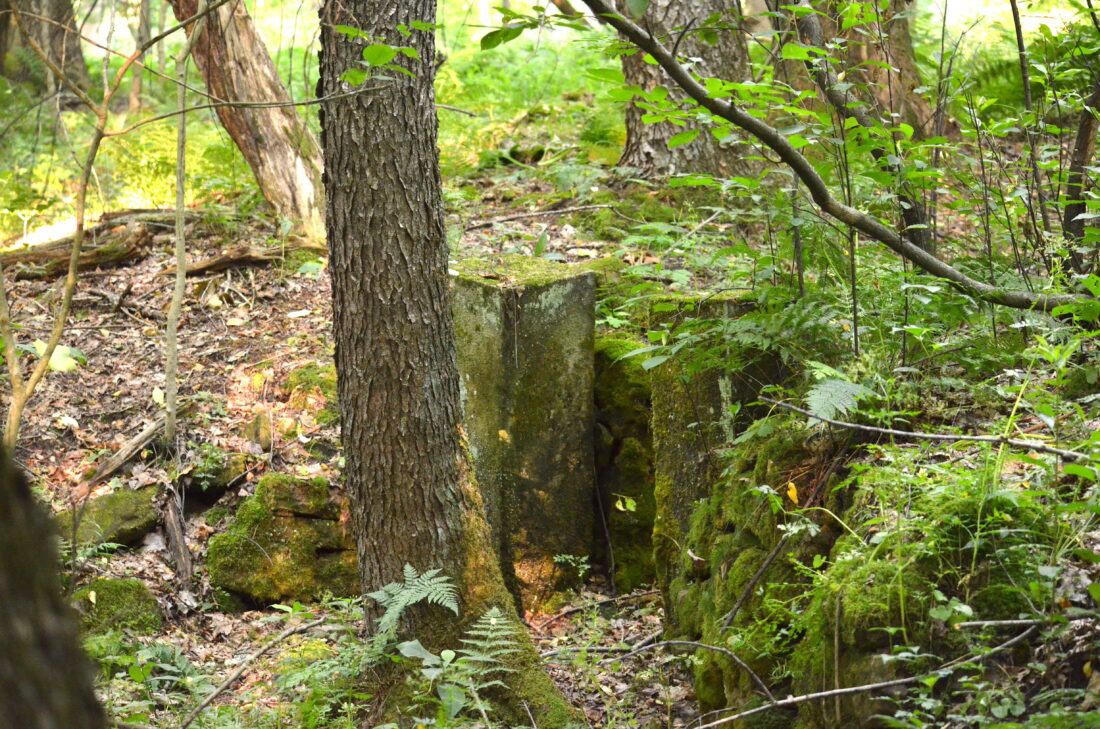
Several field stones are all that remain of the once-grand Irvine-Newbold mansion.
-
- Several field stones are all that remain of the once-grand Irvine-Newbold mansion.
-
- Several field stones are all that remain of the once-grand Irvine-Newbold mansion.
-
- Times Observer photos by Josh Cotton ANF District Archaeologist Zaakiyah Cua speaks during a tour of the Irvine-Newbold mansion held last week. The structure in the background is one of several stone houses built as part of the estate specifically to house the workers needed to make the estate operate.
Cua, district archeologist for the Bradford Ranger DIstrict, said the property, 1,000 acres, was sold to the National Forge in 1963 and that the mansion — which had fallen into disrepair — was demolished in 1973.
She explained that the Western Pennsylvania Conservancy purchased the property. From there, the ANF purchased some of the property from the Conservancy, resulting in the current ownership of the estate with some land in state, federal and private hands.
The state property, the Anders Run Natural Area, includes one of the stone homes built in the 1840s for those who worked on the estate.
It’s easy to throw terms like “estate” and “mansion” around.
The proof?
As the tour criss-crossed the estate, Cua walked through what once was there — a guest house, horse barn, water tank, windmill, flower gardens, corn crib, greenhouse with a banana tree, boat launch, saw mill, milk house, wool mill and tenant farmer houses.
The most visible remaining element is the ice house along the riverfront just steps from the site of the mansion.
Fence posts can be found on the forest floor in places as well as fieldstone where the mansion was once located.
The Irvine Story by Nicholas Wainwright asserted that upwards of 50 people were needed to work the estate.
“The architectural style of the house was Gothic, with much ornamentation of an individual style,” Wainwright wrote. The whole was exceedingly well constructed of heavy timber and the trim, both inside and out, was impressively done.
Cua said the ANF has a map of the estate by an engineer who once worked on the estate. That map is not without its challenges though because the man drafted it by memory and acknowledges it may not be accurate.
Forest service management of the site is weighing competing factors.
Cua said the site is managed for wildlife habitat as well as the treatment of invasive species.
Any archaeological work or development is complicated by “balancing the cultural resources versus tribal elements.”
The history of the land far predates Irvine and his family.
“This is Seneca homeland,” Cua said, explaining that it was occupied 12,000 years ago and that burial mounds were located on the property.
She said there’s also record of African American servants working at the site before the Civil War but that there is “very little written about tenant farms and the servants.”
Local News

Warren County receives Trail Town recognition

Warren’s Tellmann made mark in Milwaukee
Judge denies motion to dismiss charges against Sugar Grove man
A judge has ruled against a motion to dismiss the charges filed against a Sugar Grove man accused of ...

Jamestown native works on NASA’s Artemis II, receives special invite to launch
Warren to host new U.S. Forest Service regional headquarters amid national overhaul