
Law Day bring students to courthouse
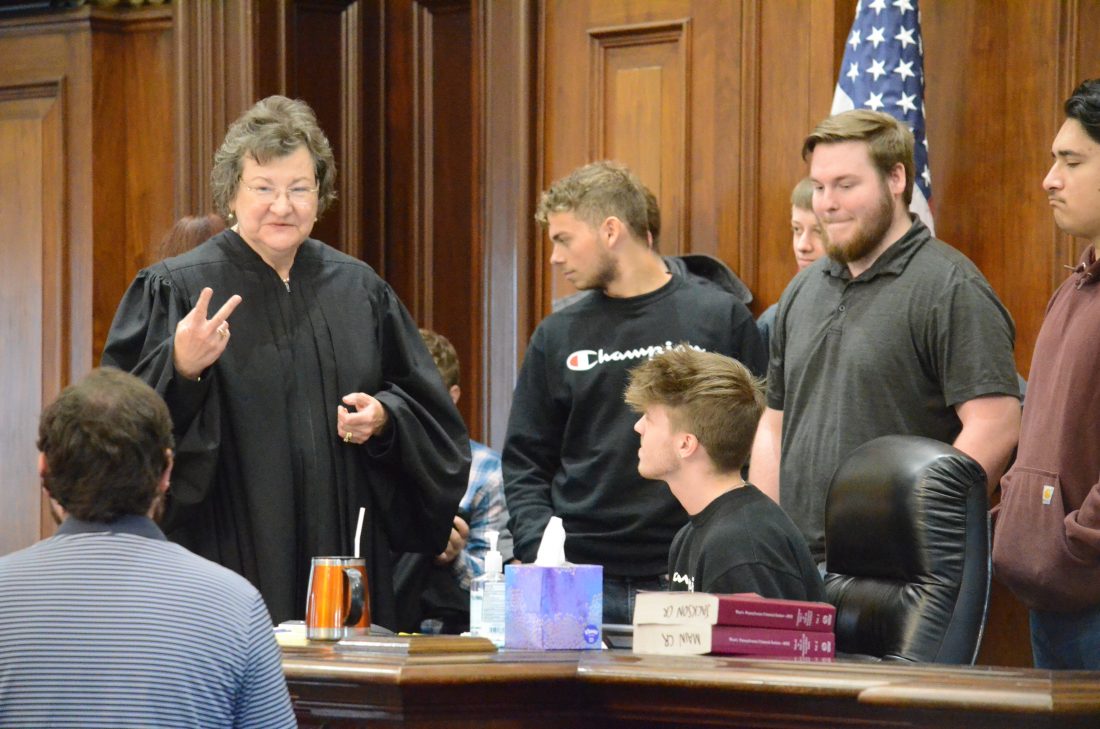
President Judge Maureen Skerda shared the bench with students from West Forest High School, including, seated, Shade Gilbert and, standing, from left, Antonio Martinez, Camron Call, Braden Custer and Allen Johnston, during Law Day festivities held Monday at the courthouse.
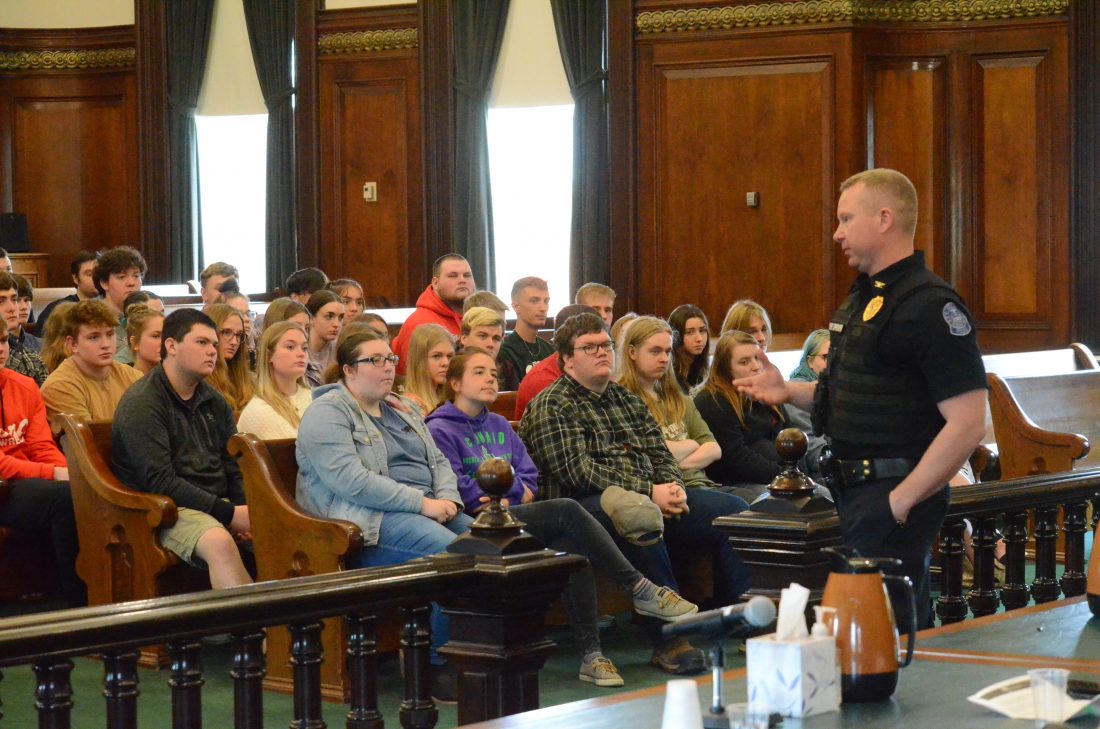
City of Warren police Chief Joe Spoveri talks to high school students during a Law Day event held Monday at the Warren County Courthouse.
President Judge Maureen Skerda shared the bench with students from West Forest High School, including, seated, Shade Gilbert and, standing, from left, Antonio Martinez, Camron Call, Braden Custer and Allen Johnston, during Law Day festivities held Monday at the courthouse.
City of Warren police Chief Joe Spoveri talks to high school students during a Law Day event held Monday at the Warren County Courthouse.
Trending
Law Day may have been conceived as a response to May Day celebrations in the Communist world in the 1950s.
But, on Monday in Warren County, it was an opportunity for students from schools in Warren and Forest counties to hear about some of the most profound Constitutional implications in the community from the people who live those responsibilities every day.
Speakers included President Judge Maureen Skerda, District Attorney Rob Greene, City of Warren Police Chief Joe Sproveri, Chief Public Defender Kord Kinney, Chief Juvenile Probation Officer Mike Grubbs and John Parroccini, president of the county's Bar Association.
The focus was on the Constitution and discussion ranged from the historic to the very current through the lens of each presenter.
Skerda welcomed the students to "your courtroom" and specifically highlighted the right to vote and to serve on a jury, two of the most fundamental actions citizens can take.
"You have a duty to participate in government," she said. "Without you, democracy doesn't work."
Throughout Law Day, students asked really good questions.
The first was to Skerda. Is deciding cases difficult?
"Yes and no," she said. "Sometimes the struggle is who to believe."
While criminal cases come with guidelines, Skerda said custody cases can be difficult because of the direct impact on families.
Grubbs told the students that juveniles don't have the right to jury trials which spurred another basic, yet significant, question -- why? He suggested that the confidential nature of juvenile cases might be part of the reason.
Kinney was asked about the toughest parts of public defense and why he got into that line of work in the law.
"(My) clients are human beings," he said. "They're us," calling the work "a lot more personal than what you might think about."
Sproveri highlighted a "symbiotic" relationship between law enforcement, the court, the DA, defense and the media.
He specifically address Fourth Amendment issues – search and seizure – as well as Fifth Amendment issues such as Miranda warnings.
He was asked about the process of obtaining a warrant and stressed that there shouldn't be any question where law enforcement is looking and what they're looking for.
"It takes time," he said.
But what about warrants for vehicle searches?
Greene said that issue shows how a state can give more rights to its citizens because the federal standard does not require a warrant but Pennsylvania law does.
But beyond the practical, the students heard about the philosophical underpinnings of the system in place.
"It's this document that is sacred to all of us," Parroccini said. "That is the foundation of our society."
Greene said he approaches his job with a sword in one hand and the Constitution in the other, both now as a DA and in prior defense work.
"My job is to make sure justice is served," he stressed.
He highlighted the importance of the Bill of Rights and stressed that "local politics is where you really have a voice… and that's what the Constitution was about."
Greene as asked what cases he is most proud of and he highlighted a conviction he secured in a homicide case a couple years ago as well as securing convictions in child sex assault cases.
"It's a tough job that I do," he said. "Even those dirtbags deserve a fair trial."
Law Day was held in the Main Courtroom at the Warren County Courthouse which means one topic was bound to come up – the murder of Judge Allison Wade, the only judge to ever be killed on the bench.
As a result, Law Day ended with a tour of the courtroom – especially the three remaining bullet holes from that 1954 incident.