State earned income tax credit proposed
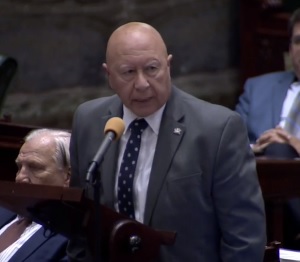
Sen. Mario Scavello, R-Monroe/Northampton, speaks on the floor of the state Senate.
By JOHN WHITTAKER
jwhittaker@post-journal.com
Legislation has been introduced to add Pennsylvania to the states offering an Earned Income Tax Credit on state taxes.
Sen. Mario Scavello, R-Monroe/Northampton, has introduced Senate Bill 1082 with bipartisan support from two Republicans, two Democrats and a registered Independent signing on as co-sponsors. The bill has been sent to the Senate Finance Committee
“The inability to afford basic necessities is all too common for many of the commonwealth’s lower income, working households,” Scavello wrote in his legislative memorandum.
“The COVID-19 pandemic only made this problem worse for many, and it is time we enact a reasonable solution that helps low-income, working families.”
The Earned Income Tax Credit helps low- to moderate-income workers and families get a tax break. Those who qualify can use the credit to reduce the taxes they owe or increase their refund. The federal government has offered the EITC since 1975, but several states also have a statewide Earned Income Tax program for state taxes.
In January, the United Way of Pennsylvania called for state legislators approve an Earned Income Tax Credit after a study showed that for every $1 in cost to the state budget, a refundable EITC will generate a return of $7 from additional state and local tax income, business revenue and reduced spending on public assistance.
A state EITC is projected to increase workforce participation and work hours, reduce child poverty, reduce the number of low birthweight births, reduce child maltreatment and foster care entry, boost educational attainment, increase access to health insurance coverage among children, reduce violent crime and help prevent adult suicides.
When a state EITC is combined with the current Pennsylvania tax forgiveness program, 1 in 4 Pennsylvanians would be receiving some form of state income tax relief.
“A refundable state-level Earned Income Tax Credit would be a resounding win for working Pennsylvanians, our state’s businesses of all sizes, and state and local governments. When qualifying households receive some of their earnings back, the majority will re-invest it in the economy to help meet household needs. That’s why several states across the country have increased their EITC as part of a strategy to help rebound from the pandemic. 2022 is the year for Pennsylvania to step into the ranks of a majority of states who have a state earned income tax credit,” said Kristen Rotz, United Way of Pennsylvania president.
According to the National Conference of State Legislatures, state EITC eligibility requirements often closely match federal requirements. But states do retain the ability to tailor their Earned Income Tax Credit programs to their constituencies. Wisconsin’s credit does not apply to childless workers, and California’s credit focuses on a narrower segment of income levels than the federal credit. Some states calculate their tax credits as a simple percentage of the federal credit, ranging from 3% in Montana to 125% in South Carolina. Beginning in 2023, Washington will offer set dollar amounts.
“For the commonwealth, this policy could resolve several issues including addressing the financial needs of families, while addressing our commonwealth’s projected revenue shortfalls in the coming years,” Scavello wrote. “The COVID-19 pandemic exacerbated many problems facing our commonwealth. Please join me in supporting the enactment of an Earned Income Tax Credit, which is a great first step towards helping low-income working families, stabilizing local economies, and generating additional revenues for the commonwealth.”
Local News

Warren County receives Trail Town recognition

Warren’s Tellmann made mark in Milwaukee
Judge denies motion to dismiss charges against Sugar Grove man
A judge has ruled against a motion to dismiss the charges filed against a Sugar Grove man accused of ...

Jamestown native works on NASA’s Artemis II, receives special invite to launch

Warren to host new U.S. Forest Service regional headquarters amid national overhaul