Medicaid funding boost proposed for EMS agencies
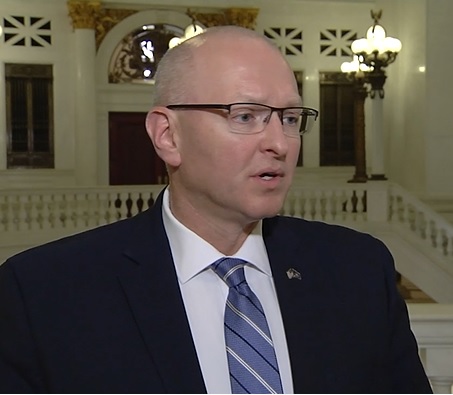
Rep. Martin Causer, R-Cameron/McKean/Potter, speaks in the state Capitol Building about an EMS funding bill the House of Representatives approved in February.
With EMS providers in Warren County and across the state struggling both financially and to attract enough manpower to respond to calls, Rep. Martin Causer is proposing a boost to the Medicaid reimbursement agencies receive.
Causer, R-Cameron/McKean/Potter, has introduced House Bill 2434 to increase the rates for advanced life support to $400 and basic life support to $325, representing a reimbursement of approximately 80 percent of the current base Medicare rate in Pennsylvania, plus a reflection of the change in the Consumer Price Index (CPI) since 2018. The bill would also offer an added premium for rural providers, similar to that offered through Medicare, to recognize the added costs those services face.
“Prompt response by an ambulance is the difference between life and death for many patients, and we have a responsibility to do all we can to ensure those services remain available to people across the Commonwealth,” Causer said. “Too many EMS agencies, especially in rural communities, are really struggling to keep their doors open, in part due to low reimbursement rates from the state that come nowhere near covering actual costs. My bill aims to change that.”
EMS providers have received two increases in reimbursement for transporting individuals covered by Medicaid in the last two decades with the last increase taking place in 2018 through legislation Causer sponsored. The current rates for ALS and BLS services are $300 and $180 per trip, respectively, much less than Medicare and commercial insurance reimbursements.
Causer is also proposing a requirement that EMS agencies be paid for all loaded miles at a rate of $4 per mile. Currently, Medicaid reimburses $2 per loaded mile, but only after the first 20 miles. Future reimbursement rates for services and mileage would increase when Medicare rates increase based on changes to the CPI to keep pace with the increased cost of providing this service.
“EMS providers truly are the first line of contact when it comes to the emergency medical care Pennsylvanians receive, and it is critical these organizations are properly reimbursed to ensure they are able to continue their mission of saving lives,” Causer said.
He has also supported laws to reimburse for treatment, even when transport does not take place, and for direct payment by insurance companies to ambulance service providers.
In February, Causer voted for Senate Bill 739, which sent $25 million in federal disaster relief funds for EMS providers through the Emergency Medical Services COVID-19 Recovery Grant Program. EMS companies that qualified for similar grants in the 2019-20 fiscal year would be eligible for these funds through the Office of the State Fire Commissioner. The funding would be divided evenly amongst all applicants. Qualified uses would include recruitment and retention; construction or renovation of an EMS company’s facilities; purchase or repair of equipment; debt reduction; training and certification; public education; or revenue loss.
Local News
Commissioners: no changes for May primary election
A representative of the League of Women Voters of Warren County addressed county officials Wednesday, voicing ...
Buffalo residents face false gun form statements
Two Buffalo residents face several felony charges in Pennsylvania involving false statements involving the sale or ...

‘Powerful Example’: North Warren native honored by PASSHE

Rapp: $2.25M awarded to county water projects
Sugar Grove man jailed after alleged assault
A Sugar Grove man has been jailed on $20,000 bail after an alleged incident Wednesday. William R. Fehlman Jr., ...