
Departments challenged to ‘action’ on EMS issues
Trending
"You have to recognize it's time for action and not more talk."
That was the heart of the message given to municipal officials and county fire department and emergency medical services officials by Jerry Ozog, executive director of the Pa. Fire & Emergency Services Institute, during a joint training session held Wednesday night at the Pleasant VFD Social Hall.
The event was aimed to bring the two groups responsible for providing fire and EMS services in the county together as officials grapple with challenges in the system.
"All of you who are involved … have a sacred responsibility for responding and helping members of the community," he said. "You as leaders … have the opportunity to define your future and figure out what direction you'd like to go in."
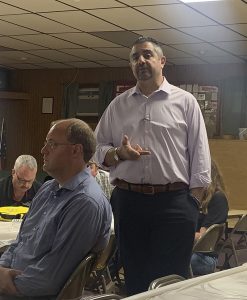
Well over 50 people were in attendance and Ozog wanted their thoughts on the greatest concerns they have about fire and EMS response in the county.
"Manpower is it," Rich Barrett said. "Without it, (we're) not going out the door."
Other concerns raised include costs, a lack of volunteers and retention problems.
"The biggest issue is very clear to me," Paul Pascuzzi said. "The biggest problem is communication" for both municipal officials and the departments. "And that is on us. "(It is) up to us as elected officials to solve that."
Concerns were also raised about the size of the county and the ability to cover the entirety.
"County-wide doesn't make sense," Pascuzzi said.
"Really, (a) rural county, you can't expect to have the same level of service in Deerfield as the City of Warren," Todd Steele with EmergyCare said. "Ambulances strategically placed throughout the county with someone getting to the patient quickly is key here folks (to) be able to do those life saving things."
Ozog walked through several options implemented in other parts of the state -- regional EMS options, emergency services commissions and legislation pushing for public safety authorities.
"It is ultimately the leaders of the organizations and municipal officials," Ozog said. "You're responsible for fixing it."
In his view, any solution will have "to be a collaborative effort" and "that collaborative effort will require you to deeply think about what you're doing."
It will also require knowledge, he said, of the "community expectation" from a service perspective.
He provided a timeline that shows there have been 12 years of discussion, meetings and plans on this issue in the county.
"It's time to move towards solutions guys," Ozog said. "Sometimes if we continue to do the same thing and expect a different result it just doesn't happen. You have an opportunity in Warren County to come up with some ideas. … To implement some of those ideas will require change. The community expects top notch service in Warren County.
"Working together is the theme of my presentation. … It has to be a collaborative effort."
So what should the municipalities and the departments do?
"Recruitment has to be a commitment," he said. "It's not a stop and start thing."
He then discussed various retention options to get those people to stay active.
"(You) have to ask your own members what will work for them," he said, noting that incentive options now are all focused on monetary incentives. "It requires an investment and it requires transparency."
Ozog acknowledged that a handful of people are supporting the system in most departments and Pascuzzi highlighted declining emergency medical responders, EMT and paramedic numbers in the county.
"(The) system is resting on the shoulders of a really small group of people," he said. "They are very tired. (I'm) not sure we have any solution…. These numbers are not going the right direction. It's a trend that we can't sustain…. I want that to sink in. This is the most important number in that whole presentation. It's a very, very small collective group of people that are supporting the BLS (basic life support) system… that can no longer continue to do it."
Ozog said he is "very encouraged" by the number of people in attendance on Wednesday.
"You have the core group," he said. "Survival is going to require some difficult decisions and some changes."