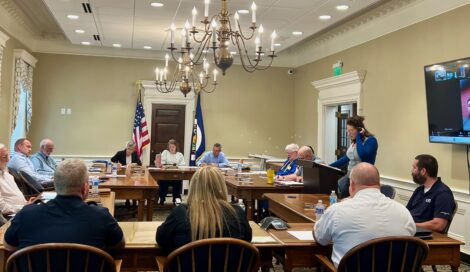
STRIVE to help district with students transition
The Warren County School District is striving to prepare its students for whatever comes next.
In the 2021-22 school year, the district will start STRIVE — Social interaction, Transition planning, Recreation and leisure, Independent living, Vocational learning, and Exploration and employment skills.
“All of those components serve specific purposes for students with significant disabilities as they get closer to graduation,” District Director of Pupil Services Dr. Patricia Hawley said. “Right now, we’re opening with a targeted population — significant disabilities in the areas of intellectual disability and autism.”
The program will help students transition from the school setting to either the workforce or independent living.
“The STRIVE program includes a performance-based curriculum and assessment program,” she said.
The scripted curriculum follows the Practical Assessment Exploration System (PAES).
“Children are provided the opportunity to explore career opportunities and jobs,” Hawley said. Students are evaluated on five components: “business and marketing, computer and technology, construction and industrial, processing and production and consumer service.”
“There will be four core teachers: Steve Edwards, Susan Wilson, Shawn Bedow, Melissa Page,” Hawley said. “Those four teachers will be leading the way.”
The district’s occupational and physical therapy and assistive technology will also participate.
There is space – about 2,000 square feet – for the program at the newly renovated Warren County Career Center.
There is a learning lab, two simulated hotel rooms, a “large, fully-functioning kitchen with a service window,” a laundry facility, and a simulated office.
“We’ll be working collaboratively with the career center,” Hawley said. “If there is a student who shows an interest in marketing or computers… we’ll allow a student to explore that. It gives them a level of exposure. It gets them out in the community in a work-based learn center.”
The federal Workforce Innovation and Opportunity Act required states to work on workforce development plans.
“These children and young adults with significant disabilities, were to be provided with equal opportunity in the work setting,” Hawley said. “It’s in our best interest to provide them an opportunity to explore careers.”
The STRIVE program will also serve students whose disabilities could make them unemployable, Hawley said. “The other piece of the STRIVE, beyond vocational and career experience, is instrumental activities of daily living (IADL).”
Activities of Daily Living (ADL) are “things that we do every day,” she said. “IADL… those are things that we as adults do on a daily basis and are more appropriate for students 16 and older.”
Examples include maintaining a household, managing a checkbook, how to do laundry, and how to make coffee.
“With children with a level of disability that they won’t be employable, show IADL skills to transition from school to independent living,” Hawley said.
The program will be open to students in grades seven through 12 and those ages 19 to 21. “The IEP teams will be working with parents to facilitate meetings to discuss eligibility,” Hawley said.
Students will attend STRIVE for half of their school day.
Hawley expressed her appreciation to the school board and administration for their support.
“There’s not another program like this around,” she said. “You find programs like this in large metropolitan areas. We’re pretty blessed in this community to add another special education program.”
While the district’s total student population is decreasing, “our special education population is staying the same,” Hawley said.
“We’ll be doing an open house for community providers in May,” she said. “We hope to hold an open house for community and parents before school opens next year.”
Local News

Bicyclist taken to hospital after mishap
Commissioners agenda includes 911 recognition
The Warren County Commissioners will meet at noon Wednesday in the Jackson Courtroom of the Warren County ...
Temporary signal installed on Scandia Road
The Pennsylvania Department of Transportation (PennDOT) is advising drivers to be alert for temporary traffic ...
Team efforts

Warren, McKean county businesses eligible for facade work