
Spraying is OK’d to combat gypsy moths
Trending
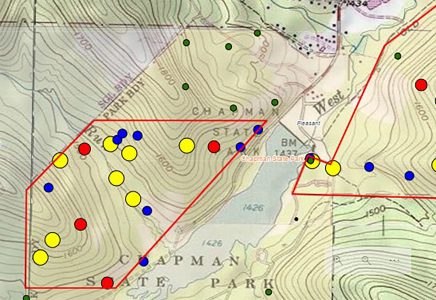
Those who see gypsy moth damage at Chapman State Park are not alone.
"Gypsy moth defoliation has increased significantly at Chapman in recent years," according to Park Manager Tyson Martin. "Last fall, the Department of Conservation and Natural Resources (DCNR) Bureau of Forestry sent a Forest Health Program Specialist to survey the impact."
"These surveys scientifically quantify what the average observer sees through their windshield," Martin said. "The results were significant enough to require action by DCNR."
That action features aerial deployment of a targeted insecticide.
DCNR secretary Cindy Adams Dunn announced the start of aerial spraying of state woodlands to combat gypsy moth populations poised for spring outbreaks in some sections of Pennsylvania -- including Chapman State Park.
"As the insects emerge and begin feeding, the suppression effort will begin in early May," Dunn said. "Our recent cool, wet springs had emerged as an enemy of the gypsy moth in years past, but populations have climbed in some areas to a point where aerial spraying is needed to keep this invasive pest in check and protect the trees from defoliation."
"In Pennsylvania, these destructive, invasive insects go through cycles where outbreaks occur every five to 10 years," DCNR Forest Health Manager Dr. Donald Eggen said. "Populations had declined in years past thanks to the gypsy moth fungus disease and wet spring weather but that no longer is the case for 2021."
The gypsy moth suppression program is conducted with the goal of preventing defoliation so that trees do not become stressed and succumb to disease, other insect pests, or drought, according to DCNR.
Aerial spraying will be conducted by helicopter and fixed-wing aircraft.
Helicopters will likely be used at Chapman, Martin said.
"The specific treatment date will not be known until shortly before treatment begins due to weather, leaf-out, and other factors," he said. "However, it is applied by helicopter so it is unlikely anyone in the immediate area will be unaware the application is occurring.
"Because of the characteristics of the pesticide and the areas it will be used, there is no need to alter our operation or activities," Martin said. "We did post signs at trail heads and other areas where folks might enter the area that will be treated, so they can make their own decision whether or not to continue. However, there is no need to cordon it off or restrict access to visitors."
The BTK pesticide is a biological one that causes disease in some insects, but has been cleared by the Environmental Protection Agency for human consumption on food crops immediately after spraying. When eaten by gypsy moth larva, the pesticide starts to dissolve the creatures from the inside.