
Trending
By JOHN WHITTAKER
jwhittaker@post-journal.com
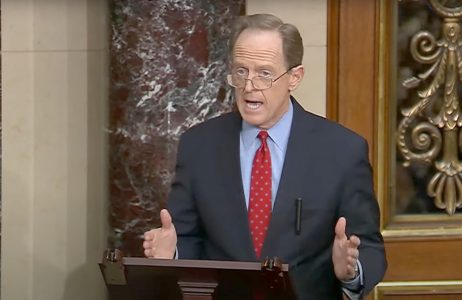
Before protesters stopped the counting of electoral votes on Wednesday, Sen. Pat Toomey, R-Pa., said he would not support objections to Electoral College votes.
Sen. Mitch McConnell, R-Ky., his colleagues that Congress should not override the voters' verdict in electing Democrat Joe Biden president, saying, "If we overrule them we will damage our republic forever."
The Kentucky Republican made his remarks as the Senate weighed a challenge by a handful of GOP lawmakers to the 11 electoral votes Arizona cast for Biden. It was the first of several states' electoral votes that some Republicans are challenging, encouraged by President Donald Trump's groundless charges that the election was riddled with fraud. Congress seems certain to reject all those challenges on Wednesday and formally certify Biden's victory.
McConnell says while all elections have irregularities, they weren't "anywhere near the massive scale that would have tipped the entire election." He says Congress should not declare itself "a national board of elections on steroids," and says reversing the election results would push the country's democratic institutions toward "a death spiral."
Republicans from the House and Senate have objected to the counting of Arizona's electoral vote, forcing votes in both chambers on Joe Biden's victory in the state. Biden won the state by more than 10,000 votes. In all, eight lawsuits challenging Biden's Arizona win have failed, in part over a lack of evidence. The state's Supreme Court on Wednesday upheld the dismissal of an election challenge, because the plaintiff lacked the right to bring the suit in the first place. The woman wasn't a registered voter when she sued. Arizona Secretary of State Katie Hobbs, a Democrat, has said there were no irregularities with the vote in her state.
Toomey, speaking about the Arizona objection, said those who want to reject Electoral College votes from states whose electoral processes they disapprove of are asking Congress to select the President of the United States instead of the American people.
"The answer Mr. President, is no, there is no such authority under the constitution," Toomey said. "The Constitution assigns to the states the responsibility to conduct elections, it's clear in Article 2, Section 1, it leaves courts with the responsibility to adjudicate disputes and assigns to Congress the ministerial function of counting ballots except for extreme circumstances such as when a state sends competing slates of electors to Congress."
Toomey argued that there is no real precedent to set aside electors as some argue was created in 1877. Toomey said the situations are not at all analogous. In 1877, Congress had before it two slates of electors from several states. In 2020, there are no Trump electors from swing states, but instead only Biden electors. Second, legislatures from the swing states have already spoken and made their decision. They've chosen not to send alternative electors.
Nullifying Electoral College votes, Toomey said, would reshape elections for decades to come.
"If the objectors are right and it really is Congress's job to sit in judgement on the worthiness of the states' electoral processes, then what's the criteria for acceptable election processes?" Toomey asked. "What investigations have been conducted of these processes? What body has deemed that certain states' processes are unacceptable? What opportunity were these states given to challenge the findings? Why are the objectors only objecting to swing states that President Trump lost? What about the ones he won? I don't know...North Carolina? What about California? They have ballot harvesting, I'm told. … If we adopt this new precedent, and we sit in judgement of states' processes, then we're federalizing the election law. We would necessarily have to establish the permissible criteria and rules for the states' elections. The ballot harvesting example, it's illegal in some states, it's encouraged in others. Does it become mandatory or forbidden depending on who is in control of Congress? And as the leader pointed out, it would be the end of the electoral college. And the electoral college is the mechanism by which the people select the president. But if Congress gets to decide which states get to vote in the electoral college, then clearly Congress is selecting the president, not the people."
Toomey said such a system would result in whichever party both houses of Congress controlling the presidency.
"Let me conclude with this: I voted for President Trump," Toomey said. "I publicly endorsed President Trump. I campaigned for President Trump. I did not want Joe Biden to win this election. But there's something more important to me than having my preferred candidate sworn in as the next president. That's to have the American people's chosen candidate sworn in as the next president. A fundamental, defining feature of a democratic republic is the right of the people to elect their own leaders. It's now our duty, our responsibility to ensure that that right is respected in this election and preserved for future elections. I urge you vote against this objection."
Vice President Mike Pence defied Trump, saying he does not have the unilateral ability to discard electoral votes that will make Joe Biden president on Jan. 20.
Pence, in a statement issued minutes before he was to begin presiding over a joint session of Congress to count electoral votes, said, "It is my considered judgement that my oath to support and defend the Constitution constrains me from claiming unilateral authority to determine which electoral votes should be counted and which should not."
Trump has pressured his vice president to toss electors from battleground states that voted for Biden during the session.