Riley Horner sees the world — in living color

Times Observer photo by Stacey Gross The emotion that came with experiencing the ability to see the colors red, green, and yellow for the first time literally brought Riley to the ground.
The only color Riley Horner’s ever seen is blue.
Until Thursday.
Thursday morning, in the Health and Medical Assisting classroom at the Warren County Career Center (WCCC), Horner’s life changed.
As career center students and his family watched, Riley put on a pair of EnChroma high-performance glasses.
The specs, created by MIT graduate Dr. Don McPherson and UC Berkeley-trained mathematician Andrew Schmeder, are the product of years spent studying why a pair of glasses, which McPherson originally invented to protect the eyes of surgeons performing laser surgery, enabled his severely colorblind friend to see a rainbow of hues when he put them on by happenstance during a game of ultimate frisbee in 2002.
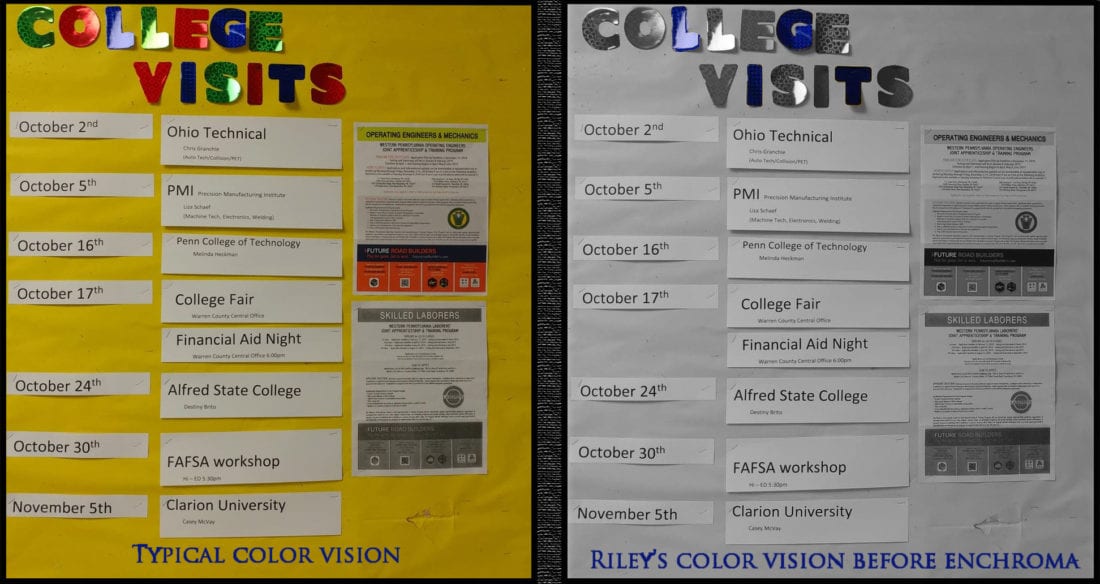
Times Observer photo by Stacey Gross On the left, a bulletin board seen with typical color vision. On the right, a bulletin board as Riley would have seen it before receiving his EnChroma glasses. The only color Riley could see before getting the glasses was blue.
EnChroma, the company behind the glasses that gave Riley his first experience of red, green, and yellow in his life on Thursday, was founded in 2010 and combines the neuroscience of color perception with lens craft that enhances color vision for people around the world.
For his entire life, Riley’s been unable to see any color but blue. The typical human eye can see numerous shades of red, green, and yellow, in addition to blue, thanks to cone cells in the eye itself. Cone cells send information about what the eye is looking at to the brain for interpretation, and each of the approximately six million retinal cone cells in our eyes is designed to pick up one of the three primary colors of light — red, blue, or green — in the world around us.
The eye itself takes in the world around us, but the visual cortex of the brain interprets the light and images which are projected onto the retina and sent from there to the brain for interpretation. Everything from where an object is to its properties such as motion, shape, and color must be interpreted by the brain’s visual cortex.
When an object blends in well to its background, the ability to see color is what helps us decipher it. Without color vision, we’d be unable to see much of the world around us a lot of the time.
As Riley described it, the inability to see color made the world like a black bulletin board with black letters stapled to it. He could see that something was there, he explained, but it was often difficult to tell exactly what that something was.

Times Observer photo by Stacey Gross Riley Horner (foreground) and his mother, Heather Tomaschefski, hugged after Riley’s first experience seeing the colors red, yellow, and green.
It wasn’t always a huge problem per se, Riley said.
He’d been able to compensate for the visual deficiency, just as most people who are colorblind can do throughout their lives. But when it came to his coursework at the WCCC — and his future employment opportunities –the inability to see red, green, or yellow had become a significant challenge.
Riley, a Junior at the career center, is enrolled in the Computer Maintenance and Administration program. This year, along with classmates, he’ll be taking the National Occupational Competency Testing Institute (NOCTI) exam for his program.
The NOCTI exams are integral for career center students as they develop a portfolio that demonstrates their proficiency within the field to which they have devoted three years to studying; further enhancing prospects of working in that field after graduating.
That means that, for career center students who want to seek employment in their program field, it’s as important to score well on the NOCTI as it is for students who want to enroll in traditional four-year universities to do well on standardized tests such as the SAT. And, like the SAT, a student can’t ask for help during the NOCTI exam.
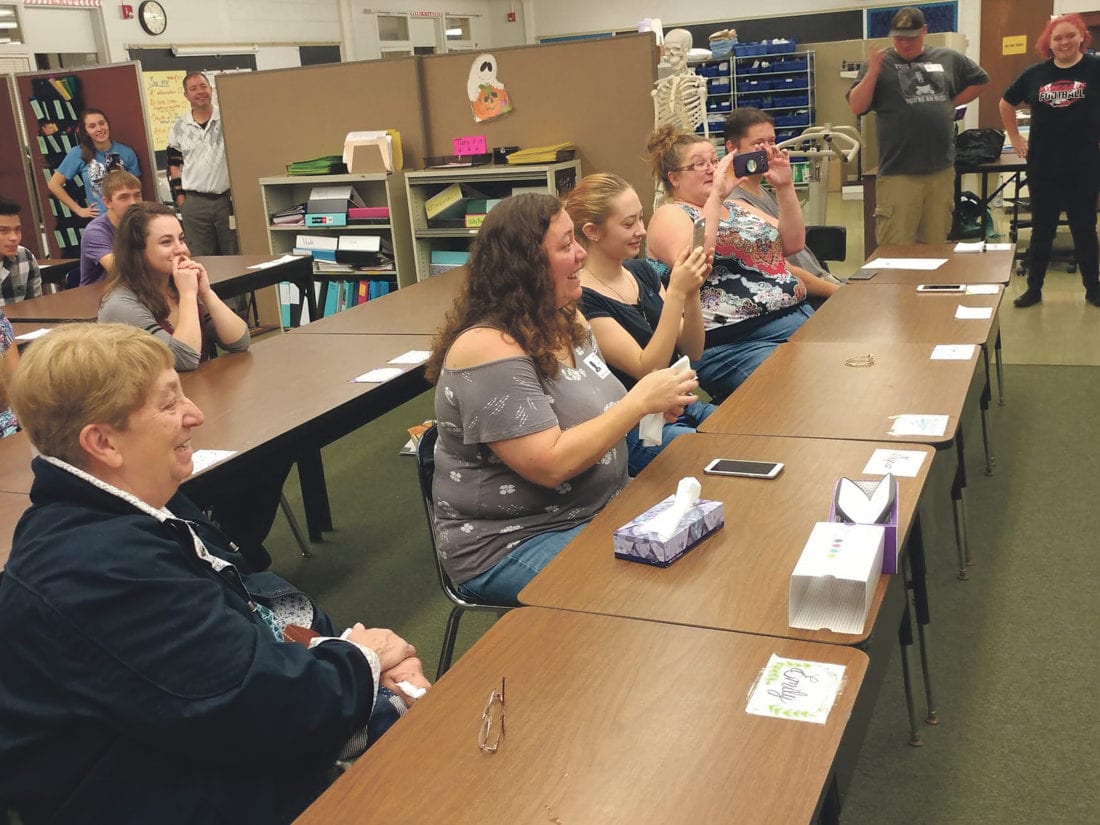
Times Observer photo by Stacey Gross Riley Horner’s family watches as he sees the colors red, green, and yellow for the first time. Left to right, they are: Riley’s grandmother Deborah Horner, Riley’s mother Heather Tomaschefski, Riley’s girlfriend Dakota Hensel, Riley’s family friend Jennifer Wilcox, Riley’s father Scott Kemery, Riley’s stepfather Randy Tomaschefski, and Riley’s sister Halia Tomaschefski. In the background, Warren County Career Center students from the Health and Medical Assisting program and career center Principal Jim Evers, look on.
Jessica Trundel, the Computer Maintenance and Administration teacher at the WCCC, approached Assistive Technology Consultant Mark Sweet earlier this academic year with a problem: Riley had to ask other students which wires were which color during classwork.
That was something that wouldn’t fly on the NOCTI, she said.
Sweet approached the Warren County School District’s Director of Pupil Services, Dr. Patricia Hawley, to find out what could be done. He approached her with one idea in mind.
“I went home after talking to Jessica,” said Sweet, “and I did a little research, and I came across these glasses.”
The pitch to get Riley set up with two pairs
-

- Times Observer photo by Stacey Gross The emotion that came with experiencing the ability to see the colors red, green, and yellow for the first time literally brought Riley to the ground.
-

- Times Observer photo by Stacey Gross On the left, a bulletin board seen with typical color vision. On the right, a bulletin board as Riley would have seen it before receiving his EnChroma glasses. The only color Riley could see before getting the glasses was blue.
-

- Times Observer photo by Stacey Gross Riley Horner (foreground) and his mother, Heather Tomaschefski, hugged after Riley’s first experience seeing the colors red, yellow, and green.
-

- Times Observer photo by Stacey Gross Riley Horner’s family watches as he sees the colors red, green, and yellow for the first time. Left to right, they are: Riley’s grandmother Deborah Horner, Riley’s mother Heather Tomaschefski, Riley’s girlfriend Dakota Hensel, Riley’s family friend Jennifer Wilcox, Riley’s father Scott Kemery, Riley’s stepfather Randy Tomaschefski, and Riley’s sister Halia Tomaschefski. In the background, Warren County Career Center students from the Health and Medical Assisting program and career center Principal Jim Evers, look on.
-

- Times Observer photo by Stacey Gross Clockwise, from left, Riley Horner, Dakota Hensel, Randy Tomaschefski, and Mark Sweet. Sweet, Warren County Career Center Assistive Technology Consultant, made brownies for Horner’s first day of full color vision with red, yellow, green, and blue sprinkles. Before donning his new glasses, the only color of sprinkle Horner could decipher from the others was blue.

Times Observer photo by Stacey Gross Clockwise, from left, Riley Horner, Dakota Hensel, Randy Tomaschefski, and Mark Sweet. Sweet, Warren County Career Center Assistive Technology Consultant, made brownies for Horner’s first day of full color vision with red, yellow, green, and blue sprinkles. Before donning his new glasses, the only color of sprinkle Horner could decipher from the others was blue.
He’d been able to choose his frame style, said Sweet, and he’d seen them before the actual presentation, but he hadn’t put them on.
YouTube is littered with tearjerking videos of colorblind people from adults to small children putting on EnChroma glasses for the first time. It’s a genre unto itself on the video streaming website, and most people have seen one or two of the videos pop up on their social media timelines before. The event is always an emotional one because the ability to see color is not only a perfunctory skill.
Decades of research in the social sciences clearly shows the relationship between color and emotion, and the very experience of each color produces a unique emotion in people. Not only is the experience of seeing color for the first time in, for Riley, 17 years an emotional one. The individual emotions that come along with each color are also overwhelming.
Everyone was expecting Riley’s experience to be just the same. But, said Sweet before Riley put his new glasses on, there was a slim chance that they wouldn’t work and that the reaction would fall flat.
According to the EnChroma website, four out of five cases of colorblindness are addressable using the glasses. But there’s always that one anomaly.
Sweet said Thursday morning that he was beyond hopeful Riley’s would not be the anomalous one-out-of-five case.
Luckily for everyone, a joyfully tearful crowd of fellow students, faculty, family, and friends — and most especially for Riley — his was not an anomalous case, and his reaction was much like those seen on the videos of people having the same experience.
The emotion of it all literally took Riley to the ground, and rendered him speechless as Sweet pointed to a spectrum of colored balloons tacked to the classroom wall.
“See this color right here Riley,” Sweet asked, pointing to one balloon. “That’s green.”
Then, Sweet went on through purple, yellow, red, and orange, naming the experience that so many of us take entirely for granted as Riley saw – and learned – each for the very first time.
With the glasses, explained Trundel, Riley will be just as able to perform on the NOCTI exam, and in his chosen field, as any other person with the same education and experience. The glasses, she said, level the playing field for Riley not just academically now, but financially well into his future, and enable him to compete equally with his peers of typical vision.
The glasses have, quite literally, changed his life.
Once everyone had recovered from the initial wave of emotion Thursday morning, when asked what his favorite color was now, Riley laughed, still a bit awestruck, and thought for a moment.
“Probably still blue,” he answered with a shrug.
That may change over the next few days, however, as Sweet explained that the more Riley wears his new specs the more brilliant and vibrant the colors will become, as his eyes and visual cortex adjust to perceiving and interpreting color information.
To see a video of Riley’s first experience seeing colors other than blue, visit bit.ly/rileyhorner.
Local News

Showers, toilet flushing optional as residents tackle high water bills

Learn about raptor migration at Audubon on Friday

Area students receive instruction in building construction program

Crimestoppers offers cash reward for drug crime tips
UPMC Chautauqua hosts training for birth emergencies