Lost to History
While little is known about his life, Warren County native son Leonidas Lytle was awarded the Medal of Honor... 141 years ago
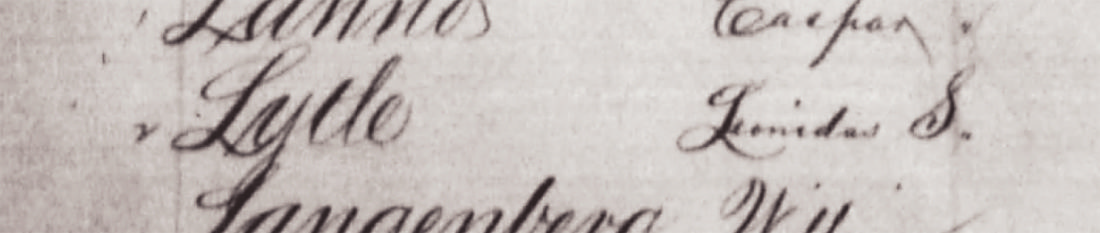
Photos from Fold3.com records This is one of the four enlistment records that includes Leonidas S. Lytle, a Warren County native who was awarded the Medal of Honor in April 1875. The inset photo, at right, is a piece of a listing prepared by the U.S. Government Printing Office that lists all Medal of Honor recipients between 1863 and 1978.
He entered military at the age of 15 as a musician.
In peace time, he re-enlisted for four five-year terms, serving a total of 20 years in the U.S. Army.
He was awarded the Congressional Medal of Honor.
He was born in Warren County.
And we bet no one knows his name.
His name? Leonidas S. Lytle.
When it comes to Medal of Honor recipients in Warren County, the conversation usually starts and ends with John Gertsch, who was awarded the Medal of Honor posthumously for service during the Vietnam War.
We assumed – with a reasonable degree of certainty – that Gertsch was the lone Medal of Honor recipient who once called Warren County home.
Well, it turns out that’s not the case.
Lytle was born in Warren County on September 5, 1846.
No information about where he was born, or where in the county he spent his childhood, has emerged in an extensive investigation of this man’s life.
His name first pops up in historical records in 1862.
The nation had been at war for less than a year when a 15-year-old Lytle entered the U.S. Army from Clevelend, Ohio on February 13, 1862 and was assigned as a musician to company H and F of the 58th Pennsylvania Infantry, according to a Civil War Soldier listing made available by the National Park Service.
Companies H and F were recruited from Warren, McKean, Erie and Tioga counties.
According to a unit history from the National Park Service, the 58th was organized between September 21, 1861 and March 1, 1862.
The 58th was stationed as part of the occupation of Norfolk and Portsmouth in the fall of 1862 until January, 1863 when it was transferred to North Carolina and South Carolina and remained in dury there until April 1864.
The regiment re-enlisted January 1, 1864 and was moved to Yorktown, Va. on April 28, 1864 and then moved to the south side of James River and against Petersburg and Richmond in May.
The unit’s major engagements were at Cold Harbor from June 1-12, 1864 and siege operations against Richmond and Petersburg from June 1864 to April 1865, during which it was engaged at the Battle of Chaffin’s Farm in September.
The 58th was a part of the Appomatox Campaign and occupied Richmond from April 1865 until August before being mustered out of the service in January 1866.
Casualties for the regiment included six officers and 68 enlisted men killed or mortally wounded in the fighting as well as four officers and 139 enlisted men who died of disease.
Lytle would serve with the 58th Infantry throughout the Civil War when he was mustered out with his company.
Over one million men were counted in the US military during the last year of the war, 1865. That number would drop to 43,228 by 1873 and 34,094 in 1877, according to a Department of Defense report.
Lytle would remain as one of the men in that drastically reduced fighting force.
Enlistment records show that he re-enlisted on September. 24, 1866 for a five year hitch with the U.S. Army’s 8th Cavalry, Company C.
At the time, he was 20 years old and his occupation is listed as a “gas fitter.”
This is the first time that we get an image of what Lytle looked like as we were unable to unearth any photographs.
Lytle was short, listed at five-feet four-and-one-half inches tall with grey eyes, brown hair and a light complexion, as detailed in each of his enlistment reports.
In each enlistment record, his home was listed as “Warren” or “Warren County.”
His first enlistment to the 8th Cavalry, nine months after his discharge from the 58th Pennsylvania, occurred in Philadelphia.
The other three? Fort Selden, New Mexico; Brownsville, Texas; and Fort Duncan, Texas.
Those locations put Lytle squarely in the middle of conflict during what has since come to be known as the Indian Wars.
When he was stationed at Fort Selden in July 1873, he was assigned as part of a patrol responding to a report of an Indian raid at Shedd’s Ranch, according to information on Fold3.com, part of the ancestry.com network that specifically focuses on military records.
A total of ten men from Co. C of the 8th U.S. Calvary were told to “locate and punish the Apache Indians who had been involved in the attack.”
Here is the narrative of the patrol:
“By 9 a.m. the troopers arrived at Shedd’s ranch, where they were held up for seven hours waiting for a tracker, thus giving the Apache a 36 hour head start. Once the troopers got moving, however, they pushed hard traveling for seven hours through the foothills of the San Andreas range, not making camp until after twelve o’clock. The troopers have covered 65 miles that day.”
Another 45 miles were covered on the second day and, on the third day, an illness resulted in the patrol shrinking by two men.
“After following the hostiles for four days at 1 p.m. the troopers found a cooking fire that had recently been abandoned. The determined troopers resumed their chase. Three hours of hard riding brought the hostile Indians into sight. Captain Chilson ordered a charge with pistols until the distance had closed and he then ordered his men to dismount and fight on foot.
“A running battle followed. During the battle Corporal Frank Bratling gallantly moved into the open… for a better shot at the Apaches but was shot through the heart and instantly killed. Three of the Apache were killed, only one managed to escape.
“In all the troopers traveled some 350 miles through extremely rugged country in seven days. The command suffered from heat, thirst and fatigue without a murmur.
“Corporal Frank Bratling, Sergeant James L. Morris, Sergeant Leonidas S. Lytle, Blacksmith John Sherin and Private Henry Wills were each awarded the Medal of Honor for their conduct during the engagement with the Apaches.”
Lytle’s Medal of Honor citation is brief – “Services against hostile Indians.”
The citation was issued on April 12, 1875
A total of 3,498 men and women have been awarded the Medal of Honor since its inception in 1863 with the vast majority, 1,523, awarded during the Civil War.
Though the Army was small during the years Lytle served, 424 recipients were recognized during the Indian War campaigns.
In more recent conflicts – where the size of the army was much greater – even fewer awards have been given, including 453 in World War II when there were, at its peak, over 12 million men in the service.
Enlistment records show that Lytle was discharged in August 1882 at Fort Clark, Texas.
While the records can be challenging to read, there is a mention of the rank of “private” in that record. Some speculation uncovered on the internet postures that Lytle was court martialed and discharged at the lower rank of private but the enlistments records don’t clearly spell that out. Additionally, there is no mention of the discharge being nefarious in the enlistment records.
Pension cards indicate that he passed away on January 23, 1924 in Glenwood, New Mexico. He appears to have stayed out west after his Army service as he is buried at the Memory Lane Cemetery in Silver City, New Mexico.
His grave stone includes the crest of the Medal of Honor as well as his position – “1ST SERG CO C 8 US CAV INDIAN WARS.”
Note: We’ve are under no pretense that this is a complete telling of Lytle’s life. If anyone has any additional information about him, feel free to call 723-8200 ext. 623 or email jcotton@timesobserver.com.
Local News
Dairy Princess points out opportunities
Warren man charged after fleeing officer
=A Warren man has been jailed on $25,000 bail after allegedly fleeing from a police officer on a motorcycle. ...
Warren man sentenced to probation after domestic incident
A Warren man will spend the next 4.5 years on probation after being sentenced on three separate dockets recently. ...
Paid family leave proposal debated in capitol
To convince colleagues that Pennsylvania workers need access to paid family and medical leave, state Rep. Jennifer ...
Historical Society Founder’s Day Exhibit and raffle