
Fall fungus on display at Audubon
Trending
Mushrooms are interesting. At a glance, fungi may look similar to plants, but they are their own separate kingdom, neither plant nor animal. Fungi actually share more things in common with animals, both in the chemical materials that cells are made of but also because fungi eat rather than photosynthesize. Ultimately, Fungi eat to survive, just like animals. Most fungi break down matter, most often dead things like leaves or rotting logs, however some are more parasitic and will feed off still living things like trees (and even insects). In fact, their cell walls even include a bit of chitin, the same material that insect exoskeletons are made of.
Scientists estimate that there are around five million different species of fungus on Earth, but only about 150,000 or so have been officially described.
Mushrooms are the fruiting body of a fungus, so a mushroom is to a fungus like an apple is to an apple tree. This means that picking a mushroom doesn't harm the fungi that produced it. In fact, this can help it reproduce by dispersing spores. The main body of a fungus is made of many tiny hair-like strands called mycelium. Sometimes they are microscopic, but others are visible to the naked eye and can be found if you flip over a rotting log. The largest fungi live underground and can be several acres wide and weigh hundreds of tons.
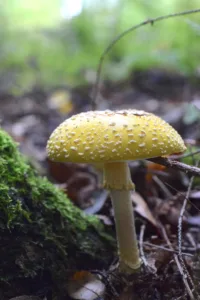
The stereotypical image of a mushroom, a red cap with white spots, is based on an actual species - Amanita muscaria, also called fly agaric. It can be found in western NY, and has several color variations, being found in orange and yellow in addition to red, with the yellow/orange varieties more common here. The white spots on an amanita mushroom are remnants from the universal veil, a thin coating that surrounds and protects the mushroom as it emerges from the soil, erupting from the ground. Amanitas are commonly found in woody areas and have symbiotic relationships with many trees.
Some mushrooms will last for a long time, and you will be able to see them even after they've fulfilled their purpose. Many species of polypore, also called shelf fungus for their appearance, will form large woody conks which stick around on a tree long after the spores have dispersed. Other mushrooms only exist for a brief moment in time, sprouting up and spreading spores before decomposing in a matter of hours. Inky cap mushrooms are known for this, because only a few hours after forming their black caps will turn into an inky goo before the rest of it breaks down.
Some mushrooms are so full of spores that merely poking them will unleash a small cloud of spores. This is both fun to find and interact with, and beneficial to the fungus! If you find an interesting mushroom you can also create a spore print. While spores themselves are microscopic, mushrooms have so many that by placing a piece of paper or foil underneath and waiting several hours, the millions of spores will collect until they become visible. Spore prints come in many different colors, which can also aid in mushroom identification.
It's possible to find mushrooms during most of the year, but by far the best time is when the ground is damp, like the day after it rains. Mushrooms love moisture and they need it to grow. Fall is a great time of year to search for mushrooms because the cooling temperatures combined with higher humidity and rainfall make for ideal conditions. Mushrooms are often found in damp areas, usually near whatever they are using as a food source and often on dead or decaying material, whether they're fallen logs, leaf litter, or some other natural material. Many species of fungi have symbiotic or parasitic relationships with specific kinds of plants, so finding one increases the odds of finding the other.
Their presence often attracts other wildlife, like flies that love to eat them when they are decomposing. Some mushrooms specifically attract flies by smelling stinky. Stinkhorns, aptly named, are a great example. They look like fingers emerging from the ground and smell putrid. Other types of mushrooms are enjoyed by a variety of woodland creatures like squirrels, chipmunks, and deer. If you go find a mushroom at this time of year it's very possible to see a bite or two taken out of it.
Wild animals aren't the only ones who enjoy a good mushroom - they are popular in many types of human cuisine. In addition to what you might find in a grocery store, some kinds of edible mushrooms must be foraged.
Chicken of the Woods and Hen of the Woods, also called maitake, are common species foraged at this time of year. While certain mushrooms are edible, others can be toxic and even deadly. If you are interested in foraging, make sure you go with a mushroom expert, because even edible mushrooms can have toxic lookalikes.
Mushrooms are found in every color of the rainbow, and all shapes and sizes exist. After a rain, see how many kinds you can find! Personally, I've seen red, orange, yellow, purple, black, and white, among others. Mushrooms are wacky, wild, and fun. Whether tall and narrow or short and stout, perfectly round or covered in craters, on a tree, emerging from a path, or hiding in some secret spot, fungi make the world a little bit more magical.
Audubon Community Nature Center builds and nurtures connections between people and nature. ACNC is located just east of Route 62 between Warren and Jamestown. The trails are open from dawn to dusk and birds of prey can be viewed anytime the trails are open. The Nature Center is open from 10 a.m. until 4:30 p.m. daily except Sunday when it opens at 1 p.m. More information can be found online at auduboncnc.org or by calling 716-569-2345.