
Sleeping moths keep nature alive
Trending
Photo by Katie Finch
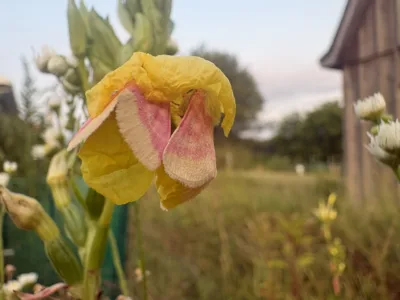
Primrose Moths rest during the day in Evening Primrose flowers.
Flowers serve many purposes. For plants, they are reproductive parts and the first step in creating seeds. For insects, birds, and even us, they are a food source. They are also a source of joy, beauty, and meaning in our lives. But have you ever thought about a flower as a place to sleep?
That is exactly what I observed one late afternoon in my yard. I found two pink and yellow moths resting among the yellow flower petals of an Evening Primrose flower. Their heads were tucked deep inside the flower while the edges of their wings hung out; the flower petals closed around them. If I hadn't been searching for them, I would have right walked by. A perfect illustration of camouflage.
I went in search of these specific moths because one landed on my T-shirt the previous afternoon while weeding. It was striking with a fuzzy yellow body, mostly pink wings with yellow, fringed ends. The thread-like antennae curved gently up and away from its head. The entire creature was not much longer than an inch.
With colors more common to cotton candy than insects, I knew it would not be hard to identify. A quick internet search told me it was a Primrose Moth. They are widespread across eastern North America (and not to be confused with another pink and yellow moth, the Rosy Maple Moth.)
Its presence in my yard is the direct result of the plants growing in my yard. The caterpillars of Primrose Moths feed exclusively on Evening Primrose and other plants in the primrose (Oenothera) genus.
Monarch butterflies and milkweed plants are a widely understood and observed relationship. Many know monarchs eat only milkweed. But there are other species of moths and butterflies that are food specialists, depending on one plant as a host plant for their caterpillars. Learning that Primrose moths were one of those picky eaters, I went in search of Evening Primrose flowers.
These tall, multi-branching plants may be viewed more as weeds than landscape flower. They are usually found in fields, roadsides or, in my case, the unmowed parts of one's yard. A biennial, they flower in their second year. But their seeds are abundant and they self-seed easily, one flowering plant, easily becoming more, year after year and often in places you don't want or at least didn't plan for. For these reasons, they aren't favored in more formal flower beds.
Both the flowers and moths come out at night, the moths drinking nectar from the flowers. Come morning, as the moths search for a daytime resting spot, the petals lay open, like motel vacancy signs, until they close later in the day. It is in these closed-up flowers, I find several moths. They reminded me of the Hans Christian Anderson fairytale Thumbelina, in which, after her adventures, this tiny girl curls up for the night in a flower.
Where there are moths, there should be caterpillars too. I read that the caterpillars also camouflage themselves among primrose plants. The easiest way to search for a hard-to-find caterpillar is to look for frass, otherwise known as poop. Caterpillars are eating machines, so it doesn't take long to spot their tiny, brown droppings.
Years of evolution have perfectly matched the green of this caterpillar to the green of the leaves and flower buds. And the way they position their bodies vertically along the plant stem mimics the unopened flower buds and freshly formed seed pods. They were easiest to spot with their heads inside a hole chewed in a seed pod, munching away.
Once grown, the caterpillar burrows underground and pupates all winter. When the adults emerge in the late spring, they seek out primrose to lay their eggs among their flower buds. The cycle begins again, as long as there are primrose plants for food and shelter.
Ecologist, E.O. Wilson called insects "the little things that run the world". Insects are food, pollinators, decomposers, and pest control. The are the foundation to our big world, fueled and sheltered by plants and the soil they grow in.
I know this. But in my yard, I am torn at times between the desire for order and neatness and the knowledge that wild spaces support wild things. I associate order with beauty and wildness with messy unruliness. I want my yard to be beautiful but also support native wildlife. So that means giving in to the wildness with plants like Evening Primrose, at least in some places in my yard. And with that comes the joy of discovering new creatures and new understanding of the way this world works.
These relationships, such as the one between primrose moth and primrose plant is order. Our world is built on these connections between organisms, some general and some highly specific. Some we understand and many we are still learning about. Not all are cotton candy-colored and sleep in flowers like fairy-tale characters. But they all have a story, a home, and a role in this complicated, connected, beautiful world.
Audubon Community Nature Center builds and nurtures connections between people and nature. ACNC is located just east of Route 62 between Warren and Jamestown. The trails are open from dawn to dusk and birds of prey can be viewed anytime the trails are open. The Nature Center is open from 10 a.m. until 4:30 p.m. daily except Sunday when it opens at 1 p.m. More information can be found online at auduboncnc.org or by calling (716) 569-2345.