
Discovering a herd of tree cattle
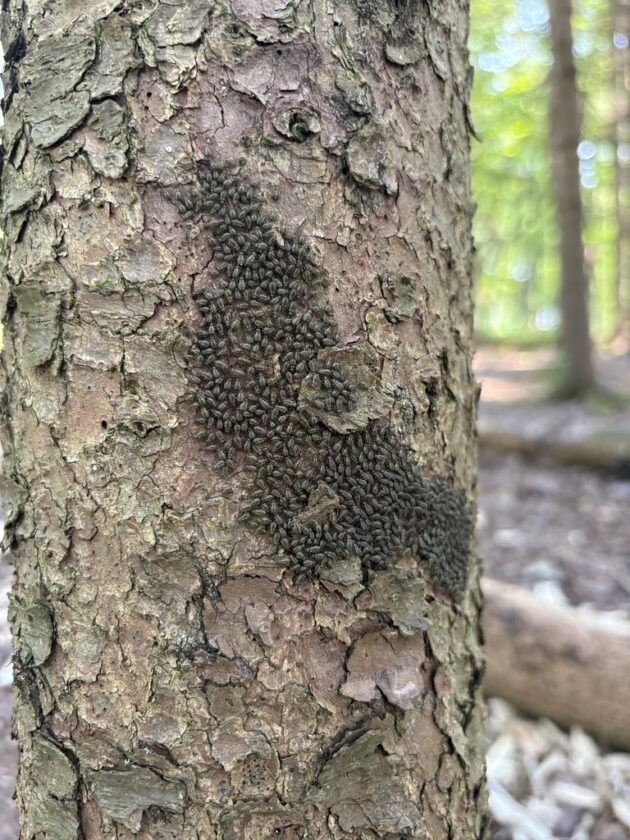
A herd of bark lice gathers on a tree.
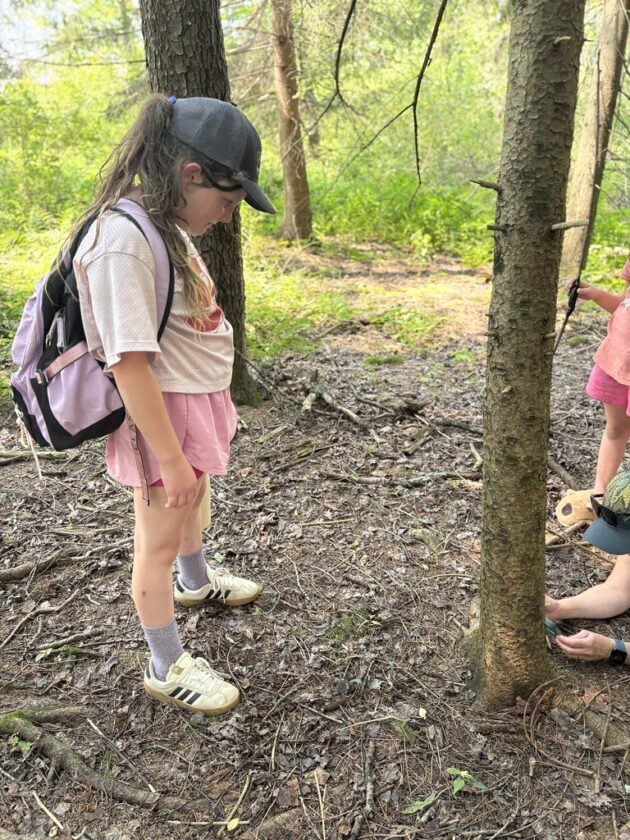
A camper watches as the bark lice move along the tree trunk.
A herd of bark lice gathers on a tree.
A camper watches as the bark lice move along the tree trunk.
Trending
We are in the midst of summer camp season here at Audubon, and with camp comes a plethora of discoveries. While campers are exploring the woods, ponds, and fields, they often find strange and wonderful things--things that even our seasoned staff may never have encountered, and that's just what happened yesterday.
While playing in our "driveway forest", a forest near the building mostly made of Norwegian Spruce, with some Black Cherry and Beech mixed in, campers discovered some bugs. Now bugs alone are not an uncommon discovery, especially in these woods where centipedes, craneflies, ants, and mosquitoes abound; however, these bugs were different. Thousands of tiny insects were clustered in groups on tree trunks, forming what looked like miniature rivers as they marched their way from the ground to the canopy.
At the time of discovery, their identity was a mystery, but plenty of observations were made. The insects were flightless with black and white stripes on their bodies, and seemed to be able to sense a hand or finger above them without being touched, moving out of the way like a school of fish moves from a predator at the threat of being poked. Blowing on the insects sent them into a swirl of activity as they reacted to the breeze.
Later, these critters were identified as bark lice, and while it seems their presence is not uncommon, it was the first time myself and other staff members had encountered them. While the name "lice" may cause concern for some, these lice do not infest the hair or fur of animals, preferring the surface of tree bark. While adult bark lice do have wings, the immature nymphs, what we had found on the trees, are wingless and unable to fly.
Upon finding the bark lice, we were concerned that the lice may be harming the tree. Luckily, this was not the case. Bark lice are a clean-up crew for the trees, eating the moss, lichen, and fungi that grow on the tree bark, helping more than harming the trees they inhabit.
The communal aspect of these insects was especially interesting, as they clustered so close together and moved almost as one, somehow able to sense and react to the movements of their neighbors nearly instantaneously. This behavior has earned bark lice a fun nickname: tree cattle, as their communal movement mimics that of a herd of cows. Following from this, a group of bark lice are called a herd, rather than a swarm or a colony used for other insects.
Bark lice do not always stay on the tree, however. Much of their time is spent on the ground, where they tend to be more solitary and are rarely seen due to their small size. The more noticeable herds, like the ones our campers discovered, form when they wish to forage on the trees. Forming a herd gives them some safety in numbers as they sit on the exposed tree trunk, a waiting target for predators like birds.
The ability for the bark lice to sense touch before it occurs, such as a camper's finger hovering over the herd, is due to an amazing ability to sense the smallest changes in air currents. The lice have a hairy portion on their abdomen called a sensorium. The hairs are very sensitive and can feel the smallest changes in the air around them. The presence of a finger changes the currents enough to tell the lice to move away. This same sense is how they move as a herd, as the sensorium can also pick up on the air changes caused by the movements of their neighbors, allowing the lice to react nearly instantly to the movement.
All this being said, the most amazing thing about these lice was the curiosity they inspired in everyone. From campers to counselors to parents at pick up, these little creatures made us wonder, question, and encourage a fascination with the natural world.
Audubon Community Nature Center builds and nurtures connections between people and nature. ACNC is located just east of Route 62 between Warren and Jamestown. The trails are open from dawn to dusk and birds of prey can be viewed anytime the trails are open. The Nature Center is open from 10 a.m. until 4:30 p.m. daily except Sunday when it opens at 1 p.m. More information can be found online at auduboncnc.org or by calling (716) 569-2345.