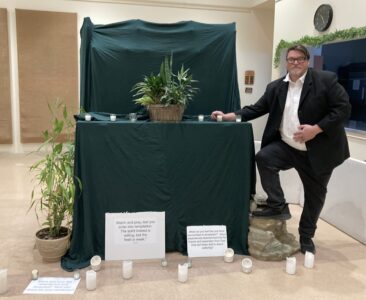
St. Louis de Montfort Academy is anchor of faith in state
The year 1995 marked a decisive turning point for the Catholic Diocese of Harrisburg. In a sweeping reorganization, the diocese shuttered or consolidated dozens of parishes, created twelve new ones, and redrew the spiritual map for thousands of the faithful across central Pennsylvania.
Amid this period of closures, mergers, and uncertainty, St. Louis de Montfort Academy, named for a French priest who was canonized a saint in 1947 by Pope Pius XII, an independent Catholic boarding school for boys, quietly took root in the small borough of Herndon. Founded as the wider ecclesial order was being upended, the Academy forged its identity while many longstanding parishes and schools were being merged or simply closed.
Nestled in rural southern Northumberland County, the school positioned itself early on as a traditional and conservative cultural harbor in a sea of trend chasing pedagogies that age faster than last year’s smartphones. From its founding, it was staffed entirely by nine fulltime volunteers from Tradition, Family, Property (TFP), a lay apostolate dedicated to developing and sustaining a classical Catholic vision of social and moral order through education.
TFP brings to the Academy a distinct philosophical orientation that shapes both its curriculum and daily life. TFP was founded in Brazil in 1960 and headquartered in the United States in Spring Grove, Pennsylvania,
Over the last three decades, the Academy grew from a modest, mission driven initiative into one of our nation’s most respected centers of traditional Catholic formation. Its structured environment, emphasis on discipline, and its unapologetically faith rooted education attracts families from across the nation seeking clarity in a culture increasingly defined by moral ambiguity and institutional distrust.
Its appeal becomes unmistakable when contrasted with the broader cultural landscape that is increasingly defined by secularism, relativism, and a quiet erosion of meaning.
As Alexis de Tocqueville, another Frenchman, once famously observed, America’s democratic character was long reinforced by a shared Christian moral framework that united civic life. But new data tells a different tale. The latest Gallup poll out just in time for Easter shows 24% of Americans now identify as religious “nones,” up from just 2% in the late 1940s, while only 47% went on to say religion is “very important” in their lives, a steep decline from the roughly 75% documented through the mid-20th century.
For much of the last century, especially post-World War II, religious observance was a cultural norm, strengthened by a Cold War ideology that cast the United States as a religious counterweight to atheistic communism. Faith was not merely personal; it was woven into the nation’s public fabric.
Such a dramatic change did not happen overnight.
The secular drift began more than half a century ago, accelerated by the Sexual Revolution and a broader cultural turn toward a more individualized conviction with regard to religious faith. By the early 2000s, institutional religion had lost much credibility with younger generations, and faith became an àlacarte encounter, if anything at all.
Gallup’s statistics are less a surprise than the culmination of a long, steady unraveling.
Against that backdrop, the Academy’s success carries an almost improbable quality, the kind of growth that seems to defy the cultural currents swirling around trying to devour it.
It is within this widening societal and religious void that institutions like St. Louis de Montfort Academy have found renewed relevance. While many established and conventional organizations are struggling, the Academy chose to articulate and preserve a coherent moral vision, one rooted not in nostalgia, but in continuity, tradition and faith.
Set among stately buildings, the Academy’s campus becomes a place where study, prayer, recreation, and camaraderie naturally take root.
The day begins with their daily trek to Mount Carmel where daily Mass is celebrated in the traditional Latin Rite at the former St. Peter’s Church, ironically once the Italian parish of the borough that was subject to closure due to the merger in 1995 that has been restored as St. Elijah’s Oratory. Holy Mass in the traditional Latin Rite is the anchor of a day filled with scholarship, music, and outdoor activities like fencing that are intentionally and unapologetically holistic.
Ted Huerena, the Academy’s headmaster for the past quarter century said the school keeps a steady rhythm of outings that include urban excursions to New York City and Washington, D.C., outdoor treks, and camping trips. Students also step into public witness, joining events that reflect Catholicism’s longstanding magisterium, most notably the March for Life, the annual anti-abortion rally on the National Mall each January.
Such communal works rekindles the spirit of Catholic chivalry that blends personal formation with civic action. This vision shapes every aspect of Academy life. Education is viewed not merely as instruction, but as a battleground of ideas, where students learn to think critically, defend truth, while remaining faithful to the Church’s two millennia of tradition.
It is the classical liberal arts curriculum, grounded firmly in the Catholic intellectual tradition that prioritizes clarity, doctrinal stability, and philosophical depth.
Now in its 30th academic year, the Academy has moved far beyond its once quiet reputation. Families are increasingly drawn to its dynamic Catholic identity, robust moral formation, academic excellence, and countercultural commitment to courage, honor, and service. A generation later, graduates from the first class now send their sons. The Academy’s reach is both national and international, welcoming students of its current class from Texas, Louisiana, Florida and Kansas to Brazil and Ecuador, alongside a contingent of local Pennsylvania boys.
With growth came the need for expansion that is driven not by administrative ambition but by genuine pastoral necessity.
Over its three decades, the Academy has undertaken two major building projects, and its most recent stands as the largest and most consequential milestone yet.
Huerena explained, “Rather than finding another property, we decided to add on, with construction beginning in March 2025 and with a dedication on Saturday, April 25, 2026.” The four-level, 10,000-square-foot addition nearly doubles the size of the main building. Huerena added, “With this addition we should be able to have about 55 students, we currently have 31, and we hope to continue expanding in the future.”
The project marks one of the most consequential steps in the Academy’s history, a clear sign of enduring confidence in its mission, and in the young men it forms, as the expansion strengthens its founding purpose of shaping students who understand their faith with clarity and live it with conviction and commitment.
New classrooms, dedicated formation spaces, and generous communal areas broaden the Academy’s ability to deliver a truly immersive boarding environment. Rising across four levels, the addition secures the space required for academic discipline, spiritual maturation, and the bonds of brotherhood.
It is a visible affirmation of the Academy’s resolve to defend and transmit Catholic civilization through the formation of young men rooted in faith, reason, and virtue. As the Academy enters its third decade, it stands as a testament to vitality, resilience, and unwavering fidelity to the ideals upon which it was founded.
Even with this growth, the Academy maintains its signature 5:1 student‒teacher ratio, ensuring that personal mentorship and intellectual rigor remain at the heart of its work.
With the support of its Scholarship Committee, the Academy keeps affordability at the heart of its mission, ensuring families can pursue a faith centered education regardless of their financial circumstances. Behind every scholarship is a story of a family choosing hope, a donor choosing kindness and legacy and a young man discovering who he is meant to become.
This sustained commitment strengthens the school’s long‒term stability, broadens its reach, and reinforces the conviction that excellence in formation must remain accessible. By investing in affordability, the Academy invests in the future of its students, its community, and its mission. By widening the door rather than narrowing it, the Academy safeguards its founding promise that every young man called to this community has a place here.
The results speak unmistakably of those who champion its mission. It reflects not only strategic growth, but the deep conviction that the formation offered here is worth every investment made on behalf of the young men it serves.
The Academy’s graduates are not just well read, they are battle hardened young men, forged with sharp intellect, unshakable Catholic backbone, and the fearless resolve to stand firm as the tidal wave of secularism crashes down, threatening to drown the very foundations of Western Civilization and the faith that built and sustains it
According to Huerena, 98% of graduates actively practice the faith, while 42% serve in Catholic apostolates or leadership roles that are a testament to its mission of forming future leaders of Catholic life in America.
On Saturday, April 25, the Academy will celebrate its anniversary in a dedication ceremony, marking the completion and blessing of its new addition.
His Eminence Cardinal Raymond Leo Burke, among the most esteemed and influential shepherds in the Catholic Church, will honor the Academy with his presence, celebrating Holy Mass and delivering the keynote address. His participation lends the day a profound spiritual weight, reminding all in attendance that this work of formation stands firmly within the heart of the Church.
Also joining the celebration is His Imperial and Royal Highness Prince Bertrand of Orleans and Braganza, Head of the Imperial House of Brazil and a steadfast defender of Christian Civilization. His presence further underscores the historic and dignified character of this gathering, uniting ecclesial and cultural leadership in support of the Academy’s mission.
The day will include a formal blessing and ribbon‒cutting ceremony, a presentation on the Academy’s founding purpose, a musical performance by the Holy Choir of Angels Band, guided campus tours, a banquet, and a Rosary procession. Together, these moments form not merely a celebration of expansion, but a visible witness to the grace, generosity, and fidelity that have sustained the Academy from its founding.
In an age increasingly marked by confusion and hostility toward the faith, the St. Louis de Montfort Academy’s mission is to form young men who know the truth, love the Church, and live their vocation with conviction and commitment has never been more urgent.
The Academy’s recent expansion stands as a testament to what is possible when the faithful unite their prayers, sacrifices and resources, laying the groundwork for future generations that is not only relevant but essential.
Community
Youngsville High School Alumni offering scholarships
The Youngsville High School Alumni Scholarship Fund will be again offering scholarships at graduation in June to ...
St. Louis de Montfort Academy is anchor of faith in state
The year 1995 marked a decisive turning point for the Catholic Diocese of Harrisburg. In a sweeping ...
Grasslands, meadows and prairies come to life in spring
Briefs
Class meets for lunch The Warren High School Class of 1955 will hold its monthly luncheon at Lawson's West Side ...
Youngsville Life: Library hosting monthly programs
Please email community news to Colette Nelson at Colettenel.ypl@gmail.com by Wednesday of each week to be included ...