
Take a look at the night sky
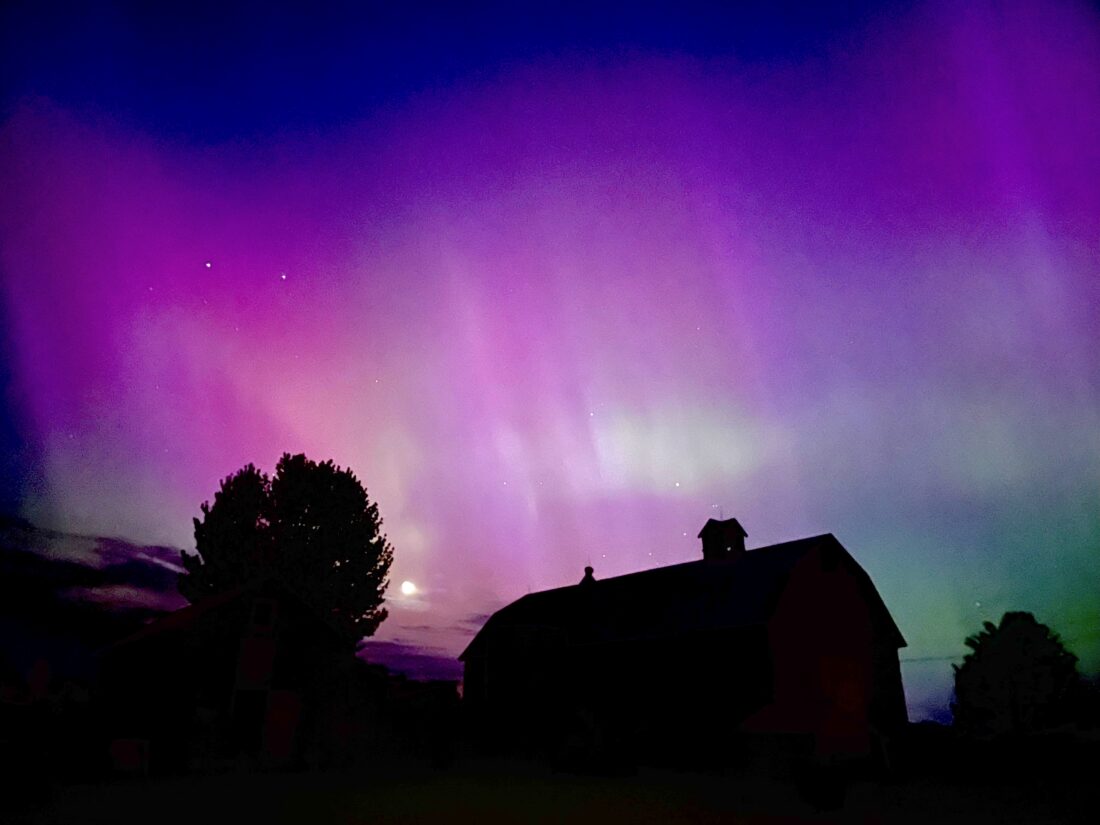
Photo by Taylor Spontaneo Solar activity peaks every 11 years. These peaks allow residents as far south as Western New York (and sometimes Florida!) to see the Northern Lights.
-
- Photo by Taylor Spontaneo Solar activity peaks every 11 years. These peaks allow residents as far south as Western New York (and sometimes Florida!) to see the Northern Lights.
-
- Skies at night showcase its own beauty if you look long enough.
Think of when you step outside at night or walk into a dark room to find something. After a few moments, your eyes begin to adjust. Your pupils open wide to let more light in, helping you see better. This happens with our sky as well. When we have more lights shining towards the sky, we aren’t able to see as many celestial objects. Luckily, in our region, we do not have major cities that emit light pollution. On a clear night with a new moon and giving your eyes time to adjust, you can begin to see part of the galactical spiral that stretches over the sky, our Milky Way Galaxy.
Our sky at night puts on a grand show for those who are willing to bundle up during these last few chilly nights. The lack of summer’s humidity creates prime stargazing conditions. One of my favorite constellations to spot in the sky is called the Pleiades, known as the ‘Seven Sisters.’ This cluster is seen on a clear night when you look southwest in March. Nearby is a well-known wintertime constellation known as Orion, or ‘The Hunter.’ Orion’s belt is made up of three stars across the southwestern-facing sky. When you find Orion’s belt, shift your focus upward and to the right, and you will spot the Pleiades twinkling in all their glory.
The brightest star in the night sky during the winter and spring months is Sirius, part of the constellation Canis Major, known as ‘The Great Dog.’ If you follow Orion’s belt towards the horizon, you can see the shimmer of Sirius, flashing colors before your eyes. Some of these colors include reds, blues, and greens as light enters our atmosphere and becomes distorted, bringing along all sorts of color from the light spectrum.
Stargazing is a celestial game of ‘connect the dots’ we have played for millennia, creating stories of stars to pass time. Constellations have been used by sailors for centuries to guide their ships as they navigate unexplored waters. Certain stars act as a compass, indicating which direction you are moving towards. In the northern hemisphere, we have the Big Dipper (Ursa Major), known as ‘Big Bear,’ and the Little Dipper (Ursa Minor), known as ‘Little Bear.’ A very important navigational star is at the tip of Ursa Minor, known as the ‘North Star,’ Polaris. Venus, known to many as the ‘Evening Star,’ can be spotted low in the east right after the Sun sets. Although Venus is not a star, its light reflected from the Sun makes it appear as a bright star in the sky.
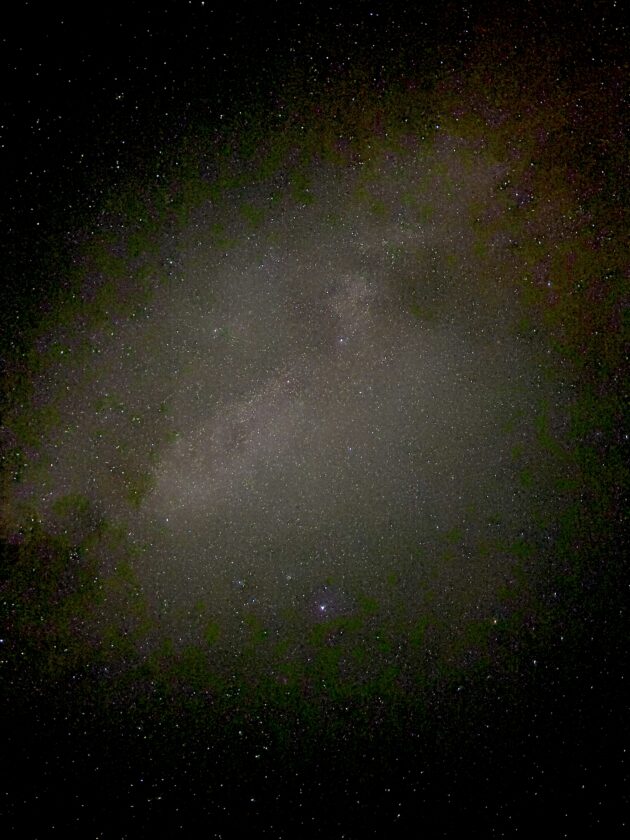
Skies at night showcase its own beauty if you look long enough.
Have you seen a ‘shooting star?’ Those ‘stars’ moving across the sky in a flash of light are actually giant hunks of space rock called meteors. Icy meteors moving at such high speeds begin to burn up in our atmosphere, creating light trails. Throughout the year, we can experience many meteor showers. Some range from 50 per hour, like the Eta Aquariids in between April and May, or up to 100+ an hour like the Geminids in December. As we orbit around the Sun, we travel through groups of floating space rocks that appear to ‘launch’ out of these constellations.
We have had a great year for witnessing the Aurora Borealis, known as the Northern Lights. This fantastical light show is caused by the Sun. Going through solar cycles every 11 years, we are in the midst of a solar maximum right now. Peak solar activity includes coronal mass ejections (CMEs), which is when the Sun builds pressure from a sunspot. These spots are seen as a black dot on the surface, causing instability. Soon enough, it explodes, sending radiation and plasma into the Solar System. Think of the explosion as a rubber band. When it comes under too much pressure, it snaps, jutting the split ends up and outward. The same happens with our Sun’s constantly shifting surface.
Earth has a geomagnetic field on the north and south poles, protecting us by pushing the Sun’s plasma over and under our planet. The Sun’s solar flares are attracted to our magnetic fields, helping deter damage to Earth as these magnetic fields act as a line of defense. This causes the beautiful ribbons of color we see in the night sky if a solar storm is strong enough. The National Oceanic and Atmospheric Administration’s Space Weather Prediction Center has many researchers who monitor the Sun’s activity. I frequently check their Aurora Borealis map to see when I can see the Northern Lights in New York next.
When you find yourself looking up at the sky at night, thank your ancestors from long ago for creating stories through constellations, identifying planets, and paving the way for us to understand all there is in the Universe. No matter where you are in the world, we are all beneath the same sky.
Audubon Community Nature Center builds and nurtures connections between people and nature. ACNC is located just east of Route 62 between Warren and Jamestown. The trails are open from dawn to dusk and birds of prey can be viewed anytime the trails are open. The Nature Center is open from 10 a.m. until 4:30 p.m. daily except Sunday when it opens at 1 p.m. More information can be found online at auduboncnc.org or by calling (716) 569-2345.
Community
Take a look at the night sky

Celoron’s ‘Ribfest’ canceled for 2026
Youngsville Life: Irvine church to host auction Sunday
Editor’s Note: Please email community news to Colette Nelson at Colettenel.ypl@gmail.com by Wednesday of each ...
All-County Musical to benefit PAWS Along the River
The curtain has risen on a beloved classic as the Warren County School District presents this year’s All-County ...

Celebrate on the Chadakoin: Annual turn the river green event is Saturday in Jamestown
JCC Announces Fall 2025 Graduates
Dr. Jessica Kubiak, vice president of Academic Affairs, and Ron Shidemantle, vice president for Student Experience, ...