
Get a look at the red-tailed hawk
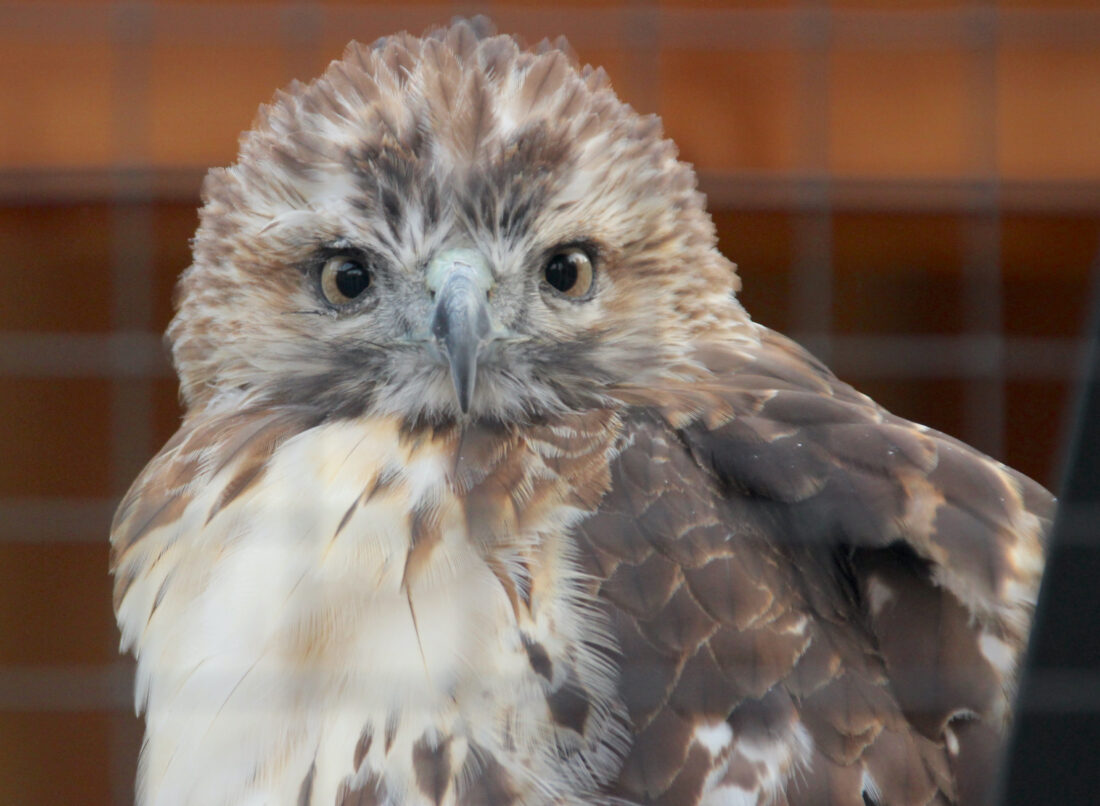
Bridgette, one of the Audubon Community Nature Center’s ambassador red-tailed hawks, shows off her feathers.
Red-tailed Hawks are one of the most common and widespread raptors of North America, but they are also beautiful and fierce birds. Bridgette, one of the Red-tailed Hawk ambassadors at Audubon Community Nature Center, is always sure to alert me to the presence of any of her wild counterparts by letting out a loud screech. You have likely heard this iconic call before even without knowing, because their majestic call is used all over in the world of television and film to represent eagles. In addition to being unsung heroes of bird voice acting, Red-tailed Hawks are amazing birds in their own right.
At Audubon, we have two Red-tailed Hawk ambassadors, Bridgette and Soren, and you can come visit their aviaries to observe them up close. Looking so closely, one can appreciate all their intricate details and field markings. Gorgeous golden eyes are piercing in their intensity. In front is a cream-colored stomach and breast, ringed with a brown belly band. Their backside is covered in chestnut brown feathers. Of course, you can’t discuss this species without mentioning the distinguishing red tail for which they are named, a color deep and saturated. At the end of the tail a thin black line laces the edge. In addition to their striking appearance, Red-tailed Hawks evolved to be skilled predators.
Red-tailed Hawks are a type of bird known as a raptor. The term “raptor” comes from the Latin rapere, which means “to seize” and refers to the talons that are a key characteristic of all birds of prey. Talons, or raptor claws, are both very sharp and extraordinarily strong. And they are key to taking down or seizing prey. Raptors can squeeze with the force of several hundred PSI, approximately 200 PSI for a Red-tailed Hawk. This is more than double the strength of an adult human and is enough for sharp talons to easily pierce through fur and skin to kill prey. Despite their strength, hawks are deceptively light and only weigh a few pounds at most. Bridgette, a large female hawk, only weighs about 3 pounds.
Once they catch prey, hawks will often display a behavior called mantling, where they will hold out their wings and spread their tail to hide their food from any competitor who might try and steal it. Red-tailed Hawks are highly opportunistic, and while their diet primarily consists of mammals, especially rodents like rats and squirrels, they have been recorded eating snakes, frogs, birds, and more. They are also willing to steal food from other birds and eat roadkill. However, because of their rodent-heavy diet, these birds are also excellent at keeping pest populations in check.
These birds are often seen soaring; their broad wings are skilled at catching warm pockets of air, called thermals, and using them to rise in the air with little effort. They are also partial migrants, which means that some hawks travel south for the winter while others stay in the area year-round. With spring migration starting, our local population is soon going to increase, with the migrants coming up north to rejoin our year-round residents.
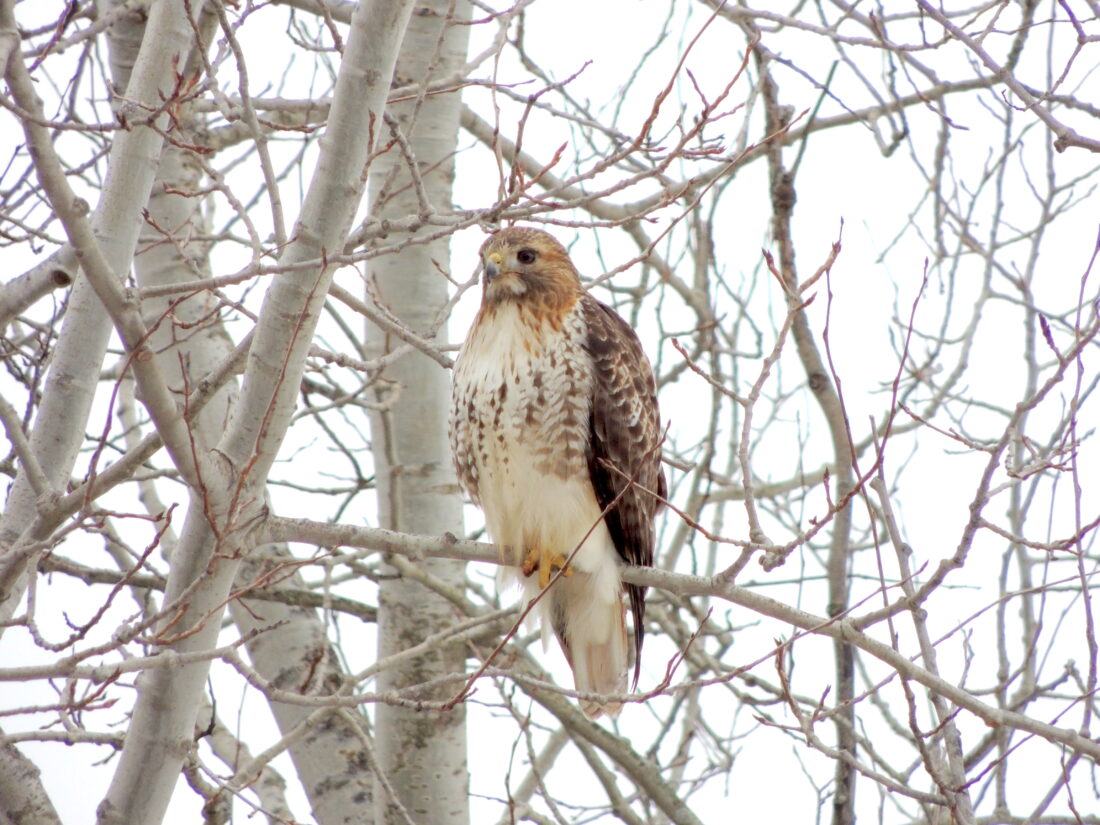
A wild red-tailed hawk perching in a tree is pictured.
Red-tailed Hawks are sometimes referred to as a mile marker bird – this is because they are usually seen perched or soaring over highways and can feel as common as every mile. When food is abundant, they don’t need a large territory, it can be as small as 0.5 square miles. This is as opposed to other raptors. For example, a Golden Eagle can require a territory upwards of 77 square miles. They are also a species which adapt well to human presence, so they will even live near populated areas if there is food available.
Red-tailed Hawks are primarily ambush predators, waiting up high for the perfect moment to strike. This means that a tree near a highway is an ideal spot to hunt and watch for prey. Red-tailed Hawks possess incredible eyesight, just think of the common phrase “eyes like a hawk.” They see more detail than we can, with eyesight several times sharper than that of a human, which allows them to pick up the smallest of details, like a mouse hiding in a field. They also see faster than we do, able to process more visual information per second than a human. If you’ve ever watched a frog, only to blink and have it vanish, a hawk would be able to follow the exact path it took and catch it at the end of the jump. Lastly, hawks can see more colors than we can. Humans have 3 types of cones, or color detecting cells, in our eyes – red, green, and blue. Hawks have an additional cone that lets them detect ultraviolet light.
In addition to being population control for prey species, Red-tailed Hawks are an important part of the ecosystem as an indicator species. This means that the status of their population reflects the health and quality of the rest of their environment. By monitoring wild populations, we can also learn about the health of their ecosystem. Of course, you don’t need to study Red-tailed hawks to care about them. Whether it’s meeting our birds at Audubon or spotting one soaring overhead, next time you see a Red-tailed Hawk I encourage you to take a moment to observe and appreciate this beautiful and important member of our ecosystem.
Audubon Community Nature Center builds and nurtures connections between people and nature. ACNC is located just east of Route 62 between Warren and Jamestown. The trails are open from dawn to dusk and birds of prey can be viewed anytime the trails are open. The Nature Center is open from 10 a.m. until 4:30 p.m. daily except Sunday when it opens at 1 p.m. More information can be found online at auduboncnc.org or by calling (716) 569-2345.
-
- Bridgette, one of the Audubon Community Nature Center’s ambassador red-tailed hawks, shows off her feathers.
-
- A wild red-tailed hawk perching in a tree is pictured.
-
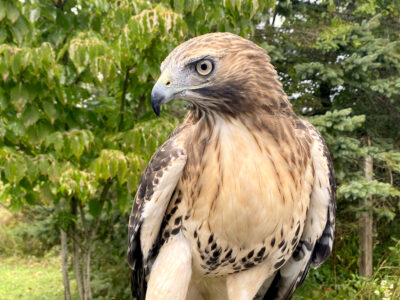
- Soren, one of the Audubon Community Nature Center’s ambassador red-tailed hawks, is pictured.
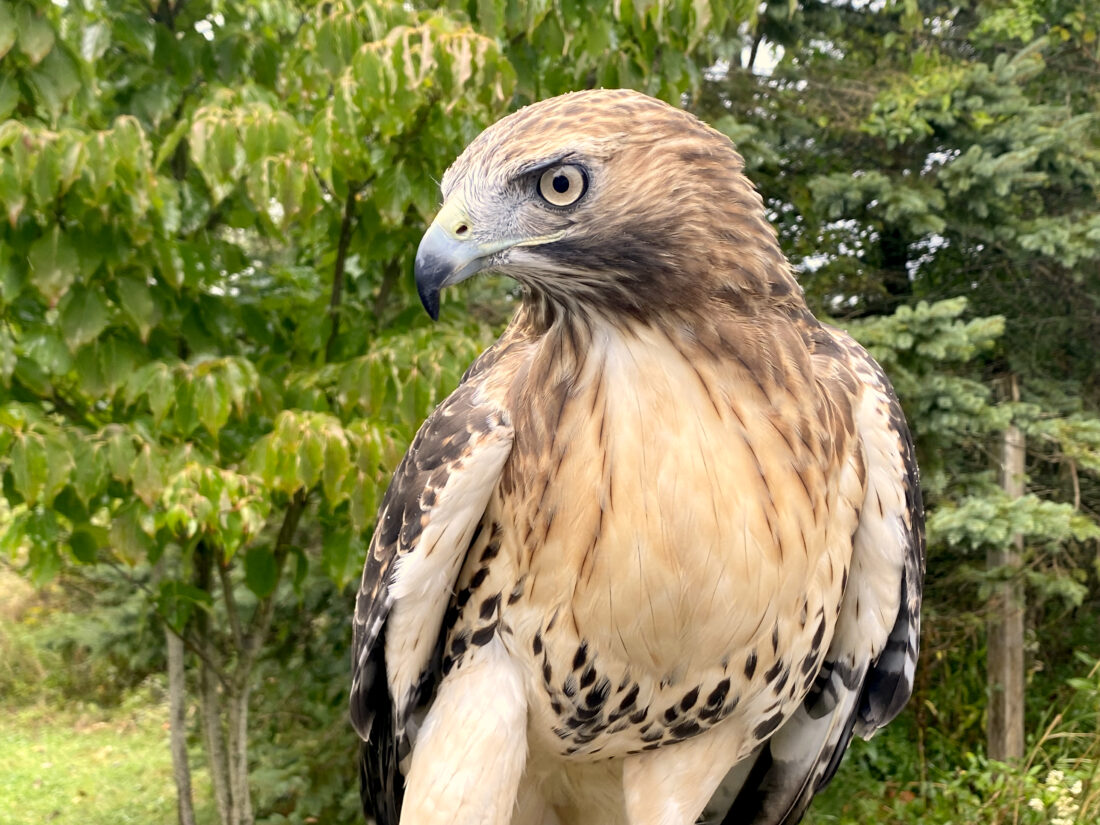
Soren, one of the Audubon Community Nature Center’s ambassador red-tailed hawks, is pictured.
Community
Youngsville Life: Thursday concert at Youngsville New Life Church canceled
Editor’s Note: Please email community news to Colette Nelson at Colettenel.ypl@gmail.com by Wednesday of each ...
Get a look at the red-tailed hawk

Local students perform at Bandfest event
Briefs
Outdoor Club to hike Sunday On Sunday, March 29, members of the Allegheny Outdoor Club will hike at Game Lands ...
Community Foundation of Warren County receives contributions, grants
The Community Foundation of Warren County received $15,060.90 in contributions from donors in February to the ...
Youngsville Life: Youngsville church to host concert April 2
Editor’s Note: Please email community news to Colette Nelson at Colettenel.ypl@gmail.com by Wednesday of each ...