
Migrating Raptors
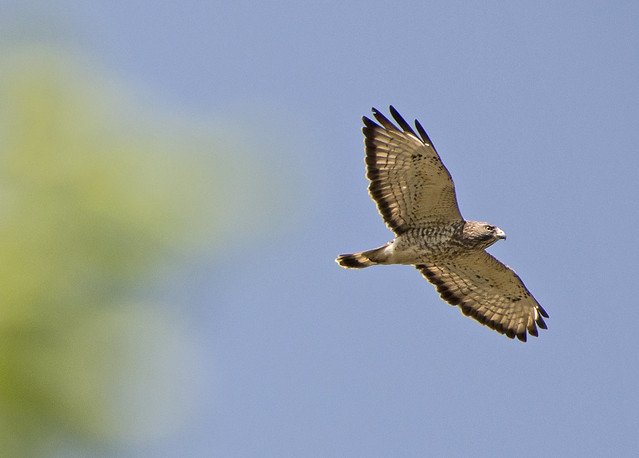
Photo by Patty McGann Broad-winged Hawks are long-distant migrants. They may spend the summer in the forests of Chautauqua County and fly thousands of miles to winter in South America.
-
- Photo by Patty McGann Broad-winged Hawks are long-distant migrants. They may spend the summer in the forests of Chautauqua County and fly thousands of miles to winter in South America.
-
- Learn more about Ripley Hawk Watch by emailing ripleyhawkwatch@gmail.com or attending a program at Audubon on Friday, April 3 with Devin Banning (pictured here).
With the longer days, the natural world is slowly starting to wake up. Last week, I saw both a chipmunk and a skunk, both of which spend much of winter in slumber and inactivity.
All plants and animals have ways they adapt to the colder temperatures, lack of food, and change in the environment that winter brings in northern regions. Black Bears pack on fat and hibernate. Maple trees lose their leaves and go dormant. Red-tailed Hawks have a varied diet that is still available throughout winter. But other species of birds fuel up and migrate south.
Several of our region’s raptors, a group which includes hawks, falcons, and eagles, are migrants. A Broad-winged Hawk, for example, who spends the summer in the forests of southern Canada might travel 4,000+ miles to the forests of Peru, Columbia, or Brazil for winter. And now they are gearing up to return north.
When I think about migrating raptors, particularly hawks, I recall a family trip to Hawk Mountain when I was a kid. Hawk Mountain Sanctuary is located in the Appalachian Mountains, between Reading and Allentown, Pennsylvania.
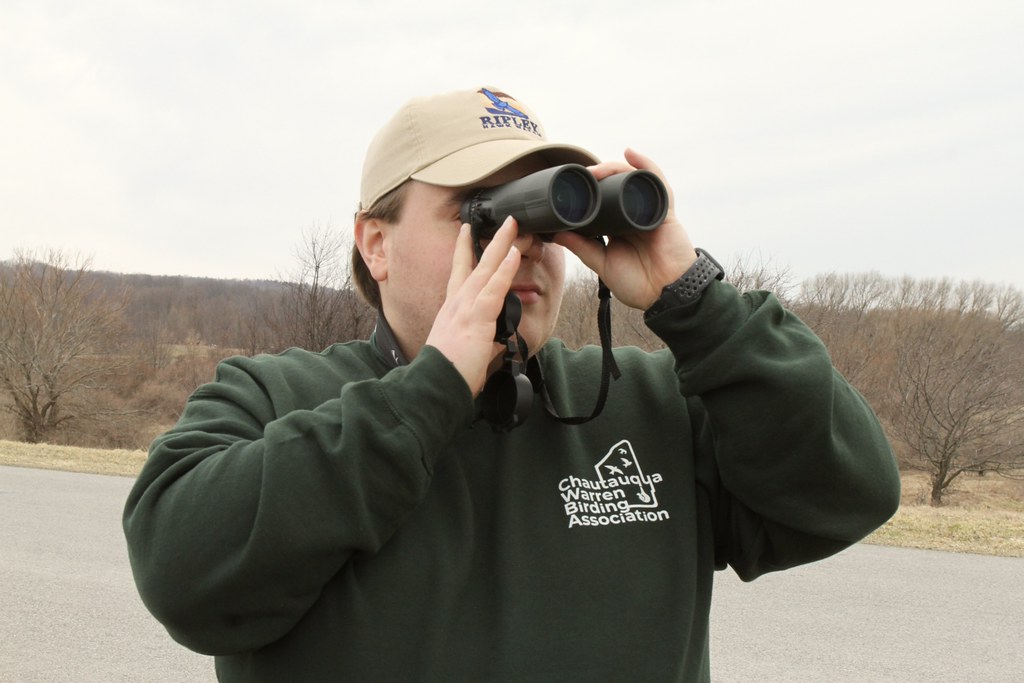
Learn more about Ripley Hawk Watch by emailing ripleyhawkwatch@gmail.com or attending a program at Audubon on Friday, April 3 with Devin Banning (pictured here).
What stands out most distinctly is walking uphill on a trail which ended at a cliff edge. I remember the sense of surprise at being so high above the rest of the landscape. A view of the valley spread out below. And I remember thinking, “What a strange place for birds.”
But Hawk Mountain, along with many other elevated sites throughout the United States, Mexico, and Central America are the perfect locations to witness raptor migration.
To conserve energy, many raptors use the rising currents of air off land to carry them up to 300 miles a day. This strategy reminds me of the phrase “work smarter not harder.” The change of elevation, often along bodies of water like the Great Lakes, creates these updrafts.
One of these locations is in Chautauqua County. For over 30 years volunteers for the Ripley Hawk Watch have staked out several sites along the ridge outside of Ripley, New York. Binoculars in hand, they watch and count spring migrating raptors soaring over our area to our own fields and forests, or those farther north.
The watch season runs from mid-March to mid-May with an average count of 20,000 raptors per season. In addition, this site has one of the highest songbird migrations documented in the past decade.
For example, on a cool but cloudless day in mid-April last year, volunteers counted 148 Turkey Vultures, 3 Bald Eagles, 7 Cooper’s Hawks, 159 Broad-winged Hawks, and 1 Merlin. And these are just the raptors. When you spend time outside, especially in the spring, there’s often much more to see too.
The volunteers at Ripley Hawk Watch are recruiting new volunteers. There are some advantages that come with raptor watching in the spring that don’t always occur with other birding excursions.
Birding often means early mornings, but during raptor migration most sightings are during the mid-morning through early afternoon. So, you can still press snooze on the alarm and have a second cup of coffee. Better yet, bring the coffee with you. At Ripley much of the birding is done from one of three locations, all accessible by car. And the birding could be done seated. While waiting for birds, Ripley provides spectacular views over vineyards and Lake Erie and north to Canada.
Admittedly, identifying soaring raptors can be a challenge. They are far away and often backlit, so you see a silhouette more than details. Instead of colors and patterns, the overall size and shape of the wings and tail are more helpful identifying features to pay attention to.
For example, a Red-tailed Hawk has a chunky body, broad wings and a short, square-ish tail. A Turkey Vulture is larger, with wide wings and long feathers on the end. And vultures hold their wings in an “V” shape, where their wings are higher than their body.
Identification may sound intimidating. But in my experience, birders can be patient teachers. I’ve learned more about birds by birding with other people than I would have ever learned on my own.
The biggest reward in being part of a hawk watch may be knowing you are part of something larger. The daily counts from Ripley are compiled with data from over 200 other sites across North America. These community scientists at hawk watch sites provide critical data that creates a better understanding of raptors and their seasonal movements across continents.
So, keep your hopes and eyes up as spring does return once again to our northern climate. If you are interested in more information or in volunteering for Ripley Hawk Watch, email ripleyhawkwatch@gmail.com.
Audubon Community Nature Center builds and nurtures connections between people and nature. ACNC is located just east of Route 62 between Warren and Jamestown. The trails are open from dawn to dusk and birds of prey can be viewed anytime the trails are open. The Nature Center is open from 10 a.m. until 4:30 p.m. daily except Sunday when it opens at 1 p.m. More information can be found online at auduboncnc.org or by calling (716) 569-2345.
Local News

Trump says he doesn’t know if aliens exsist but directs UFO files released
Eisenhower senior serves as Fair Queen, athlete, cheerleader and fire department member

Area church reads in the New Year
Hospice receives January contributions
Hospice of Warren County received contributions during the month of January 2026. They are: In Memory of: ...

Volunteers needed for Audubon Lights