Bryophyta and no rolling stone
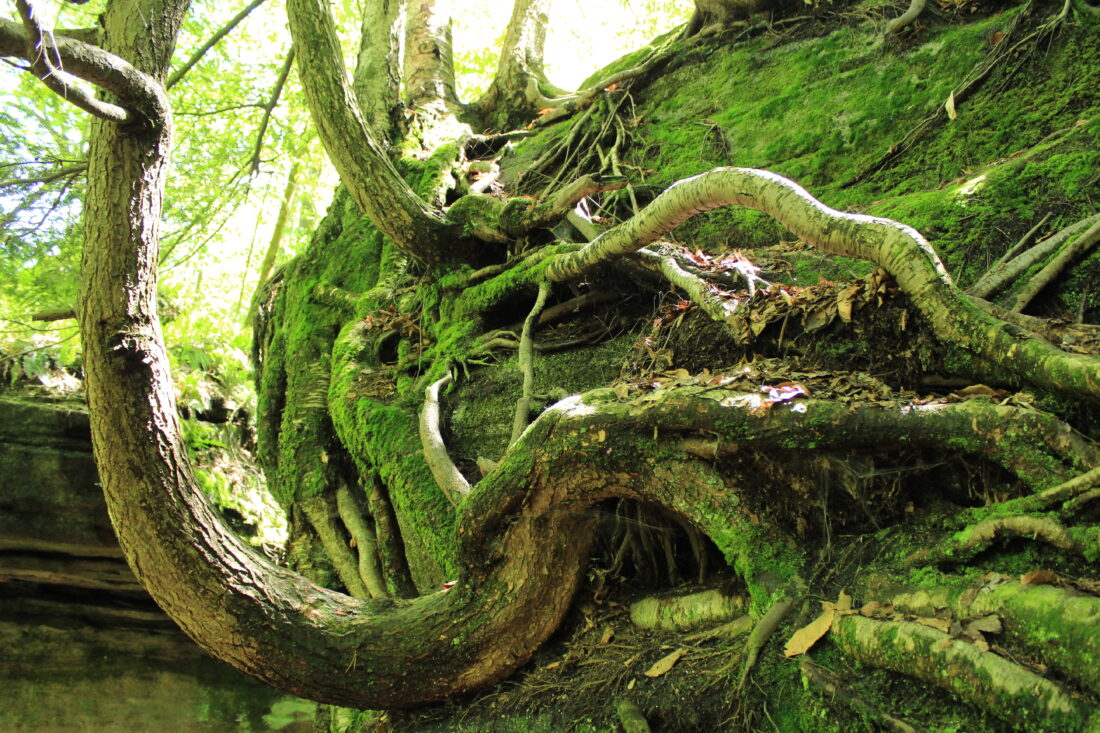
Various mosses including pincushion (Platygyrium repens) at Panama Rocks.
-
- Various mosses including pincushion (Platygyrium repens) at Panama Rocks.
-
- Photos by Emma Pryll American Giant Millipede crawling along a variety of broom moss (Dicranum scoparium) and sword moss (Callicladium haldanium) at Panama Rocks.
The book Gathering Moss, written by Robin Wall Kimmerer, came into my life as I entered college. A close family friend recommended the book as her work focuses on a small bryophyte I have always had a special interest in. That bryophyte being moss! At that time in my life, I was never able to fully take in Kimmerer’s messages and themes conveyed in this narrative. I was blissfully unaware of the weight life carries. As time continues to pass and my perspective of the world around me is altered through experiences, I decided to revisit Kimmerer’s narrative. As I reread each chapter I felt emotional, as though I found the words to thoughts I have only ever kept inside.
Kimmerer emphasizes the importance of looking closely at the world that surrounds us, including the smallest organisms that are often overlooked. Rather than solely relying on empirical knowledge as we can in labs, Kimmerer shares tales from her Potawatomi heritage to connect us to the natural world and its processes. Using her knowledge as a botanist, Kimmerer discusses the adaptations moss has developed to be a successful organism all while relating these challenges to human experiences. Referencing folklore and knowledge from her Potawatomi heritage, Kimmerer reminds readers of the flow from the natural world and how we all have a place in it no matter how small or complex.
Moss is one of the most resilient land plants to date. Thought to have evolved from algae roughly 450 million years ago, moss has overcome major challenges throughout its existence. From mass extinction events, changes in global temperatures, and even whole genome duplications, mosses have persisted and adapted to numerous challenges. Classified as a bryophyte, mosses are small non-vascular plants. Lacking roots and vascular tissues, moss uses structures called rhizoids to anchor themselves onto surfaces. Once anchored, mosses are able to absorb necessary resources like water and nutrients into their surface through phyllids. Phyllids are the irregular leaf-like structures we see when we take a closer look at moss. Usually only a cell or two thick, phyllids provide a surface for water and nutrients to be absorbed directly rather than through a root system as in vascular plants.
Living in a small area where the earth meets the atmosphere, moss is found growing in what we call the boundary layer. Utilizing condensation on stone and the stagnant airflow near the earth’s surface, moss is seen thriving in its own microenvironment within the forest. This boundary layer acts as mosses’ own greenhouse by trapping heat and moisture due to the lack of air flow close to the earth’s surface. Mosses persist using these simple structures that have carried them through multiple megaannum.
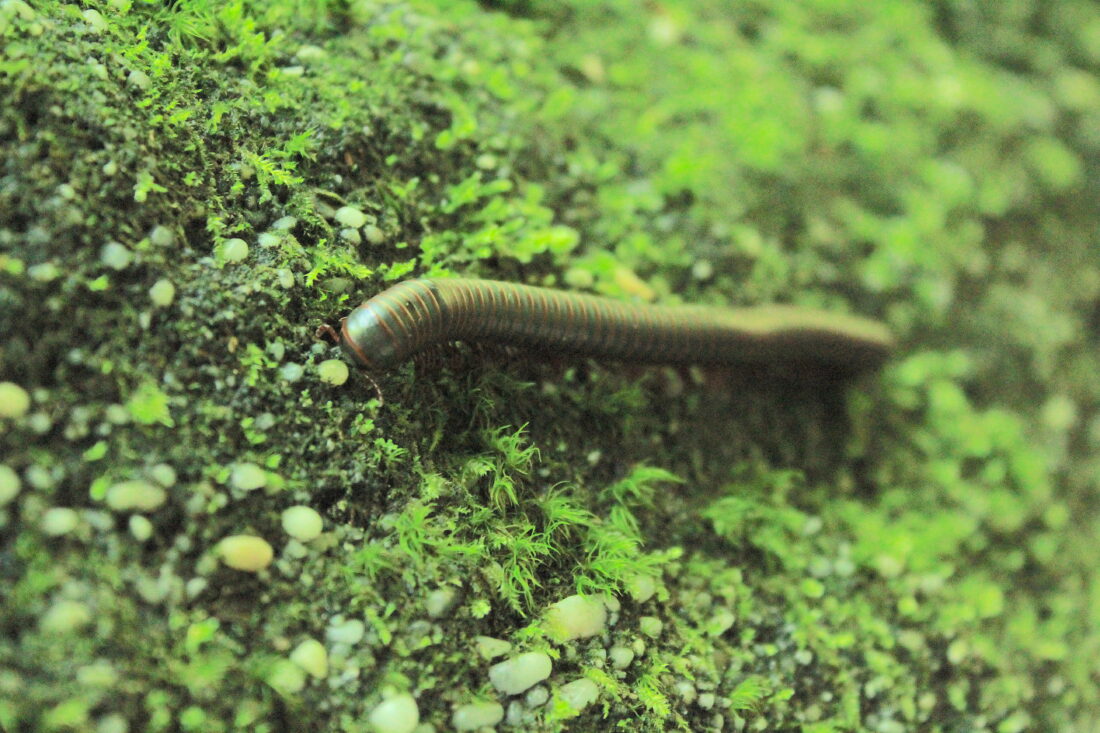
Photos by Emma Pryll American Giant Millipede crawling along a variety of broom moss (Dicranum scoparium) and sword moss (Callicladium haldanium) at Panama Rocks.
As moss persists and adapts, I find myself inspired by the power this bryophyte holds. This connection to nature and the world around me has not only comforted me through my struggles, but has taught me to release that which is holding me back. Release and grow, change and allow myself to connect with the nature that surrounds me. Familiarity is comforting but fosters stagnancy. Change brings forth growth whether it’s seen in a riverbed expanding, rock formations eroding, moss growing, all of nature’s motions are with reason and cause. This natural flow that nature has found is not something to be jealous of or envious of but something that we can all learn to tap into and utilize as we heal and grow during our lives. Being surrounded by places like Panama Rocks and Letchworth State Park, I have been humbled to have experienced nature in these raw forms. The experiences and clarity I have embodied by immersing myself in the natural grooves and hills surrounding me has changed my perspective on life itself.
“But the world is still unpredictable and still we survive by the grace of chance and the strength of our choices.” – Robin Wall Kimmerer, Gathering Moss: A Natural and Cultural History of Mosses
Audubon Community Nature Center builds and nurtures connections between people and nature. ACNC is located just east of Route 62 between Warren and Jamestown. The trails are open from dawn to dusk and birds of prey can be viewed anytime the trails are open. The Nature Center is open from 10 a.m. until 4:30 p.m. daily except Sunday when it opens at 1 p.m. More information can be found online at auduboncnc.org or by calling (716) 569-2345.
Community
Rouse Home honors volunteer of year
YOUNGSVILLE - The Rouse has named Barb Luce as its Rouse Volunteer of the Year in recognition of her dedication and ...
Community Foundation Receives Contributions
The Community Foundation of Warren County received $168,400 in contributions from donors in the month of January to ...
Bryophyta and no rolling stone
Youngsville Life: March library programs include Leprechaun trap building
Please email community news to Colette Nelson at Colettenel.ypl@gmail.com by Wednesday of each week to be included ...
Five decades of service: North Star Lodge honors longtime member