
There’s a life beneath the snow
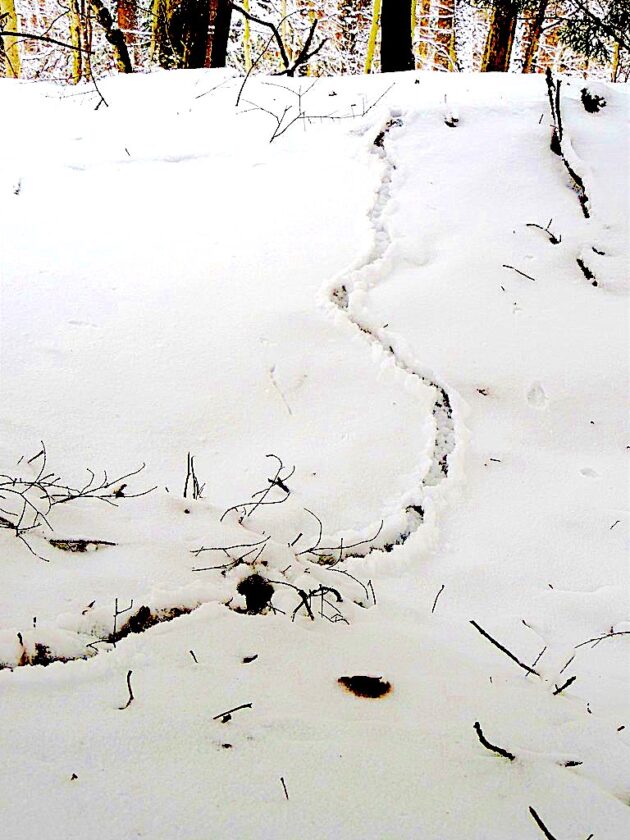
Photo by Katie Finch Melting snow uncovers tunnels made by creatures in the subnivean zone, such as shrews and voles.
Snow. While it’s still early in the winter, here in Chautauqua County we are already feeling the freeze. The world has been blanketed with white, and it seems like that blanket is here to stay. While the snow does cause some inconveniences for us humans, for many animals it is one of winter’s finest gifts.
A snowy winter forest is a peaceful sight. Quiet and calm, the scurrying of squirrels, quiet chirping of chickadees, and the occasional huff of a dear may be the only sounds we hear. Compared to the hustle and bustle of summer, a winter forest is nearly silent. However, there is action aplenty occurring; it’s just happening underneath our feet, as animals bury themselves under a thick blanket of snow.
Snow is a happy addition to the forest floor for many of the forest critters who are desperately trying to survive in the cold of winter. The main goal for most of these animals is simple: don’t freeze. Many animals accomplish this by burying themselves underground, deep enough where soil temperatures remain stable and frozen temperatures don’t reach. Somewhat counter-intuitively, snow is a fantastic insulator, making this task easier to accomplish. Cold-blooded critters like reptiles, amphibians, and insects rely on this insulation to keep their temperatures stable while they are dormant, lying in wait for the warmer weather of spring to come.
Our warm-blooded friends use the snow to their advantage as well by utilizing the subnivean zone, or the area between the ground and the bottom of the snowpack. This insulated space remains at a fairly constant temperature, near 32 Fahrenheit, and allows small critters, such as voles, moles, mice, shrews, and even some birds such as the ruffed grouse, to keep themselves protected from the freezing temperatures above. When enough snow falls, a new world opens below, unseen from above.
Our little critters begin tunneling, through the snow layer closest to the ground, where they are able to access food resources such as plants, seeds, and insects that would be inaccessible from above. Their tunnels also allow them to travel, in relative safety from the eyes of predators above. With the exception of entrance and exit tunnels, or small air ventilation holes, from above the subnivean zone is invisible, masking the activity happening below.
That’s not to say, however, that these little animals are perfectly safe. Some predators have adapted to hunting creatures under the snow. Owls and foxes, with their incredible hearing, can listen to the scurrying sounds beneath them, pouncing or swooping down to grab a meal through the snow. Other predators, such as ermine and small weasels, are able to enter the subnivean zone on their own, following the tunnels of their prey to find a tasty snack.
It’s not only animals that benefit from a good layer of snowy insulation. Many plants also enjoy the protection it offers. The stable temperatures provided by the subnivean zone allow roots and bulbs to stay protected from harsh freezes, and the melting of the snow right at the ground surface provides much needed water. Once the snow melts fully and the warmer temperatures of spring penetrate the ground, these plants know it is time to get growing.
The subnivean zone is not a zone for humans. Our large size and poor senses exclude us from experiencing the area on our own, but traces of the zone remain as the snow melts, giving us a glimpse into this secret area. Spring will, eventually, come and with it, warmer temperatures and the melting of snow. As the snow melts, be on the lookout. Snaky, snowy outlines often appear on the ground as the snowpack melts away. These are the final remnants of the network of tunnels left by the creatures who make the subnivean their home. Sometimes, these tunnels melt with the grass, or dive into holes underground, as the creatures burrowed their way through.
When out in the winter forest, it’s easy to forget about what’s happening underfoot. As I snowshoe or ski, I rarely think of the creatures that I may be stepping over, although I’m sure they notice me. However, when little tunnels into the snow appear, or a trail of tiny footprints suddenly pops out of the snow, only to disappear a few feet later down a hole, I am reminded that the winter forest is not nearly as calm and quiet as it seems, and a flurry of activity is occurring just outside the limits of my senses.
Audubon Community Nature Center builds and nurtures connections between people and nature. ACNC is located just east of Route 62 between Warren and Jamestown. The trails are open from dawn to dusk and birds of prey can be viewed anytime the trails are open. The Nature Center is open from 10 a.m. until 4:30 p.m. daily except Sunday when it opens at 1 p.m. More information can be found online at auduboncnc.org or by calling (716) 569-2345.
Local News

School board continues solicitor debate
After being forgotten, County’s PA 250 Bell to be unveiled Sunday

States face a choice on whether to embrace Trump’s tax cuts on tips, overtime and more
Russell man sentenced to prison
A Russell man will spend at least the next nearly six years in prison after being sentenced on two dockets Tuesday ...
There’s a life beneath the snow
Structure fire reported on Teal Hill Road
SUGAR GROVE — A structure fire broke out on Teal Hill Road on Monday at approximately 9:30 a.m. Shortly after ...