Myth meets reality
The life of the real Johnny Appleseed is wrapped in legend but remarkable on its own
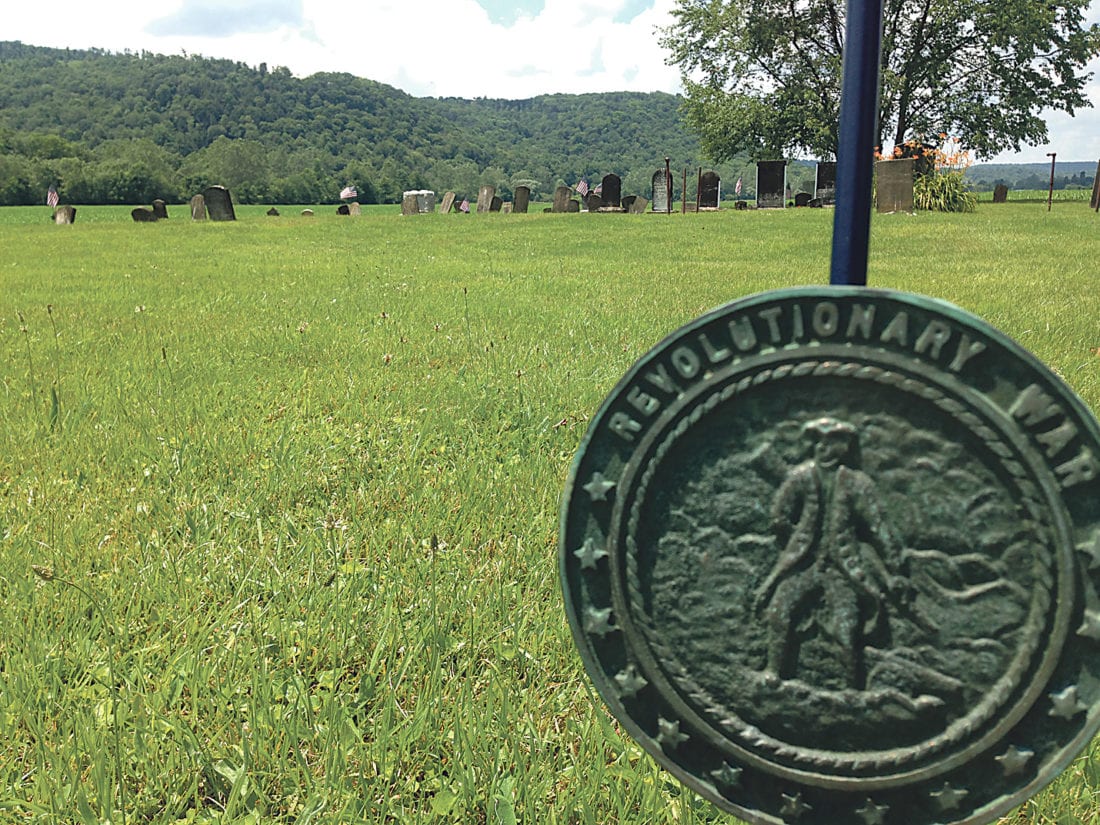
Times Observer photo by Josh Cotton The Old Whitestown Cemetery outside Garland is located on property once owned by Giles White, who owned the land where John Chapman planted his first apple orchard.
-
- Times Observer photo by Josh Cotton The Old Whitestown Cemetery outside Garland is located on property once owned by Giles White, who owned the land where John Chapman planted his first apple orchard.
-
- Library of Congress photos Photos of the purported grave of John Chapman in Fort Worth, Indiana.
From Venango County, it is believed that he migrated to the west into Ohio and Indiana where spent the remainder of his life – and from where his work is probably more well known.
The article claims that the Johnny Appleseed Festival in Sheffield is the first attempt to honor Chapman in Warren County.
Judge Lansing Wetmore, the Times-Mirror reported, was one of the first to tell the Chapman county connection.
Wetmore wrote that Chapman arrived in what is now known as Warren County in December. Wetmore alleges that Chapman was here as early as 1798 or 1799.
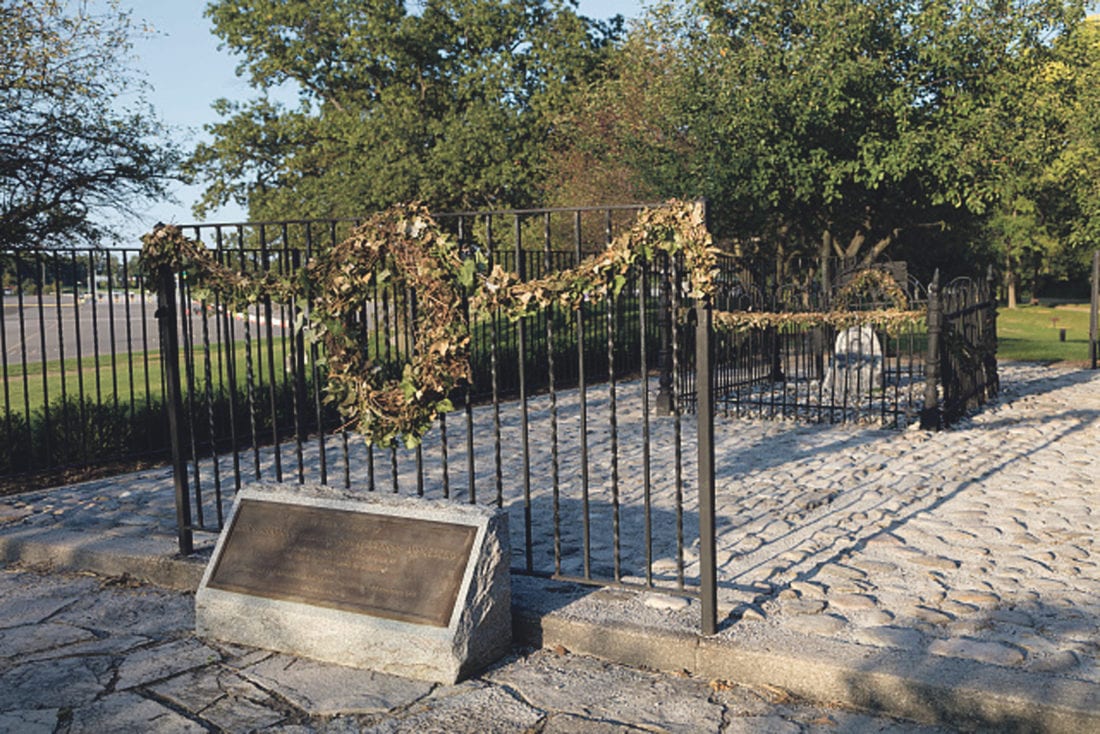
Library of Congress photos Photos of the purported grave of John Chapman in Fort Worth, Indiana.
“The following spring he selected a spot for his nursery – for that seemed to be his primary object – near White’s, on the Big Brokenstraw, and sowed his seed. The waters have long since washed away a portion of the ground and took some of his trees to a bar below, which is still known as Apple-tree Bar. This nursery furnished the trees for most of the old orchards on the Brokenstraw. The demand for fruit trees being quite limited, and unable to obtain a livelihood by his favorite pursuit, he went to Franklin where he established another nursery.
Subsequently, he removed to Indiana.”
The Times-Mirror reported, though, that scholars had started to discount Wetmore as hearsay.
“No actual documentary evidence had ever been found to confirm Chapman’s having lived in Warren County – until one day in 1953 when County Commissioner George Seavy had occasion to consult some ancient records in the Courthouse. Seavy was attracted by a beautiful old leather volume which had been used as a scrapbook, with old clippings pasted in it. It had come to the Courthouse with the papers of Mr. Ezra Trimm who died in 1893, leaving his estate for the benefit of the poor in Eldred Township.
“Surprised to see the early dates appearing between the pasted clippings, Seavy took the book to Merle Deardorff. Deardorff sent it to Harrisburg, where the clippings were removed, pages laminated, contents microfilmed and the book returned to Warren County. This treasured volume is today the oldest record in the archives of the Warren County Historical Society. It is the ‘John Daniels Ledger.’ The ledger is the account book of the Craig & O’Hare Stores, located in the Brokenstraw and Conewango from December 1795 to 1799 inclusive.”
The Times-Mirror reported that John Daniels was the keeper of the ledger and recorded the name of each purchaser, what was bought and method of payment.
In that ledger, Chapman is reported to have purchased a gimblet (a small tool) and two small histories in March 1797 as well as cheese and sundries in May.
“The mystery of how Chapman paid for these charges was discovered… by Jack Todd Erickson, formerly of Jamestown, N.Y., and who has recently been head of the research department of the University of Syracuse. While doing some research through historical records in Meadville in preparation for a paper on General David Mead, Erickson found that Mead had an interest in the store on the Brokenstraw as well as the one in Meadville, and it was recorded that John Chapman’s account had been paid to General mead with apple tree seedlings.”
By 1801, an article from ohioapples.com explains, Chapman had made it to Ohio.
“It is said that his favorite apple was the Rambo. A substantial proof of this is disclosed by the fact that this particular apple was afterward found on nearly every farm in the region traversed by this pioneer nurseryman.”
Chapman wasn’t the first to bring orchards to the midwest.
But it was the method that made him stand out.
“His strategy of moving his plantings ahead of the early pioneers was however quite unique,” according to Penn State. “Similar entrepreneurs had not the social mobility of Chapman, who never married and was famous for his skills and knowledge of surviving in the wilderness. Also, despite traditional beliefs, he did own land. In fact, some estimates say he owned as much as 1,200 acres in Ohio and Indiana.”
His work required some speculation.
“Using apple seeds from the cider mills of Pennsylvania, Chapman would move ahead of the homesteaders, on routes along which he guessed they were likely to settle, planting saplings from which they could start their orchards,” per Penn State. “It is widely stated that he would give away seeds and saplings to those who could not pay.”
He also doubled as a Christian missionary, bringing his “news right fresh from heaven,” as he would say.
A 1955 edition of Warren County Historical Society’s Stepping Stones, cited by the Times-Mirror, perhaps gives the most accurate description of the man.
“John Chapman started in November 1797 on foot and alone, to come here by the overland route. He was a tall, stalwart Yankee who was inured to the perils and hardships of the first settlers of Wyoming. He was also a God-fearing man and he feared nothing else… John, accordingly with his other fixings which he stored in his knapsack, put in a sack of choice apple seeds, with his blanket, rife and tomahawk, the usual appendages of a woodsman, barefoot and alone, he started his journey.”
Decades later, apple orchards had popped up over several states.
And that part of the Johnny Appleseed story isn’t legend. It’s fact.
It’s believed that Chapman died in March 1845 and is buried in a park bearing his moniker in Fort Worth, Indiana.
Community
Youngsville High School Alumni offering scholarships
The Youngsville High School Alumni Scholarship Fund will be again offering scholarships at graduation in June to ...
St. Louis de Montfort Academy is anchor of faith in state
The year 1995 marked a decisive turning point for the Catholic Diocese of Harrisburg. In a sweeping ...
Grasslands, meadows and prairies come to life in spring
Briefs
Class meets for lunch The Warren High School Class of 1955 will hold its monthly luncheon at Lawson's West Side ...
Youngsville Life: Library hosting monthly programs
Please email community news to Colette Nelson at Colettenel.ypl@gmail.com by Wednesday of each week to be included ...