‘All dogs are individuals’ — a quote Warren’s Danny Reynolds lives by
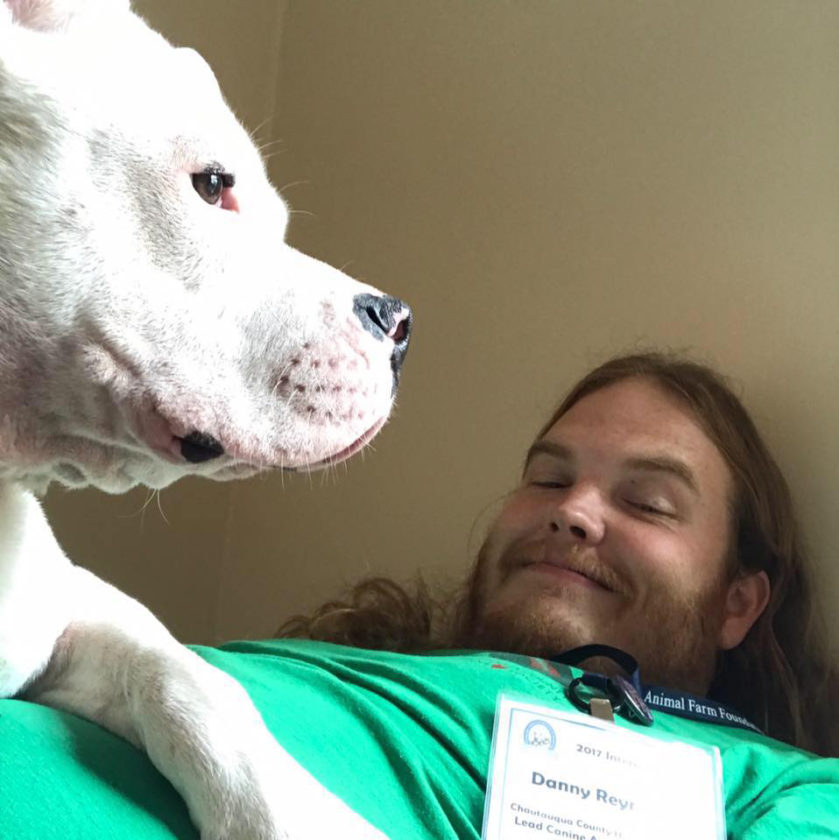
Photo submitted to Times Observer Danny Reynolds with his pooch for the week, Ellie, at the Animal Farm Foundation.
“All dogs are individuals.”
It’s not a quote of his own creation, but it’s one that Warren’s Danny Reynolds has adopted.
Reynolds is the Lead Canine Activity Specialist at the Chautauqua County Humane Society (CCHS) in Jamestown, N.Y., where he’s worked since July of last year.
At the shelter, Danny’s in charge of behavior evaluation as well as exercising dogs, training, troubleshooting, and some adoption counseling. Along with Devan Palmer and Alyssa Stockhausen, both Canine Activity Specialists, staff at the shelter work to find forever homes for homeless animals.
Chautauqua is a “no need to kill” facility, meaning that in 2003 the board of directors voted that no healthy, adoptable animal would be euthanized at the shelter even if there’s overcrowding.
To that end, Reynolds said the shelter works aggressively to evaluate surrendered animals — a process called temperament testing, and to work with all potentially-adoptable animals through behavior issues that might otherwise find those animals euthanized. The only time the shelter euthanizes an animal, Reynolds said, is when that animal is suffering from a non-correctable physical illness or temperament issues that would make them dangerous to adoptive homes.
“Nobody expires up there,” said Reynolds. “So my job is to make them as comfortable as they can be until they find a home, but a shelter is not a home. A shelter should never be a home.
“I would be thrilled to have all my kennels empty,” said Reynolds. “While euthanasia rates continue to decline across the country, animals are still euthanized for space in many shelters and animal control centers.”
And the first to go, said Reynolds, are the “pit bull-like dogs.” Any dog with pit bull or pit bull mix in its bio is facing an uphill battle when it comes to adoption.
His least favorite part of the job is getting a dog with a behavior issue what would often see a dog meet a bad end. But his favorite thing is having an opportunity to work with those dogs and see them go with owners who are prepared to accommodate them and ready to commit. As much as giving animals chances, Reynolds said, he loves being able to give people chances to adopt them.
On average, according to the shelter’s website, the CCHS houses an average of 100 to 150 animals at any given time, adopts out around 1.200 animals annually, and in 2016, reached a 98-percent save rate.
That makes for a lot of work for Reynolds.
Earlier this year, Reynolds said his supervisor, Sue Bobek, Director of Animal Services, brought an opportunity to Reynolds’ attention. The Animal Farm Foundation, in Bangall, N.Y., offers shelter workshops for employees and volunteers of nonprofit organizations like the CCHS.
The Animal Farm Foundation’s goals fit nicely with that of CCHS, Reynolds said.
The Animal Farm works with the public and shelter workers to combat the labeling of dogs that often leads to them being euthanized for no other reason than the stigma that often goes along with the words “Pit Bull.”
The workshop is a four-day event that’s provided based on an application with an essay, in which shelter workers and volunteers talk about why they want to be there.
For Danny, it was just another opportunity to learn more about the dogs he works with.
Reynolds graduated from Clarion University in 2014 with a degree in Environmental Biology and has considered a wide variety of careers since then, including working with zoos, teaching, and becoming a vet. But, in the end, it was his work in shelters he felt most passionate about, and so it’s where he’s stayed.
Reynolds said that CCHS is the most progressive shelter he’s worked for, and that’s what he loves about it. And because the shelter doesn’t put dogs down because of behaviors or simply because no one seems to want them, a large part of his job is to keep the dogs from going kennel crazy.
To that end, CCHS has instituted lots of policies and procedures that many people don’t expect. There are four pods that can house multiple dogs together where they are crate-trained at night, but allowed to socialize with one another during the day. The shelter received a grant and an MP3 player to provide music in the shelter, which Reynolds said has made an immense difference for many of the dogs. The most effective music, he said, is repetitive music like classical and children’s music.
Reynolds is responsible for creating and maintaining shelter enrichment programs and for training dog walkers, getting dog play groups up and running, and helping prospective adoptive families figure out who at the shelter might make a good pet for their family.
CCHS has a lot of pit bull mixes, so the opportunity to take the workshop at The Animal Farm Foundation was beyond helpful for Reynolds.
“I came back from it refreshed and energized,” said Reynolds.
The workshop is an immersive experience that pairs all those attending with a pit bull or pit bull mix that’s been sent to the facility from other shelters around the country. With an opportunity to “experience” pit bulls in a stigma-free environment, the idea is to help shelter workers and shelter volunteers educate those interested in adopting who may otherwise not consider a pit bull or pit bull mix. Even shelter policies and local legislation, said Reynolds, can stack the odds against these dogs based on nothing more than the breed label.
What Reynolds learned at the workshop, he said, simply reinforced his own beliefs about pit bulls, but also helped him learn ways to educate the public on the breed and how to tailor shelter experiences for the dogs in ways that would reduce their lengths of stay, provide kennel enrichment that was meaningful, and learn the history of canine discrimination and how the cycle can be broken.
Both Reynolds and Patty Linn, CCHS lead adoption counselor and intake specialist, attended the workshop, living at the facility with their own pit bulls for the week. Reynolds’ pit bull, Ellie, stole his heart, he said. It was hard to leave her at the end of the experience, but Reynolds said he was happy to learn that she was headed to a training program at Riker’s Island where she’ll be trained by inmates in the New York City jail.
Breed labeling and the stigma that comes with it is something that takes time to counteract, and even he was susceptible to it at one point.
“I can’t believe that there was a time in my life where I let outside influences sway me into thinking that I should be afraid of a dog like Ellie because of her breed,” said Reynolds. But he said he’s excited to use the experience to help the dogs at CCHS and all the future dogs who are surrendered there to find forever homes without the negative associations that have been built up over time.
What’s changed most for him since his Animal Farm Foundation experience, said Reynolds, is that he’s “so much more relaxed in general” about the dogs and the adoption process.
“I’m less reactive so I get a better read on the dogs,” said Reynolds, “and when you’re worried less about things they just seem to go better in general.”
Local News
Dairy Princess points out opportunities
Warren man charged after fleeing officer
=A Warren man has been jailed on $25,000 bail after allegedly fleeing from a police officer on a motorcycle. ...
Warren man sentenced to probation after domestic incident
A Warren man will spend the next 4.5 years on probation after being sentenced on three separate dockets recently. ...
Paid family leave proposal debated in capitol
To convince colleagues that Pennsylvania workers need access to paid family and medical leave, state Rep. Jennifer ...
Historical Society Founder’s Day Exhibit and raffle