CEO: Warren General Hospital not feeling pressure to affiliate
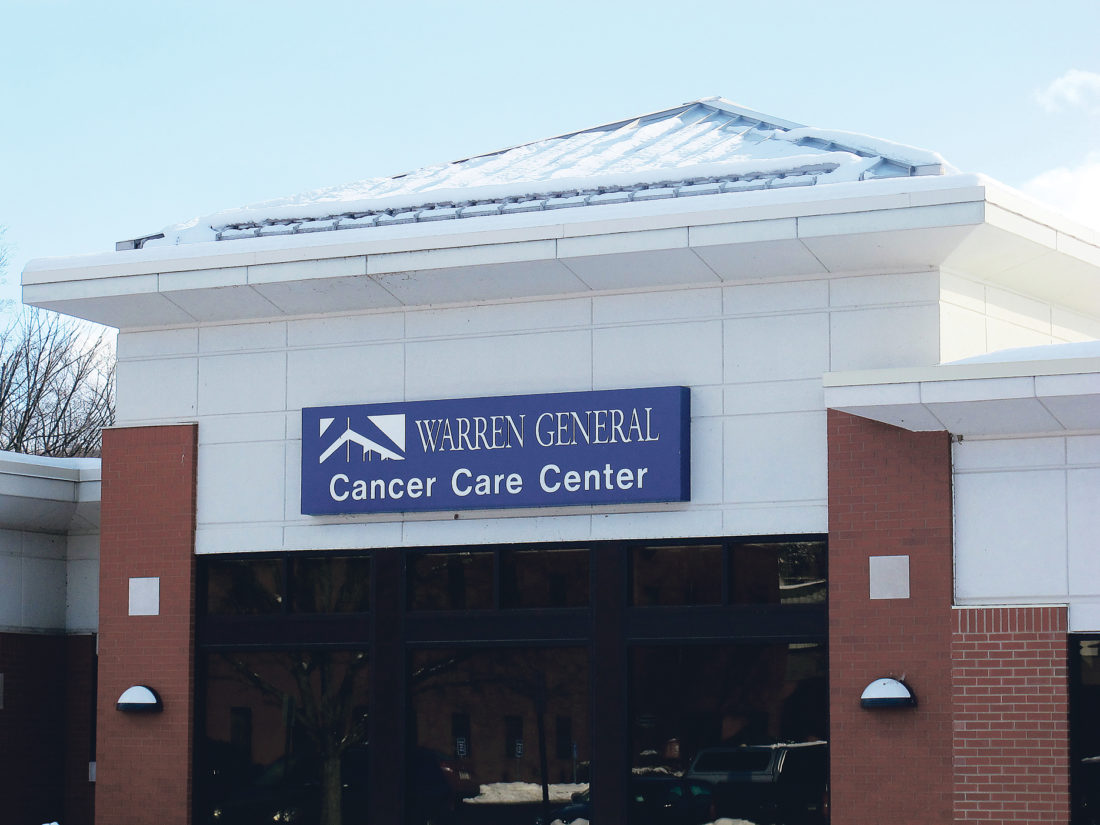
Times Observer photo by Brian Ferry The Warren General Hospital Cancer Care Center offers the kind of services that hospital leadership fear might be moved to another facility if the hospital were to merge with a hospital system.
While other hospitals in the region affiliate with industry giants, Warren General Hospital is apparently not feeling that pressure.
The hospital’s budget is about to be in the black for the first time in years. Top-notch doctors are making their way to Warren from major hospital systems across the country. And the hospital continues to offer locally services that are becoming increasingly rare in community hospitals.
The leadership of the hospital has reasons to want to retain local control.
“Our vision is an independent, community-focused hospital delivering world-class care through the collaborative efforts of staff, physicians and volunteers,” WGH CEO Rick Allen said. “It’s not independence for independence’s sake. It’s independence so we can make our own decisions as to what’s in the best interest of the community of Warren.”
The decision to affiliate comes down to what the merger can do for the hospital.
Literally, other facilities could start doing some of the things that Warren General now offers.
“If in fact this organization were put into a position to have to merge, the problem is that decision-making leaves,” Allen said. “There’d be a dramatic decrease in the number of employees. There’d be a dramatic decrease in the service offerings. It would have a significant negative impact on the ability of this organization and the leadership to focus on what the community wants.”
Maternity could be lost — handled by an affiliate hospital. “The community needs Warren General to have OB/GYN,” he said. “There are very, very few community hospitals like WGH still delivering babies.”
Inpatient behavioral health services could move out.
The hospital’s very successful cancer care center might be closed down in favor of centralized cancer care somewhere else in the system. “It’s superb, top of the line,” Allen said. “The independence drives our ability to make decisions in the best interest of the community.”
In 30 years at the head of hospitals, Allen has seen numerous mergers. “Too often, you witnessed decisions being made out of a corporate office, often not in the interest of the community,” he said. “We can choose what services we offer, we can choose who we partner with for services, we keep our decision-making autonomous.”
The hospital has partnerships with both UPMC and Allegheny Health Network.
St. Vincent — Allegheny Health employs the hospital’s OB/GYN doctors.
“Our collaboration with St. Vincent — Allegheny Health Network was because, universally, our pediatricians in town, as well as our OB/GYNs, when asked who do we use for advanced care, said St. Vincent,” Allen said. “That’s no different than our emergency room doctors and hospitalists are employees of UPMC Hamot. That has been a long-standing relationship here at Warren General.”
“We do not have an overall affiliation with either,” he said. “We choose to work with both in the best interests of Warren General Hospital.”
Those kinds of decisions would be taken out of the hands of people in the Warren community in the case of a merger.
“When I made the decision to come to Warren, the board was looking for someone who could take their experiences, use their skills, to keep this organization independent and community-focused,” he said.
He said the hospital can compete with conglomerates.
“I put our physicians up against any doctor in any system from Pittsburgh to Buffalo to Cleveland to Philadelphia, right down the line,” he said. “Those services that we perform — orthopedics, general surgery, outpatient diagnostic testing, physical rehabilitation, cancer treatment — all can be top-notch because we have top-notch physicians. All of the doctors that we recruited wanted to be part of a community-focused hospital, unencumbered with corporate directives unrelated to the community or the organization.”
The doctors, nurses, pharmacists, technicians, and housekeepers at Warren General don’t have to drive to see their leaders.
“We offer here an open door policy,” Allen said. “I value their opinion.”
He wants the staff to know their skills are valued and to feel validated in their work.
“I came up with those two because that’s how I want to feel,” he said.
WCA
In December, WCA Hospital in Jamestown, N.Y., joined with UPMC to become UPMC Chautauqua WCA.
“UPMC has been working with WCA for a number of years in terms of support, departmental consulting,” Allen said. “They own the Jamestown Area Medical Associates. UPMC has been in that market for some time.”
Warren General is not backing away from the giant.
“Our goal is expansion,” Allen said. “It can be done.”
“We have opened an office in the Jamestown market,” Allen said. “We do and will continue to receive referrals from the Jamestown area. Our ambulatory surgery center in Pine Grove, that being equidistant between here and Jamestown, we’re actively promoting that.”
Warren General does not want to follow in the footsteps of WCA, Allen said.
While the leadership does not want to see that kind of change, they are willing to admit that the culture of the hospital field could change and some kind of merger or affiliation forced upon them in coming years. “It’s not something that we ignore,” Allen said. “Right now we are focused on doing what’s best to turn the organization around financially, turn the organization around from a quality and service perspective.”
Budget
The hospital does not need a big backer to reverse the trend of running deficit budgets, Allen said.
“We’re making progress,” he said. “We’re digging ourselves out of a very deep hole. The numbers are improving dramatically.”
The budgeted revenues for the year are about $72.1 million while the anticipated expenses are about $71.5 million. Between the 2013 and 2015 fiscal years, expense budgets were from $74 million to $76.6 million. Revenue bottomed out in fiscal 2013 at $68.3 million. The 2012 year was the last time the hospital showed a profit — $69.4 million in revenue compared to $68.5 million in expenses.
Allen said the hospital is on track to meet a “break-even to 1 percent positive operating margin” this budget year. “We’re on target.”
“If we achieve it, we will have reversed six years of significant operating losses — multi-million dollar operating losses, $25 million to $30 million over that six years,” he said.
Local News

Presenter to explore area’s unsolved mysteries
Arson charges withdrawn against Warren man
Felony arson charges filed against a Warren man have been withdrawn, bringing an end to a nearly three-year-old ...

Sea Lion Scrapped: Lack of funding ends planned to Virginia

Hosting solar can be a lifeline for farmers

Public input sought on future of Kinzua Dam, Allegheny Reservoir