
‘Quiet and unostentatious’
Early Sheffield businessman remembered for modesty has gaudy grave
-
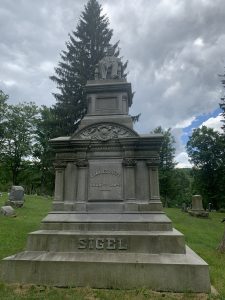
- Times Observer photo by Josh Cotton Charles Sigel’s grave at the Sheffield Cemetery.
-
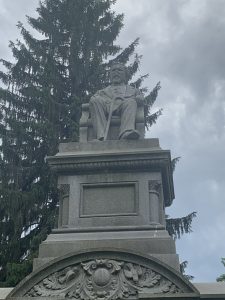
- Times Observer photo by Josh Cotton Charles Sigel’s grave at the Sheffield Cemetery.
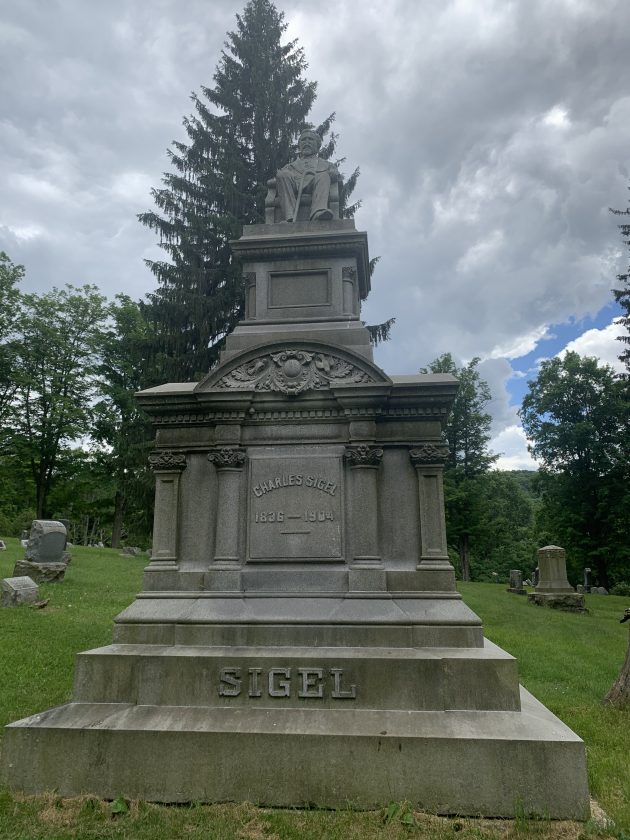
Times Observer photo by Josh Cotton Charles Sigel’s grave at the Sheffield Cemetery.
It seems inconsistent for a man described as “quiet and unostentatious” to have a gravestone that dominates a cemetery and include a full statue of himself sitting in a chair.
But the memorial certainly caught my eye and, as it turns out, the man deserves substantial credit for the early explosion of Sheffield.
Charles Sigel was born in 1836 but it’s unclear when or where, possibly New York State.
There are men named Charles Sigel that served – one in the Pennsylvania infantry and another in the New York artillery – during the American Civil War, according to the National Park Service’s database though I can’t say for certain if either of those men is him. The 74th Pennsylvania was a German-dominated regiment so the possibility certainly exists.
Regardless, we know he moved to Sheffield in 1867 from his obituary and can assume that he emigrated to the United States from Germany sometime before that, given additional details in his obituary.
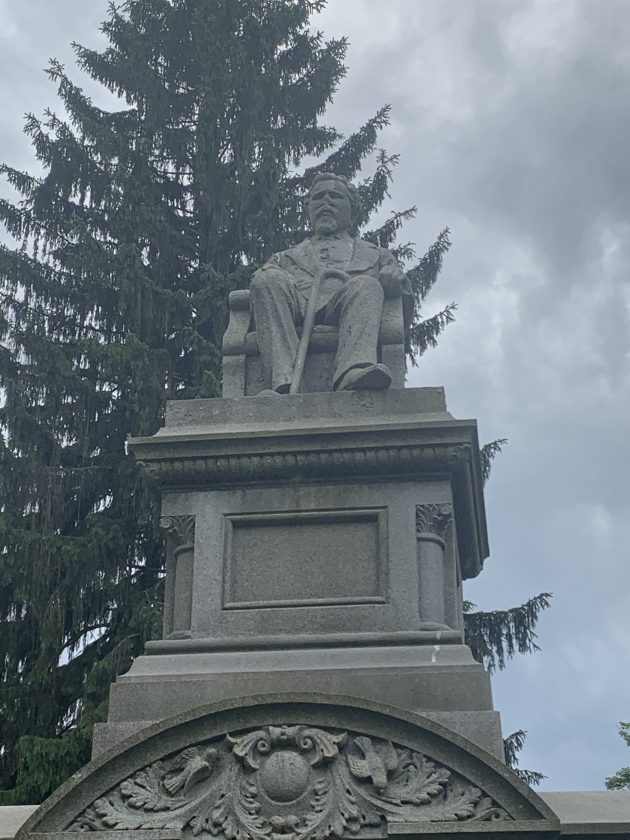
Times Observer photo by Josh Cotton Charles Sigel’s grave at the Sheffield Cemetery.
His obituary, which ran in The Forest Republican on Feb. 24, 1904, has been digitized by pagenweb.org.
“Mr. Sigel was an active factor in the building and development of the great tannery at Sheffield, remaining throughout various changes during the nearly 40 years of his activities in this community,” the obituary states. “He never married, and the only surviving relatives are a brother, living in Niagara Falls, and a brother and sister remaining in Germany.”
Sigel makes a couple appearances in Schenck’s History of Warren County.
He was involved – with other men with last names of Horton and Crary – in the development of the first profitable oil well in Sheffield Township in 1881.
But it was the tanneries – essentially, leather factories – that made Sigel his sizable fortune.
Horton and Crary were involved with Sigel in that industry as well.
It appears that tanning in Sheffield was split into a few different companies, all with the same principal owners.
Sigel appears as an owner of one of them along with Horton & Co. and a J.F. Schoellkopf.
“They employ nearly or quite 3,000 hands, most of whom are Swedes and Germans, and reside in this village,” Schenck reported. “The principal part of the business done by this enterprising firm of Horton Crary & Co. is export trade. They manufacture nothing but hemlock sole leather. The hides are almost entirely from South America. Of course the chief motive which induced them to locate here was the dense growth of hemlock in the forests. To their industrious energy, and that of their neighboring companies, is due the thrift and growth of the village of Sheffield.”
His obituary indicated he died at 6 p.m. on a Sunday evening in 1904 “of neuralgia of the heart.”
“Deceased was one of the best known men in this section, having been a resident of Sheffield since 1867. Amassing a large fortune in the tanning business, he remained the friend of the poor and struggling, and many will remember him with affection and gratitude,” the obituary claimed. “In addition to his Sheffield interests, deceased was assistant treasurer in the leather selling department of the Penn Tanning Company, President of the Niagara Falls Brewing Company, vice president of the Sheffield National Bank and director in the Warren Savings Bank. He was heavily interested in oil and gas holdings, and was a large stock holder in the Muir & Lesser refinery at Titusville. The funeral will be held from his late home in Sheffield this afternoon at 2 o’clock. The interment will probably be made in Buffalo.”
Plans for his interment must have changed because he is buried at the Sheffield Cemetery.
Additional information from pagenweb.org indicates that 1880 Census records show Sigel “boarding at the home of Liddie Kempf, 35, a widow who was supporting two young children. Interestingly, Charles is also tallied as maimed, crippled, bedridden or otherwise disabled.”
1900 Census data, per pagenweb.org, indicates he owned his own home near the home of Jerry Crary, president of the tanning company. “He also has a housekeeper, a Natalie Kemp, 55, widow, who presumably is the same Little Kempf with whom he boarded in 1880.”
“Charles Sigel, while not eccentric of character, was a man who lived in a quiet and unostentatious way. He conducted his large business interests in a careful and systematic manner and leaves an estate which will probably exceed a million dollars,” per the obituary.
Adjusted for inflation, that equates to roughly $29.7 million in 2020 dollars.