A Fond Farewell
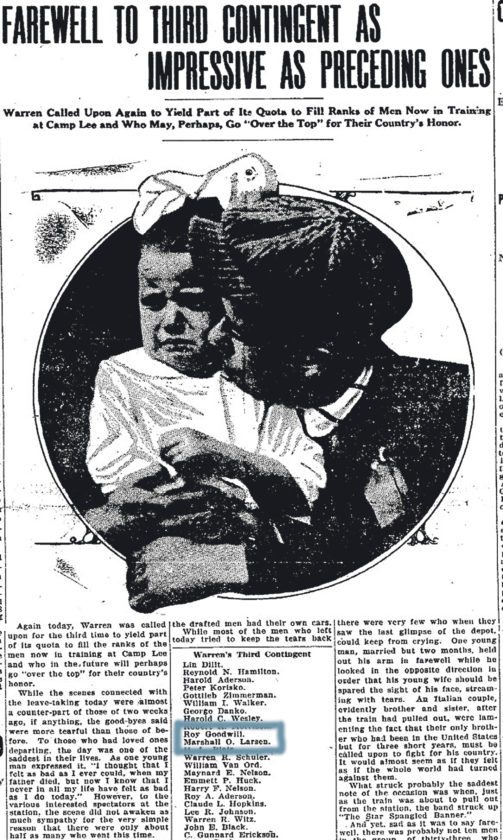
Larsen one of 43 to leave Warren in third draft contingent
The Selective Service Act passed on May 18, 1917, and all men age 21 to 30 were required to register with local draft boards. As the war continued, the age for registration went up to 45. Overall, 24,234,021 men registered for the draft, and inductees comprised 66 percent of those who served.”
That brought the trenches of France to the farms, shops and factories of Warren County.
And it would quickly touch Marshall Larsen.
According to his draft card, Larson was single, tall and slender, with blue eyes and light colored hair in 1917.
And popular.
The Warren Evening Times called Larsen “one of the best known popular young men of the town and there was not a resident of Clarendon but who was a friend of Marshall Larsen.”
He was a member of the First Methodist Church, sang in the choir and was known as an accomplished pianist.
He also participated in the local International Order of Odd Fellows lodge.
Larsen was 26 when his draft number was called as part of the third contingent of soldiers to leave Warren County.
“Dr. C.W. Schmehl, A.C. Mook and E.M. Hodges, comprising the local (draft) board, immediately mailed out notices to the men who are to depart Wednesday afternoon at 12:15 o’clock on a special trail. They comprise twenty per cent of the county’s quota,” the Evening News reported.
Larsen was one of those 43.
From the Wednesday October 3, 1917 Evening News:
“Again today, Warren was called upon for the third time to yield part of its quota to fill the ranks of the men now in training at Camp Lee and who in the future will perhaps go ‘over the top’ for their country’s honor.”
The phrase ‘over the top’ refers to soldiers in World War I climbing out of – or over the top of – trenches to launch attacks.
“As before, the drafted men were conveyed to the station in automobiles which were decorated with flags and emblems. One particularly noticeable fact was that most of the wives, sweethearts and mothers of the draftees rode with them in the cars to the station.
“While most of the men who left today tried to keep the tears back there were very few who when they saw the last glimpse of the depot could keep from crying. One young man, married but two months, held out his arm in farewell while he looked in the opposite direction in order that his young wife should be spared the site of his face, streaming with tears. An Italian couple, evidently brother and sister, after the train had pulled out were lamenting the fact that their only brother who had been in the United States but for three years must be called upon to fight for his country. It would almost seem as if they felt as if the whole world had turned against them.”
More on how the day unfolded:
After a photograph of the contingent on the steps of the courthouse, “the men were conveyed in automobiles to the Pennsylvania station. The members of the local post of the G.A.R. who were also in automobiles acted as an escort of honor and then the parade was headed by the Warren band. Way was made from the courthouse west on Fourth avenue to Liberty Street, south to Second avenue and then west to the railway station.”
The railway station was on Warren’s west end on Fourth Avenue near Beech Street. It was also tradition in Warren for Civil War veterans – part of the Grand Army of the Republic veteran society – to escort the contingents to the station.
“Way was made to the station through streets lined on each side by cheering hundreds of loyal Warren people. Homes and stores has been decorated with the Stars and Stripes and as the flag decked machines bore the young men through the crowds, hundreds rushed into the roadway to shake them by the hand and wish them well. It was a spontaneous outburst of affection for the Warren county lads and it must have warmed their hearts to be wished so well on their great adventure.”
Community
PGE assists EMS Council
Youngsville Life
Youngsville Life: High School Alumni Scholarships awarded Please email community news to Colette Nelson at ...
Memorial Day events set for county
A number of ceremonies and celebrations are planned for Memorial Day around Warren County. Some of the events ...
Four Flags Ceremony likely moving indoors due to rain forecasts
The annual Four Flags Ceremony is expected to be moved indoors Saturday due to weather forecasts predicting cold ...
Holiday weekend filled with events
Summer is just around the corner as the Memorial Day holiday weekend has arrived. Some events taking place ...